


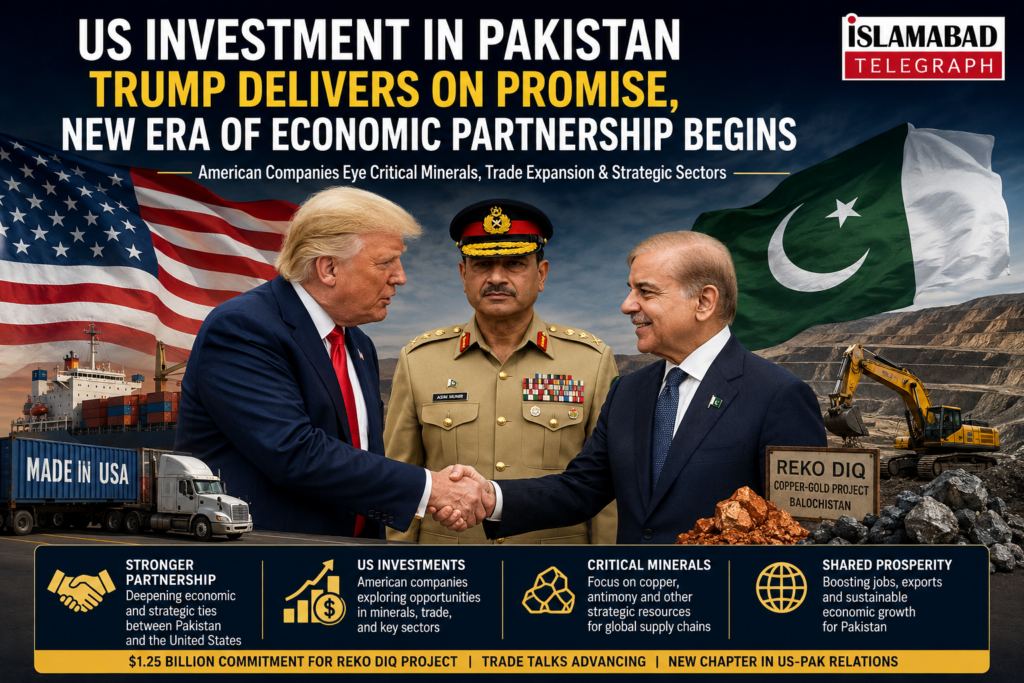
- US Investment in Pakistan: US companies are actively exploring investment in Pakistan’s mineral and industrial sectors
- Trump fulfills commitment made to Shehbaz Sharif and Asim Munir
- $1.25 billion pledged for Reko Diq project, boosting economic outlook
ISLAMABAD: US Investment in Pakistan is on the way. United States–based companies are preparing to invest in Pakistan across critical sectors, marking a decisive shift in the political economy of the region and reinforcing the enduring partnership between Islamabad and Washington.
This surge in US investment in Pakistan reflects the fulfillment of a key commitment made by President Donald Trump to Prime Minister Shehbaz Sharif and Field Marshal Asim Munir. During high-level engagements, Trump had assured Pakistan’s leadership that he would actively encourage American companies to enter Pakistan’s market — a promise now translating into tangible economic momentum.
The development signals a broader strategic recalibration, positioning Pakistan as a vital partner in global supply chains and regional economic stability.
US Investment in Pakistan Expands in Critical Minerals and Trade
At the core of this renewed partnership lies Pakistan’s vast reserves of critical minerals. American companies are exploring both small-scale mining opportunities and large projects in copper, antimony, and other strategic resources.
A U.S. Embassy official confirmed that Washington is prioritizing Pakistan in its global critical mineral strategy, supported by institutions such as the U.S. International Development Finance Corporation and the Export-Import Bank of the United States.
The EXIM Bank has already committed $1.25 billion to the Reko Diq copper-gold project in Balochistan. While progress has been slower than expected, the project remains a cornerstone of future cooperation and could significantly boost Pakistan’s GDP.
READ NEXT: Asim Munir Iran War Diplomacy: How Pakistan’s Field Marshal Convinced Trump to Delay Strike on Iran
Parallel to investment flows, bilateral trade talks are advancing rapidly. Finance Minister Muhammad Aurangzeb and U.S. Trade Representative Jamieson Greer recently reviewed progress on a reciprocal trade framework, reaffirming their commitment to finalize the agreement soon.
American firms are also exploring supply chain integration, including exporting Pakistani minerals for processing in the United States and supplying global markets such as Germany and South Korea.
Trump’s Promise to Pakistan Leadership Materializes
The current wave of US investment in Pakistan can be traced back to a pivotal White House meeting in September 2025. Prime Minister Shehbaz Sharif, accompanied by Field Marshal Asim Munir, held extensive discussions with President Trump, focusing on economic cooperation and regional stability.
The meeting marked a turning point in bilateral relations, which had remained strained under the previous U.S. administration. Trump’s direct commitment to facilitate investment has now evolved into concrete engagements between American companies and Pakistani authorities.
READ MORE: ABC leads fresh push to bring more US investment to Pakistan
Officials indicate that multiple U.S. firms are already in discussions to develop mining infrastructure, secure mineral offtakes, and establish long-term industrial partnerships.
Strategic Competition and Economic Opportunity
While global attention often highlights U.S.-China competition in critical minerals, American officials emphasize that Pakistan is pursuing a balanced investment strategy. Islamabad is welcoming capital from multiple global players, including the United States, China, Australia, and Canada.
However, Washington views Pakistan as a key partner in diversifying supply chains and reducing reliance on Chinese-controlled resources. Critical minerals are essential for advanced technologies, including semiconductors, defense systems, and renewable energy solutions.
US Investment In Pakistan: Challenges and the Road Ahead
Despite strong momentum, challenges remain. U.S. officials have urged Pakistan to ensure a level playing field, reduce bureaucratic hurdles, and strengthen institutions such as the Geological Survey of Pakistan.
Security concerns in regions like Balochistan persist, but industry stakeholders remain confident due to the high economic potential of these resource-rich areas.
Pakistan’s mineral sector currently contributes around 3 percent to GDP, with significant room for expansion as foreign investment increases.
Key Highlights
- US companies are actively exploring investment in Pakistan’s mineral and industrial sectors
- Trump fulfills commitment made to Shehbaz Sharif and Asim Munir
- $1.25 billion pledged for Reko Diq project, boosting economic outlook
The surge in US investment in Pakistan marks a defining moment in the political economy of the region. President Trump’s delivery on his commitment underscores a renewed era of trust and cooperation between the two nations.
For Pakistan, it opens doors to economic transformation and global integration. For the United States, it ensures access to critical resources and strengthens strategic influence in South Asia.