


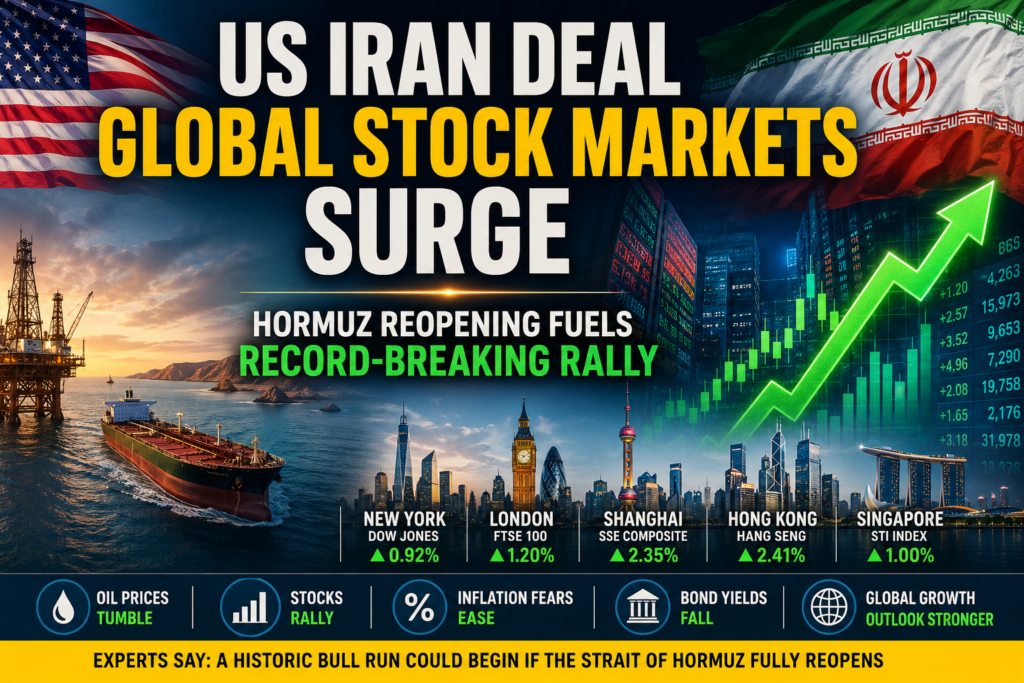
- US Iran deal global stock markets rally sharply as oil prices tumble and investor confidence surges
- Wall Street hits record highs while Europe and Asia post synchronized gains
- Falling crude eases inflation fears, reducing pressure on central banks and bond yields
- Analysts forecast a historic bull run if the Strait of Hormuz fully reopens and energy flows normalize
Global financial markets are staging a synchronized rally from Wall Street to Shanghai, London to Singapore, as investors rapidly reprice geopolitical risk following a breakthrough U.S.–Iran agreement that promises to reopen the Strait of Hormuz—the world’s most critical oil transit chokepoint. The deal, while still awaiting formal ratification, has already triggered one of the most powerful cross-asset moves of the year, lifting equities, easing bond yields, and sharply pulling down energy prices.
At the center of the market reaction is a simple but profound recalibration: the removal of a major geopolitical overhang that had clouded sentiment since late February. In New York, the Dow Jones Industrial Average surged to yet another record—its 16th this year—while the Nasdaq Composite climbed more than 3%, powered by technology and semiconductor stocks. The S&P 500 added nearly 2%, reflecting broad-based optimism.
The rally has been equally pronounced across Europe and Asia. The pan-European Stoxx 600 index reached an all-time high, fully recovering losses accumulated during the conflict. In Asia, Japan’s Nikkei 225 and South Korea’s Kospi both jumped more than 5%, leading gains among oil-importing economies that stand to benefit most from falling energy costs. Hong Kong’s Hang Seng and China’s mainland indices posted solid gains, while Singapore’s Straits Times Index climbed above the psychologically significant 5,000 level.
Oil Collapse Reshapes Inflation Outlook
The most immediate catalyst has been the sharp decline in oil prices. Brent crude has fallen below $83 a barrel, down nearly 20% from its conflict-driven peak, while U.S. West Texas Intermediate has dropped in tandem. European natural gas prices have also retreated significantly.
This decline is not merely a commodity story—it is a macroeconomic pivot point. For months, investors feared that sustained high oil prices would reignite inflation and force central banks, particularly the Federal Reserve, to maintain or even tighten monetary policy. Those fears are now receding.
BREAKING: U.S., Iran Reach Interim Peace Deal After Months of Conflict; Signing Set for June 19 in Switzerland
Interest-rate futures markets show a dramatic shift in expectations. Investors now assign a significantly higher probability that the Federal Reserve will hold rates steady through 2026. U.S. Treasury yields have edged lower, with the 10-year yield slipping toward 4.46%, while the dollar has weakened, further supporting risk assets globally.
“The market is interpreting this as a green light for stronger global growth,” said one senior economist at a major U.S. financial institution. “Lower energy costs feed directly into consumer spending, corporate margins, and ultimately earnings.”
A Three-Pillar Rally: Geopolitics, Inflation, and Technology
Market strategists describe the current rally as being supported by three reinforcing pillars. First is the geopolitical de-escalation itself, removing a major source of uncertainty. Second is the improving inflation outlook, which reduces the likelihood of further monetary tightening. Third is the continued strength of the artificial intelligence investment cycle, which remains a dominant driver of corporate earnings growth.
Stocks Have Even More Room to Fly if Hormuz Reopens
The technology sector has been a standout beneficiary. The PHLX Semiconductor Index surged more than 5%, reflecting renewed investor confidence in global supply chains and capital expenditure plans. Meanwhile, the blockbuster public debut of SpaceX—now valued at over $2.5 trillion—has injected fresh momentum into equity markets, symbolizing the scale of investor appetite for high-growth innovation.
US Iran deal global stock markets: Sector Winners and Losers Emerge
The easing of oil prices is already reshaping sectoral dynamics. Airlines and travel-related stocks have rallied sharply, with fuel costs representing a major component of operating expenses. In the U.S., major carriers posted strong gains, while in Asia, Singapore Airlines and related aviation services firms also advanced.
Real estate investment trusts and property developers are benefiting from lower interest-rate expectations, particularly in financial hubs like Singapore and London, where capital inflows are being reinforced by safe-haven demand.
Conversely, sectors that had benefited from wartime premiums—such as energy producers, offshore drilling firms, and defense contractors—are seeing more muted performance. Analysts note that the urgency premium for exploration and production spending is likely to fade as oil prices stabilize.
Banking stocks present a more nuanced picture. While lower rates may compress net interest margins, wealth management and capital markets activity remain strong, providing a structural tailwind.
The Hormuz Factor: A Potential Market “Climax”
Despite the broad optimism, analysts caution that the full market impact hinges on the successful reopening of the Strait of Hormuz. Roughly 20% of global oil shipments pass through this narrow waterway, and any disruption has immediate global consequences.
Experts warn that even under a best-case scenario, normalization will take time. Mines must be cleared, infrastructure repaired, and production gradually restored. Some estimates suggest it could take four to six months for supply to return to pre-crisis levels.
Yet it is precisely this delayed normalization that fuels bullish forecasts. If Hormuz reopens smoothly and oil flows stabilize, markets could enter what some strategists describe as a “climax phase” of the current bull cycle—characterized by synchronized global growth, abundant liquidity, and strong earnings expansion.
“This could be the kind of environment we haven’t seen in decades,” said a senior portfolio manager at a global asset manager. “You have disinflation, geopolitical stability, and a massive technology investment wave all aligning at once.”
Risks Remain Beneath the Surface
Still, the path forward is not without risks. The deal between Washington and Tehran has yet to be fully formalized, and conflicting statements from both sides highlight lingering uncertainties. Any delay or breakdown in implementation could quickly reverse market gains.
Moreover, structural challenges—ranging from supply chain fragilities to geopolitical rivalries beyond the Middle East—remain unresolved. Investors are also mindful that much of the “peace dividend” may already be partially priced in, particularly in markets that rallied ahead of official confirmation.
Outlook: A Fragile but Powerful Momentum
For now, the momentum is unmistakably positive. Global equities are rising in unison, volatility is receding, and capital is flowing back into risk assets. The reopening of the Strait of Hormuz, if achieved without incident, could act as a powerful catalyst for further gains.
In the near term, markets are likely to remain sensitive to headlines surrounding the finalization of the agreement. But if the current trajectory holds, the U.S.–Iran deal may mark not just the end of a conflict—but the beginning of one of the most powerful global market rallies in recent memory.