


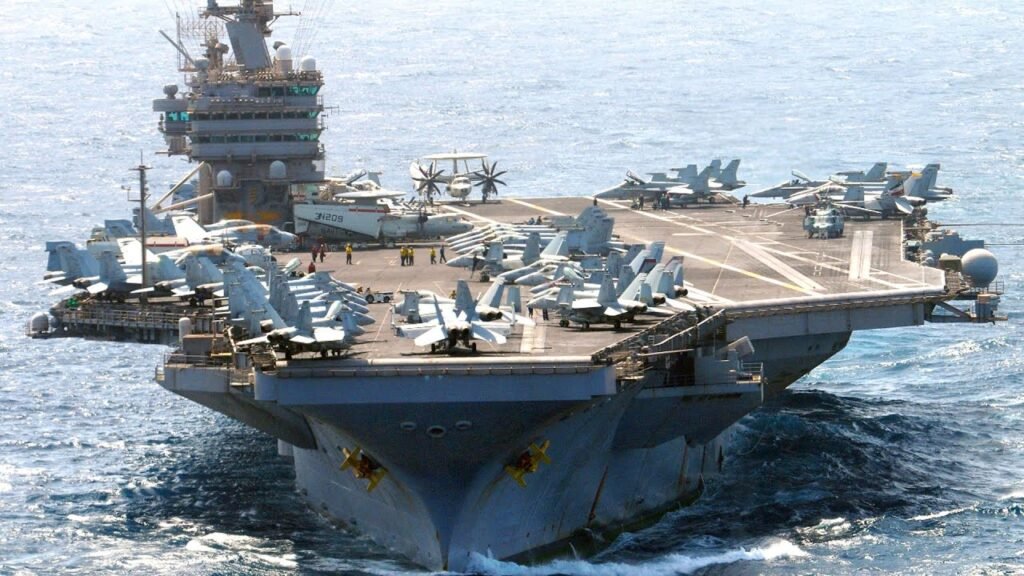
- US Iran military escalation intensifies as another American naval armada moves into Middle Eastern waters
- Regional powers including UAE, Saudi Arabia, and Pakistan refuse to support a US strike on Iran
- Trump mixes threats with diplomacy, claiming Tehran is ready to negotiate
- Analysts warn of regional fallout after conflicts in Gaza, Yemen, and Afghanistan
US President Donald Trump’s declaration that a fresh US “armada” is heading toward Iran has thrust the Middle East back into acute crisis mode, reviving fears of a regional conflagration after a year of war in Gaza, Yemen and continuing instability in Afghanistan.
Trump’s rhetoric — coupled with the arrival of a powerful carrier strike group — has energized both diplomatic anxiety and the most hawkish voices in Washington, even as key regional partners publicly resist military escalation.
“There is another beautiful armada floating beautifully towards Iran right now,” Trump told supporters, adding that he hoped Tehran would “make a deal” with Washington. The deployment, led by the USS Abraham Lincoln aircraft carrier strike group, has already reached Middle Eastern waters, though US Central Command has stopped short of placing it directly in the Persian Gulf.
US Iran Military Escalation: A Region on Edge
Diplomats and security officials across the Gulf describe a region on high alert. Tehran’s leadership, consolidating power after a brutal crackdown on nationwide protests that activists say has killed thousands, has warned that any US attack would be treated as an “all-out war.” Iranian officials have reinforced coastal defenses and underscored readiness to use asymmetric tactics — including missile batteries and drone swarms — against naval forces.
For Arab monarchies, the stakes could not be higher. Riyadh and Abu Dhabi have publicly declined to allow US military action against Iran from their airspace or bases, underscoring deep regional fatigue with foreign intervention after years of proxy conflicts and economic disruption. The lack of logistical support from key Gulf states complicates Trump’s operational calculus and signals broader regional resistance to an open war with Tehran.
Trump’s Strategic Tightrope
Trump’s messaging has been notably ambiguous — oscillating between bellicose warnings and overtures to dialogue. In interviews with Axios, he claimed Tehran had “called on numerous occasions” to talk and expressed hope that a negotiated outcome could avert hostilities. But he also repeatedly referenced the naval build-up as leverage to compel Iranian concessions.
The president’s posture reflects a broader strategic dilemma: how to uphold US credibility and respond to Iran’s repression without igniting a wider war that could destabilize oil markets, inflame militancy across the Levant, and draw in allied militaries — particularly Israel, which has its own contingency plans and is closely coordinating with US military planners.
Past Wars and Proxy Fault Lines
The specter of new conflict in the Middle East cannot be divorced from recent history. The region is already scarred by wars in Yemen, where US-backed sorties targeted Houthi forces, and the devastating Gaza conflict involving Israel, as well as the chaotic withdrawal from Afghanistan. Each of these theatres underscored that military pressure rarely produces stable political outcomes — and often fuels anti-American sentiment and militant recruitment.
Iran’s own 2025 stand-off with Israel, culminating in a ceasefire after direct exchanges of missiles, demonstrated Tehran’s capacity to absorb military blows and retaliate through proxies across Iraq, Syria and Lebanon. That experience underscored the limits of military coercion as a tool of regime change.
Is War Imminent?
Despite the charged language and highly visible naval movements, most analysts judge that a full-scale US strike on Iran’s mainland remains unlikely in the immediate term. Trump faces significant diplomatic resistance — not only from Gulf partners wary of escalation, but also from global institutions and Western allies concerned about the humanitarian and economic fallout of a war with Iran. Even within the US military establishment, there is caution about the operational risks of an engagement that could rapidly expand beyond its initial scope.
Instead, the current build-up may be best understood as a pressure campaign: projecting force to compel Iranian leadership either to moderate internal repression or to re-engage on nuclear and regional security dialogues. Whether Tehran responds with concessions, defiance, or calibrated retaliation will shape the coming months. But for now, the Gulf’s fragile equilibrium teeters between deterrence and inadvertent escalation.
Beyond Regime Change
Calls for regime change in Tehran — long a staple of hard-line policy circles in Washington — gain traction when international outrage over human rights abuses peaks. However, history suggests that efforts to topple foreign governments through force carry enormous costs and unpredictable outcomes. In Iran’s case, the regime has demonstrated both resilience and adaptability, drawing on deep nationalistic narratives and a security apparatus prepared for prolonged confrontation.
In a region weary of conflict, most capitals prefer containment and diplomacy over direct confrontation. Whether Trump’s latest “armada” will alter Tehran’s calculus, or simply reinforce the status quo of brinkmanship, remains the defining foreign-policy question of 2026.