


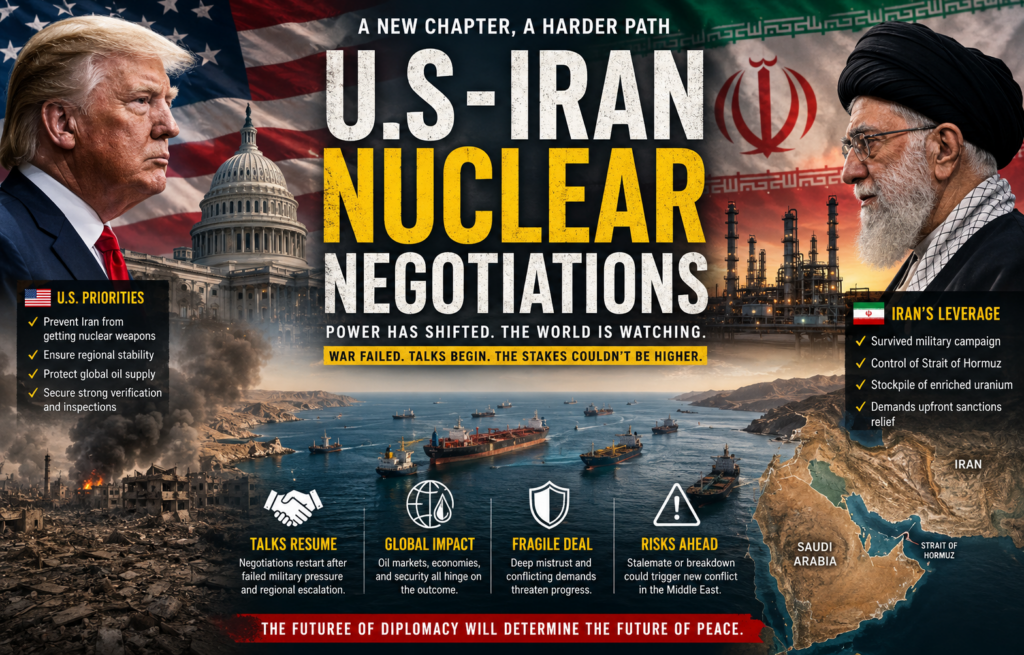
- US Iran nuclear negotiations resume after failed military campaign to force Tehran concessions
- Iran strengthens position by surviving war and gaining leverage over Strait of Hormuz
- Talks face uncertainty as Tehran demands upfront sanctions relief and distrusts Washington
- Experts warn of fragile deal, prolonged stalemate, or renewed Middle East conflict
After more than three months of sustained bombardment, covert strikes, and maritime pressure, the United States and Iran are returning to the negotiating table—yet the balance of power underpinning those talks has shifted in ways few in Washington anticipated.
What was conceived by Donald Trump and Benjamin Netanyahu as a decisive campaign to coerce Tehran into submission has instead hardened Iranian resolve. Despite the reported killing of senior leadership figures, including Ali Khamenei, and the degradation of conventional military assets, Iran’s state structure endured. More significantly, it adapted—consolidating authority under a new command architecture that appears less constrained and more ideologically rigid.
This outcome carries profound implications for the looming nuclear negotiations. For decades, the implicit threat of overwhelming U.S. military force served as Washington’s primary leverage. That assumption has now been tested—and, crucially, survived—by Tehran. Iranian negotiators will arrive at the table with a sharpened belief that escalation does not necessarily equate to capitulation.
Equally transformative is Iran’s effective control over the Strait of Hormuz, a chokepoint through which roughly a fifth of global oil supply flows. This development introduces a powerful new bargaining chip. By demonstrating its capacity to disrupt global energy markets, Tehran has shifted from being a target of economic pressure to a potential source of systemic risk—one that global powers cannot easily ignore.
US Iran Peace Deal Nears as Markets Rally on Oil Drop and Inflation Relief
The immediate diplomatic framework—a proposed memorandum of understanding—reflects this new reality. Iran is demanding upfront economic concessions, including access to frozen assets, before committing to meaningful nuclear restrictions. This insistence underscores a deep-seated mistrust shaped by past experiences, particularly the collapse of earlier agreements and the persistence of sanctions.
From a forecasting perspective, the talks face three plausible trajectories.
First, a fragile interim deal remains possible. Economic pressures inside Iran—marked by inflation, infrastructure damage, and social unrest—create incentives for Tehran to secure sanctions relief. If the U.S. offers limited, verifiable financial incentives early, both sides could reach a temporary arrangement aimed at stabilizing markets and reducing immediate tensions.
Trump Is Losing the Hawks Who Once Defended the Iran War
Second, a prolonged stalemate is increasingly likely. With diminished coercive leverage, Washington may struggle to extract significant concessions, while Tehran—emboldened by its wartime resilience—may calculate that delay serves its interests. In this scenario, negotiations could drag on inconclusively, with periodic escalations in rhetoric and regional proxy activity.
Third, and perhaps most concerning, is the risk of renewed conflict. The absence of Israel from the negotiation framework introduces a critical wildcard. Israeli leadership has signaled skepticism toward any agreement that falls short of dismantling Iran’s nuclear capabilities. Coupled with heightened tensions in Lebanon and the Gulf, even minor incidents could trigger a rapid escalation.
For global markets, the stakes are immense. Stability in the Strait of Hormuz will be a key barometer. Any indication that Iran intends to leverage its position aggressively could send oil prices soaring, while even a tenuous agreement could trigger a relief rally across energy and equity markets.
Ultimately, the post-war negotiating landscape reflects a paradox. Iran emerges economically weakened yet strategically emboldened; the United States retains financial leverage but faces credibility constraints. The result is a diplomatic arena defined less by dominance than by mutual suspicion.
In this environment, the success of the negotiations will hinge not on displays of القوة, but on the ability of both sides to construct a credible framework of trust—something that has remained elusive for more than four decades.