


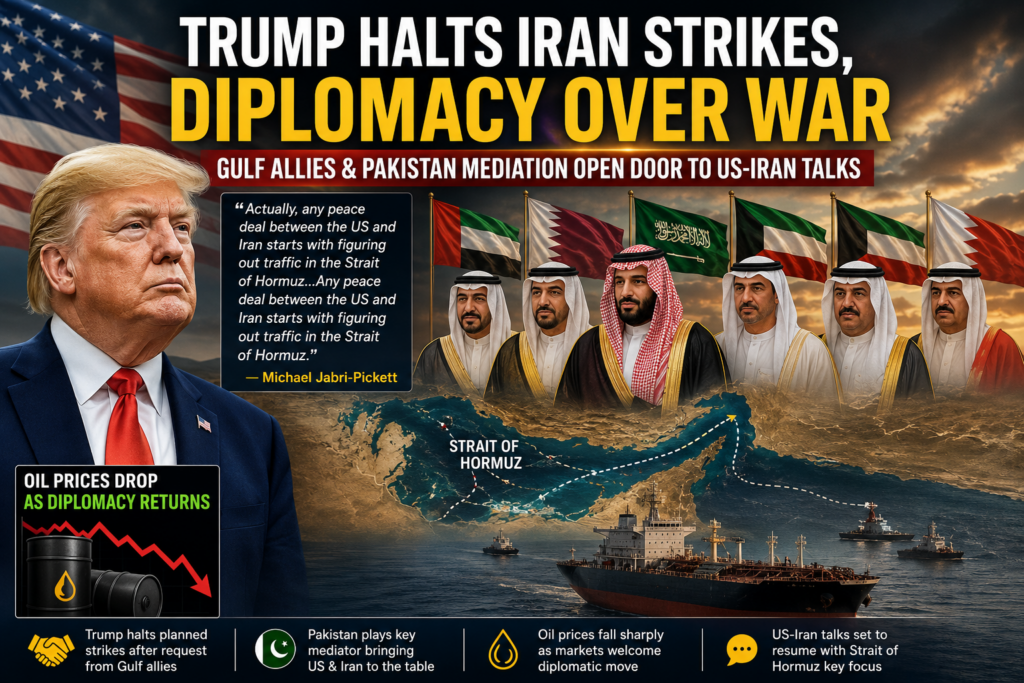
- US Iran talks gain momentum as Trump halts strikes after Gulf allies’ request
- Pakistan emerges as key mediator bridging Washington and Tehran
- Oil prices drop sharply as markets welcome diplomatic breakthrough
WASHINGTON — In a dramatic pivot that underscores the fragile balance between war and diplomacy in the Middle East, U.S. President Donald Trump has halted planned military strikes on Iran and signaled a renewed push for negotiations—after intensive consultations with Gulf allies and mediation efforts led by Pakistan.
Speaking aboard Air Force One, Trump revealed that he had been prepared to authorize what he described as “the biggest attack since World War II.” Yet, after urgent calls with regional leaders—including Saudi Crown Prince Mohammed bin Salman—he chose to stand down, prioritizing diplomacy over escalation.
“I asked them directly—would you rather see this attack or a deal?” Trump said. “They overwhelmingly preferred a deal. And frankly, so do we.”
Gulf Diplomacy Shapes U.S. Decision
Trump is currently engaged in high-level consultations with leaders across the Gulf, including the United Arab Emirates, Qatar, Kuwait, and Bahrain. These discussions come as Washington recalibrates its approach following weeks of escalating tensions with Tehran.
Regional leaders, particularly from energy-sensitive economies, warned that further military escalation could trigger severe economic shocks, disrupt oil flows, and destabilize already fragile security conditions. Their message was clear: avoid war, pursue negotiation.
READ NEXT: US-Iran War: How Backchannel Diplomacy from Islamabad Halted Imminent Strikes
Saudi Arabia, along with Qatar and the UAE, reportedly played a decisive role in persuading Washington to delay military action. Officials cautioned that Iranian retaliation could target Gulf infrastructure and shipping routes, particularly in vulnerable states like Kuwait.
US Iran Talks: Pakistan Emerges as Key Mediator
Behind the scenes, Pakistan has intensified diplomatic efforts to bring Washington and Tehran back to the negotiating table. Islamabad’s sustained engagement with both sides—alongside coordination with Gulf capitals—has elevated its standing as a credible intermediary in one of the world’s most volatile conflicts.
Pakistani officials have consistently urged restraint, warning that prolonged conflict would have devastating consequences for regional stability and the global economy. Their mediation efforts, backed by quiet diplomacy and regional outreach, are now being credited with helping create space for renewed dialogue.
READ NEXT: Why limited war with the US may suit Iran better than peace
This latest development reinforces Pakistan’s growing role as a stabilizing force in global geopolitics—particularly in bridging divides between major powers and regional rivals.
Markets React: Oil Prices Drop Sharply
US Iran Talks are happening. Trump’s decision to halt strikes triggered immediate reactions across global markets. Oil prices, which had surged amid fears of a wider conflict, fell sharply as investors interpreted the move as a signal of de-escalation.
Asian markets responded within hours, with benchmark crude prices declining significantly. The potential reopening of the Strait of Hormuz—a critical artery through which nearly 20% of global oil and gas supplies flow—has further eased concerns about supply disruptions.
“Actually, any peace deal between the US and Iran starts with figuring out traffic in the Strait of Hormuz… Any peace deal between the US and Iran starts with figuring out traffic in the Strait of Hormuz,” said Michael Jabri-Pickett, underscoring the centrality of maritime security to any lasting agreement.
Following US Iran Talks, Energy analysts say the shift toward diplomacy has temporarily calmed markets, though volatility remains high given the uncertainty surrounding negotiations.
US Iran Talks: A Fragile Path to Talks
According to regional officials involved in mediation efforts, the emerging framework envisions a return to negotiations between the United States and Iran, coupled with a broader ceasefire across the region.
Key elements under discussion include:
- Reopening the Strait of Hormuz
- Halting attacks by Iranian-backed groups
- Ending the U.S. naval blockade on Iran
- Allowing Tehran to resume oil exports
Trump indicated that talks could resume “as early as tomorrow,” though details about participants and venue remain unclear.
Iran Signals Caution
Tehran has responded cautiously to the reports of US Iran Talks amid latest developments. Iranian officials have emphasized that while diplomacy remains an option, the country will not compromise on its strategic interests.
Foreign Ministry spokesperson Esmail Baghaei stated that the Strait of Hormuz “will not return to its previous status,” reflecting Iran’s intent to maintain leverage in negotiations. Meanwhile, Iran’s defense leadership has warned that the country remains on high alert.
Will US Iran Talks bear fruit this time? It’s a million dollar question still.
Internal divisions within Iran’s leadership—between hardliners opposing talks and pragmatists favoring negotiation—continue to complicate the path forward.
A Defining Moment
Trump’s abrupt shift from brinkmanship to diplomacy highlights the volatile nature of the conflict—and the critical role of regional actors in shaping outcomes.
For now, the guns have fallen silent to give US Iran Talks a chance. But whether this pause leads to a durable agreement or merely delays another round of confrontation will depend on the success of upcoming talks—and the willingness of all sides to compromise.
As global attention turns to the next phase of US Iran Talks, one thing is clear: the Middle East stands at a crossroads, where diplomacy, not war, may determine the future.