


- Kim Jong Un’s Power Play: Why the U.S. Should Worry About North Korea’s New Nuclear Era
- North Korea, China, and Russia Unite: The Growing Threat Washington Can’t Ignore
- Trump’s Missed Chance? How Kim Jong Un’s Nuclear Ambitions Are Now Shielded by Beijing and Moscow
- From Trump to Biden: Why North Korea’s Hwasong-20 Missile Puts the U.S. on Edge
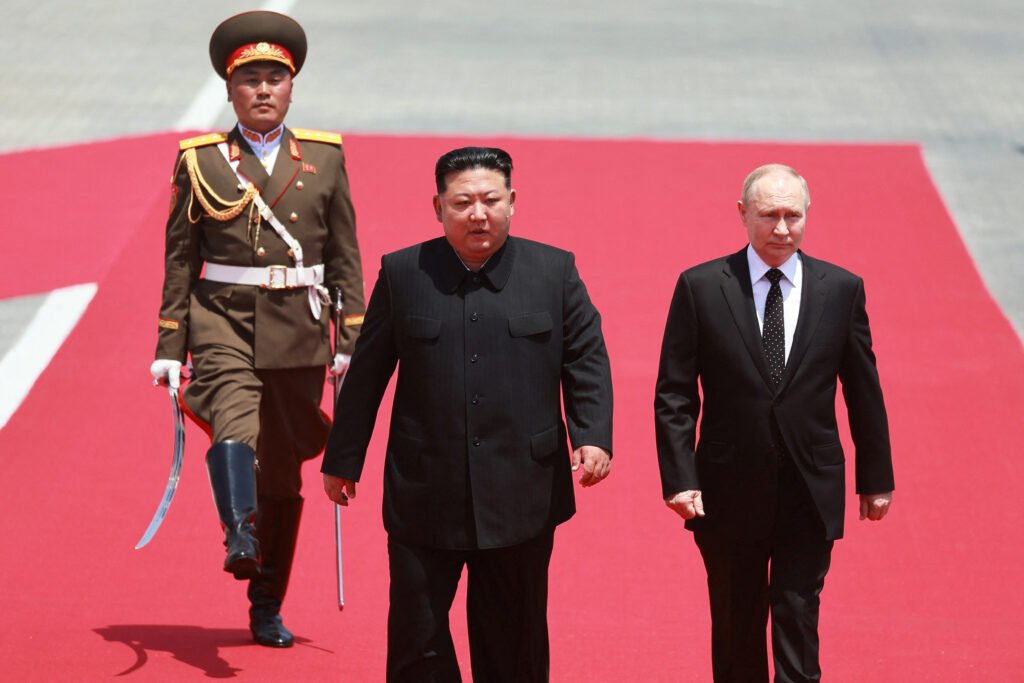
When North Korean leader Kim Jong Un stood at the podium on a rain-soaked Friday night in Pyongyang, flanked by top officials from China, Russia, Vietnam, and Laos, he wasn’t merely presiding over another military parade. He was sending a signal — clear, deliberate, and defiant — to Washington: North Korea is back on the geopolitical stage, more confident and more dangerous than ever before.
Kim’s display of the new Hwasong-20 intercontinental ballistic missile (ICBM) — capable of striking the U.S. mainland — underscored a chilling truth: deterrence is no longer theoretical. The missile, powered by solid fuel and easily deployable, marks a significant leap in Pyongyang’s nuclear capabilities. Unlike earlier liquid-fueled models that required hours of preparation, the Hwasong-20 could be launched within minutes, drastically reducing the window for American preemptive action.
The display wasn’t only about technology; it was a political theater, meticulously choreographed. Kim’s stage included Chinese Premier Li Qiang and Russia’s former president Dmitry Medvedev — both representing powers increasingly aligned against Western dominance. Their presence symbolized the rebirth of a loose anti-Western coalition, one that openly defies U.S. sanctions and norms.
A Resurgent Axis Against Washington
For Washington, the implications are severe. North Korea is no longer the isolated “rogue state” caricature of a decade ago. It has carved out a role as a strategic partner in a Eurasian triangle led by Beijing and Moscow. In recent months, Pyongyang has sent artillery shells, missiles, and even troops to aid Russia in Ukraine — a stunning reversal of the North’s once purely defensive posture.
The message from Pyongyang is clear: the era of Western containment is over. North Korea now wields a dual weapon — a credible nuclear deterrent and the political backing of two U.N. Security Council powers. This nexus undermines Washington’s leverage, reducing the effectiveness of sanctions and isolating the United States diplomatically in Asia.
Trump’s Diplomatic Gamble — and a Missed Opportunity
During his presidency, Donald Trump became the only sitting U.S. president to meet Kim Jong Un, holding three unprecedented summits between 2018 and 2019 — in Singapore, Hanoi, and the Korean Demilitarized Zone. Those meetings produced powerful imagery and a rare thaw in tensions. Trump’s bold, unconventional diplomacy temporarily slowed North Korea’s testing schedule and raised the possibility of a breakthrough.
But talks collapsed in 2019 when Washington insisted on full denuclearization before offering sanctions relief. Since then, Kim has rebuilt his arsenal, fortified his economy through black-market partnerships, and strengthened ties with China and Russia.
Now, Trump — eyeing a potential return to the White House — has signaled his willingness to meet Kim again, provided the U.S. rethinks its approach. Kim, for his part, has laid down his terms: no talks without the end of America’s “hostile policy.” That means no denuclearization demands, no sanctions expansion, and no military buildup near the Korean Peninsula.
If Washington ignores that message, North Korea may escalate — and not just rhetorically.
Pyongyang’s New Confidence
Kim’s recent military parades and expos reveal a new phase of confidence in North Korea’s nuclear and conventional capabilities. At last week’s defense exhibition, the regime unveiled a short-range ballistic missile equipped with a hypersonic glide vehicle — technology designed to evade U.S. missile defenses. The country also displayed drone launchers, rocket systems, and multiple launch vehicles capable of delivering tactical nuclear warheads.
At the same time, North Korean officials boasted of battlefield-tested weaponry derived from their cooperation with Russian forces in Ukraine. This cross-pollination of tactics and technology has made Pyongyang’s arsenal more accurate and survivable — a nightmare scenario for American defense planners.
Adding to the tension, the U.S. recently announced it has permanently stationed MQ-9 Reaper drones in South Korea, signaling an expanded surveillance footprint. Kim responded by accusing Washington of preparing for “preemptive strikes” and warned of “military measures” to restore strategic balance.
Why Washington Should Be Concerned
For decades, North Korea’s provocations were cyclical — missile launches followed by sanctions, negotiations followed by breakdowns. But today, the cycle looks dangerously different. Kim Jong Un has woven his small state into the broader anti-U.S. tapestry of Eurasian geopolitics, linking his ambitions to those of Xi Jinping and Vladimir Putin.
If tensions with China and Russia continue to escalate, North Korea becomes a ready-made flashpoint — a potential trigger point for regional or even global confrontation.
More importantly, Kim’s expanding ICBM fleet — capable of striking Los Angeles or Washington — means deterrence is no longer a one-sided game. The United States now faces the very real risk of mutual vulnerability with a regime that has far less to lose.
In the near term, Washington must rethink its strategy. Sanctions alone have failed. Military deterrence may provoke more tests. Diplomatic engagement — perhaps even through another Trump-Kim meeting — could be the only viable path to de-escalation.
But one thing is certain: ignoring North Korea is no longer an option.
As Kim Jong Un consolidates his alliances with Beijing and Moscow, he is positioning himself as a nuclear-armed disruptor in an increasingly multipolar world. For Washington, that means confronting an uncomfortable truth — North Korea is no longer a marginal threat. It is a central player in a shifting global order that challenges America’s dominance, one missile parade at a time.