


-
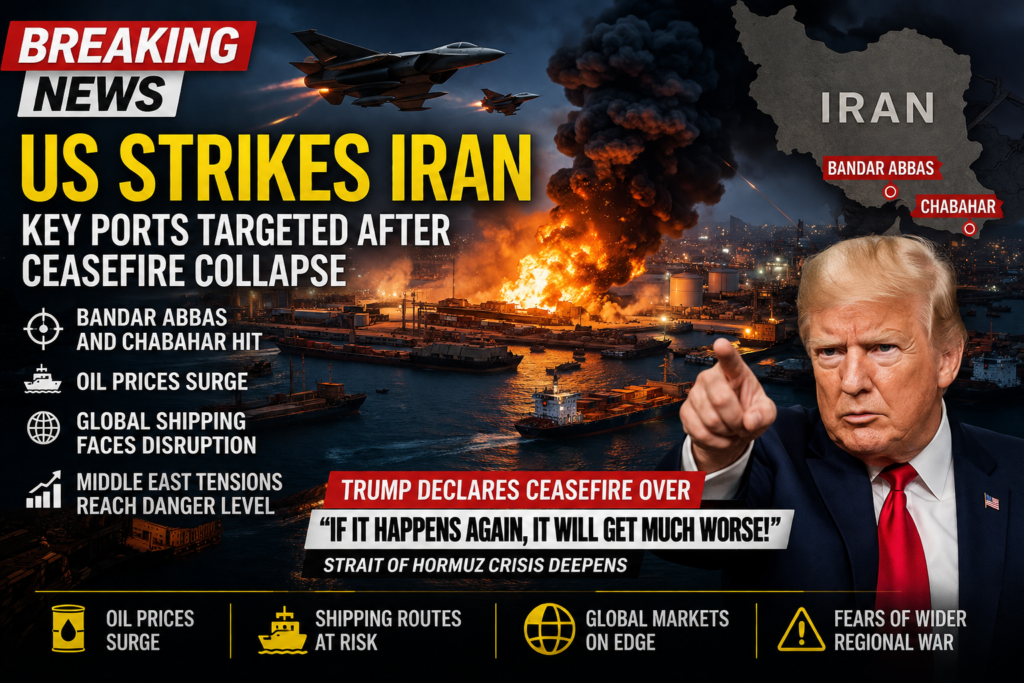
US strikes on Iran: US launches major strikes on Iran’s ports including Bandar Abbas and Chabahar
- Trump declares ceasefire over after attacks in Strait of Hormuz
- Oil prices surge amid fears of supply disruption
- Global shipping hubs like Singapore and Shanghai on alert
- Risk of wider Middle East war intensifies
Tehran / Washington / Islamabad — In a dramatic escalation that signals the near-total collapse of recent diplomatic efforts, the United States launched a fresh wave of powerful military strikes on Iran early Wednesday, targeting critical port infrastructure including Bandar Abbas and Chabahar, according to U.S. officials and on-ground reporting by The Islamabad Telegraph.
Explosions rocked multiple locations across southern Iran in the early hours, with eyewitnesses in Tehran confirming that the latest attacks were among the most intense since hostilities first erupted earlier this year. The strikes mark the second major round of U.S. military action within 24 hours, underscoring a rapid deterioration in the fragile ceasefire framework that had briefly paused the conflict.
U.S. Central Command (CENTCOM) confirmed the operation, stating that the strikes were designed to “further degrade Iran’s ability to threaten freedom of navigation in the Strait of Hormuz,” a waterway critical to global energy flows.
“The United States is holding Iran accountable for recent unjustified aggression against commercial shipping and civilian crews,” CENTCOM said in a statement, referring to Iranian attacks earlier this week on vessels transiting the strategic corridor.
US Strikes On Iran: Ports Under Fire: Strategic Targets Hit
Iranian media reported explosions in Bandar Abbas and nearby Sirik—sites that were also struck in previous attacks—but officials indicated that Wednesday’s operation was broader and more destructive in scope. In addition to port infrastructure, U.S. forces targeted missile depots, drone storage facilities, and mobile radar systems along the Persian Gulf coastline.
READ MORE: Trump Attack on Iran: Donald Trump Signals Mother of All Strike on Iran as Ceasefire Collapses
The inclusion of Chabahar—a vital port with regional trade significance—signals an expansion of U.S. targeting strategy beyond purely military installations to include logistical and economic nodes critical to Iran’s maritime operations.
A senior U.S. official confirmed that Iran had “reconstituted significant portions of its missile and radar capabilities” since the ceasefire, including deploying mobile systems to replace previously destroyed infrastructure.
Trump Declares Ceasefire Over, Warns of More Strikes
The renewed assault follows a blunt declaration by President Donald Trump that the ceasefire agreement with Iran was effectively over. Speaking a day earlier, Trump vowed decisive retaliation after Iran attacked Qatar-linked commercial vessels in the Strait of Hormuz.
“We hit them very hard last night… we’ll probably hit them hard again tonight,” Trump said, adding that further escalation was likely. In a social media post, he warned Tehran: “If it happens again, it will get much worse!”
RELATED NEWS: Trump orders new round of strikes after calling Iranian leaders ‘scum’
During remarks aboard Air Force One returning from the NATO summit in Ankara, Trump revealed that Iran had attempted to reach out for negotiations but expressed skepticism over Tehran’s intentions. “They want to make a deal so badly… I don’t know that they’re going to honor the deal,” he said.
The administration has also revoked a key sanctions waiver that allowed Iran to sell oil internationally—effectively stripping Tehran of one of the main economic incentives tied to the earlier interim peace arrangement.
From Ceasefire to Collapse: How the Crisis Unfolded
The latest escalation marks a sharp reversal from the Islamabad Memorandum of Understanding (MoU) signed in June, which had established a 60-day pause in hostilities and laid the groundwork for a broader peace agreement.
Under the MoU, both sides had agreed to reopen the Strait of Hormuz and pursue negotiations on contentious issues, including Iran’s nuclear program and regional security arrangements. However, tensions resurfaced rapidly after Iran sought to assert control over shipping routes, reportedly warning vessels to follow designated Iranian corridors.
The situation spiraled this week when Iran launched missiles and drones at three commercial vessels, including a liquefied natural gas tanker, triggering immediate U.S. retaliation. Washington responded with strikes on more than 80 targets, prompting Iran to launch counterattacks on U.S.-linked facilities in Bahrain and Kuwait.
Since then, the conflict has entered a dangerous tit-for-tat cycle with no clear off-ramp.
Global Oil Markets Surge, Maritime Trade at Risk
The renewed hostilities have sent shockwaves through global energy markets, with crude oil prices surging sharply amid fears of prolonged disruption in the Strait of Hormuz, through which nearly 20 percent of the world’s oil supply passes.
Shipping and logistics hubs across Asia are already bracing for fallout. Maritime authorities in Singapore, Shanghai, and other major ports are on high alert, fearing disruptions in shipping lanes, rising insurance costs, and potential delays in cargo movement.
Energy analysts warn that sustained instability could trigger a broader supply shock, pushing oil prices to levels not seen since previous Gulf crises. LNG shipments, heavily reliant on Gulf routes, are also at risk—raising concerns for energy-importing economies across Asia and Europe.
Pakistan Calls for Restraint, Offers Mediation
Amid the escalating crisis, Pakistan has expressed deep concern and renewed its offer to mediate between Washington and Tehran. In a statement, the Foreign Office emphasized that “a renewed conflict is in no one’s interest” and urged all parties to exercise restraint.
Islamabad also called on both sides to uphold commitments under the Islamabad MoU, describing it as a “foundation for mutual respect and shared prosperity.”
Officials reiterated that Pakistan remains ready to facilitate dialogue, building on its earlier role in brokering the ceasefire and hosting indirect negotiations between the two sides.
Forecast: A Conflict on the Brink of Expansion
The latest U.S. strikes suggest that Washington is shifting toward a sustained campaign aimed at degrading Iran’s military and maritime capabilities. By targeting key ports such as Bandar Abbas and Chabahar, the U.S. is not only seeking tactical advantage but also signaling a willingness to disrupt Iran’s economic lifelines.
However, this strategy carries significant risks.
Iran retains substantial retaliatory capabilities, including missile and drone assets, as well as proxy networks across the region. Further escalation could see expanded attacks on Gulf states, increased threats to international shipping, and possible closure—or militarization—of the Strait of Hormuz.
Diplomatic prospects appear increasingly uncertain. While backchannel communications may continue, public rhetoric from both sides has hardened considerably, reducing the immediate likelihood of a negotiated breakthrough.
If the current trajectory persists, analysts warn the conflict could evolve into a broader regional confrontation with global economic repercussions—particularly in energy markets and international trade.
For now, the Middle East stands at a critical inflection point, as military escalation overtakes diplomacy and the fragile architecture of peace painstakingly built over recent months begins to unravel.