


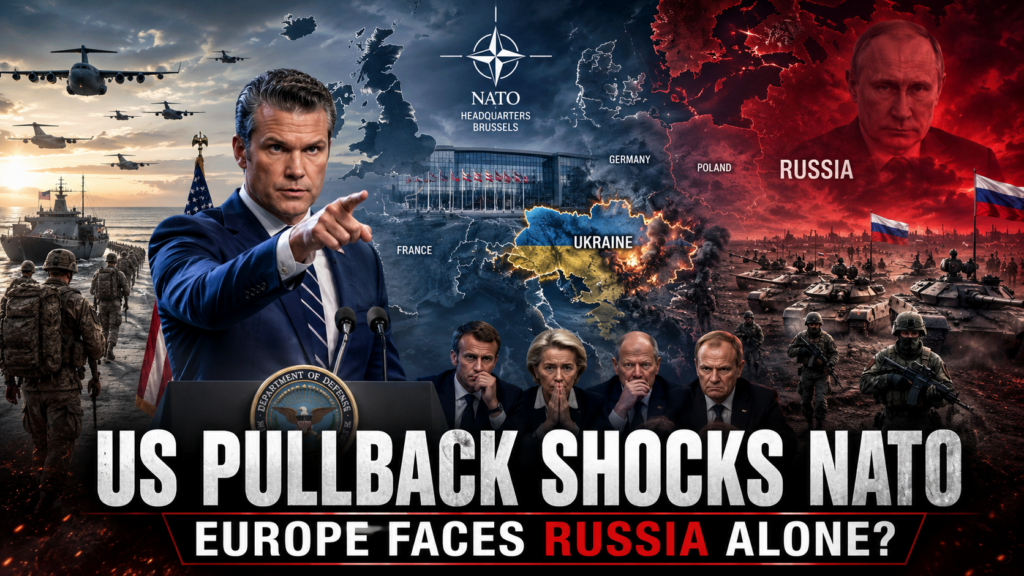
- US Troop Withdrawal Europe signals a decisive shift in NATO burden-sharing strategy
- Pentagon review may cut fighter jets, drones, and rapid-response forces in Europe
- Russia could exploit NATO capability gaps, impacting the Ukraine war
- Europe faces urgent pressure to rebuild military strength and strategic autonomy
The message from Brussels was not subtle—it was strategic, calibrated, and unmistakably disruptive. When U.S. Defense Secretary Pete Hegseth stood before NATO ministers and declared a sweeping review of American troop levels in Europe, he was not merely outlining a policy shift. He was delivering a warning. For decades, Europe has relied on the United States as the backbone of its security architecture through NATO. Now, Washington appears determined to redraw that equation.
At the heart of this recalibration is a six-month Pentagon review that could significantly reduce the U.S. military footprint across the continent. Plans already underway include scaling back fighter jets, reconnaissance drones, and naval deployments tied to NATO’s emergency response framework. Diplomats suggest that up to one-third of U.S. fighter aircraft allocated for European contingencies could be withdrawn—assets that European militaries would struggle to replace quickly.
Hegseth’s rhetoric was even more striking than the policy itself. Echoing the worldview of President Donald Trump, he accused European nations of complacency, arguing that decades of reduced defense spending and focus on social policies had hollowed out the continent’s military readiness. NATO, he said bluntly, had become a “one-way street.” The implication was clear: America will no longer subsidize Europe’s security indefinitely.
For Europe, the implications are profound. While NATO Secretary General Mark Rutte attempted to downplay tensions, framing the move as a step toward “realistic” burden-sharing, the reality is far more complex. The U.S. still maintains tens of thousands of troops, nuclear deterrence capabilities, and command dominance in Europe. But even a partial withdrawal disrupts the strategic balance that has defined transatlantic security since World War II.
Iran US Deal Strait of Hormuz: Shipping Resumes as Global Markets Rebound Amid Rising Political Tensions
Nowhere will the consequences be felt more acutely than in the ongoing war between Russia and Ukraine. Since 2022, U.S. military support—both direct and indirect—has been central to Ukraine’s resistance and NATO’s deterrence posture. A reduction in American rapid-response capabilities could weaken NATO’s ability to project power on its eastern flank, particularly in vulnerable states like Poland and the Baltic nations.
Russia, watching closely, is likely to interpret this shift as a strategic opening. Moscow has long argued that NATO’s cohesion is fragile, dependent on American leadership. A visible U.S. drawdown reinforces that narrative. Even if European nations increase defense spending—as many have pledged—the transition will take years. In the interim, gaps in airpower, intelligence, and logistics could embolden Russian military posturing, hybrid warfare tactics, and further pressure on Ukraine.
U.S. moves toward troop reductions in Europe as Hegseth scolds NATO allies
At the same time, the move may accelerate Europe’s long-discussed push for “strategic autonomy.” Countries such as Germany, France, and Poland have already begun expanding military budgets and capabilities. Yet, structural limitations remain. Advanced systems—strategic bombers, integrated missile defense, and global surveillance networks—are areas where Europe still depends heavily on the United States.
The political dimension is equally significant. Trump’s skepticism toward NATO’s Article 5—the alliance’s collective defense clause—has already shaken confidence. Hegseth’s warning that some allies may “fail” the Pentagon’s review adds a new layer of uncertainty. If Washington begins conditioning its commitments on defense spending or political alignment, NATO risks evolving from a unified alliance into a more transactional security arrangement.
For the European Union, this moment could define its geopolitical future. Either it rises to the challenge, transforming itself into a credible military actor, or it faces a prolonged period of strategic vulnerability. For the United States, the shift reflects a broader reorientation—away from Europe and toward other theaters, including the Indo-Pacific and Middle East.
Ultimately, this is more than a troop adjustment. It is a recalibration of power, responsibility, and trust within the Western alliance. By pulling back, Washington is not abandoning Europe—but it is forcing it to stand on its own. Whether Europe can do so quickly enough may determine not just the outcome in Ukraine, but the future balance of power across the continent.