


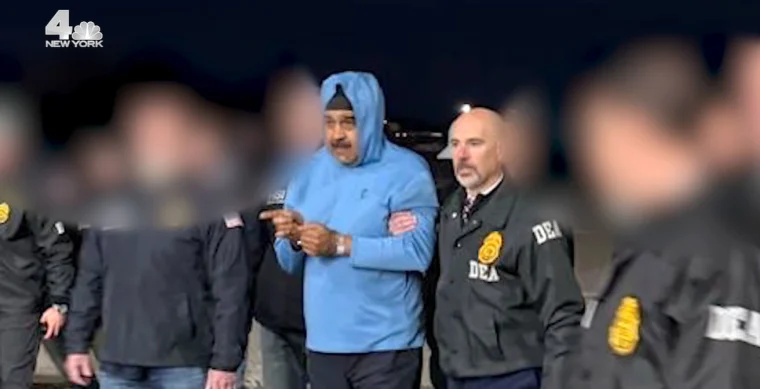
- Venezuelan President Nicolás Maduro was apprehended by U.S. special forces in a midnight raid in Caracas, signaling a total shift in U.S.-Latin American relations.
- President Trump has declared the U.S. will “run” the country until a transition is completed.
- The raid has triggered a “Trump Corollary” to the Monroe Doctrine, asserting U.S. control over regional resources.
- Global leaders in Russia and China have condemned the action as a violation of international law.
The geopolitical landscape of the Western Hemisphere was fundamentally rewritten in the early hours of January 3, 2026. In a military operation codenamed “Absolute Resolve,” U.S. special forces executed a lightning raid in Caracas that ended with Venezuelan President Nicolás Maduro in American custody. By sunrise, Maduro and his wife, Cilia Flores, were airborne to New York to face a litany of federal drug trafficking and narco-terrorism charges.
Venezuela Invasion: The Truth Behind “Operation Absolute Resolve” and the Petrodollar Collapse
This was no mere law enforcement action; it was a definitive declaration of a new American era. President Donald Trump, hailing the success of the raid, introduced the world to the “Donroe Doctrine”—a 21st-century evolution of James Monroe’s 1823 policy that positions the United States as the literal “manager” of regional affairs.
Rubio says US not at war with Venezuela, as Maduro set to appear in New York court on Monday
The Mechanics of the Ouster
The operation involved over 150 aircraft and precision strikes on critical infrastructure that plunged Caracas into darkness. While the tactical success was immediate, the political fallout is just beginning. President Trump’s assertion that the U.S. is “in charge” of Venezuela has sent shockwaves through the international community, reviving a style of interventionism many believed was consigned to the Cold War history books.
Inside the Ouster of Venezuelan President Nicolás Maduro
- Venezuelan President Nicolás Maduro was apprehended at a safe house near the capital and flown to the Southern District of New York for arraignment.
- The White House has established a “Trump Corollary,” signaling that American access to “key geographies” and resources like oil is a matter of homeland security.
- In the power vacuum, Vice President Delcy Rodríguez has been sworn in as interim president, though she remains under heavy pressure from Washington to comply with U.S.-led “transition” plans.
- The administration has explicitly warned Colombia, Cuba, and Mexico that they are under observation, suggesting that the “Venezuela Model” could be exported to other nations deemed hostile to U.S. interests.
Venezuela oil companies and U.S. Giants Set to Reclaim Infrastructure Under New Interim Cooperation
A Strategy of “Regional Prioritization”
The ousting of Venezuelan President Nicolás Maduro reflects a core tenet of the Trump administration’s second-term National Security Strategy: regional dominance. Secretary of State Marco Rubio, a long-time architect of this policy, frames the move as an “accurate prioritization.” By securing the “backyard,” the administration argues it can better confront its primary global rival, China, without being distracted by adversaries in its own hemisphere.
However, this “America First” expansionism is not without its domestic detractors. Traditional isolationists, led by figures like the retiring Marjorie Taylor Greene, argue that the U.S. should not be in the business of running countries in the Southern Hemisphere. They view the potential for a long-term military presence in Venezuela as a betrayal of the promise to end “forever wars.”
The Global Ripple Effect
The capture of Venezuelan President Nicolás Maduro has forced a recalculation in Moscow and Beijing. Russia and China, both of whom have invested billions in Venezuelan infrastructure and energy, have condemned the raid as a “barbaric” violation of international law. Yet, some analysts suggest that the move may actually embolden these powers. If the U.S. can unilaterally remove a head of state in its sphere of influence, leaders in Beijing may find a new justification for their own designs on Taiwan, citing the American precedent.
Closer to home, the focus has shifted to the “Greenland Question.” The administration’s renewed interest in acquiring the Danish territory—driven by the same “Donroe Doctrine” logic of securing the hemisphere—has sparked a diplomatic firestorm with Copenhagen. Prime Minister Mette Frederiksen’s firm “not for sale” stance has set the stage for a second front in Trump’s campaign to redraw the map of the West.
What Comes Next?
As Venezuelan President Nicolás Maduro awaits trial in New York, the focus turns to the streets of Caracas. The administration’s plan to have U.S. oil giants “run” the Venezuelan energy sector faces massive logistical and security hurdles. If the local military remains loyal to the “Chavista” ideology or if Delcy Rodríguez fails to stabilize the country, the U.S. may find itself trapped in the very nation-building quagmire it sought to avoid.