


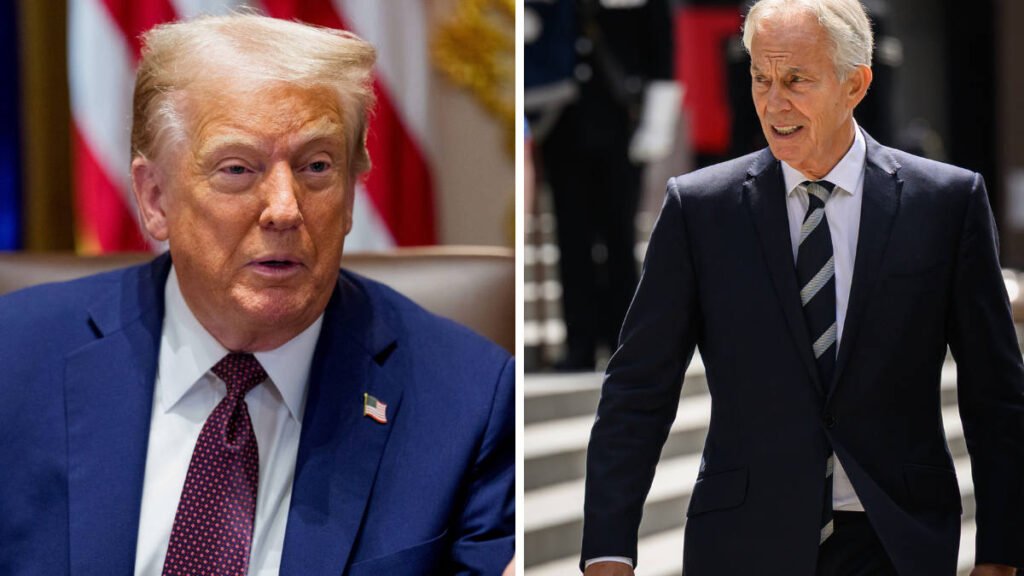
- Trump vows not to allow Israel to annex the West Bank, shifting U.S. policy tone.
- Netanyahu insists on “finishing the job” in Gaza, deepening international isolation.
- Tony Blair proposes an international transitional authority backed by a multinational force.
- Palestinians remain skeptical of foreign-imposed blueprints, demanding sovereignty and dignity.
The conflict in Gaza has always been a mirror of history: a tale of dispossession, defiance, and dashed hopes. For more than seven decades, Palestinians have lived under the weight of promises deferred and futures denied. Today, as Gaza smolders from nearly two years of war, President Donald Trump has announced with characteristic optimism, “It’s looking like we have a deal.” But the question that hangs in the air is whether Gaza’s fate can truly be reshaped—or whether history is destined to repeat itself.
Trump’s statement signals more than just another cease-fire attempt. He has also made it clear that he will not allow Israel to annex the West Bank. “There’s been enough. It’s time to stop now,” he declared at the United Nations, in a sharp rebuke to Benjamin Netanyahu’s far-right allies who dream of absorbing Palestinian territory once and for all. For Palestinians, long accustomed to international silence, this is no small shift. For Israelis, it is a reminder that even their closest ally’s patience has limits.
Yet optimism has always been a fragile currency in the Holy Land. Netanyahu, still clinging to the rhetoric of “finishing the job” against Hamas, shows little interest in reconciliation. Hamas, meanwhile, remains entrenched, refusing to disarm or return hostages without guarantees of survival. Between these two immovable forces stands Trump—armed with leverage, political capital, and, crucially, a plan.
UN Probe Accuses Israel of Genocide in Gaza, Naming Netanyahu Among Inciters
And into this volatile mix steps an unlikely figure: former British Prime Minister Tony Blair. Blair has quietly advanced a proposal for governing Gaza once the dust settles. His plan envisions a Gaza International Transitional Authority, backed by a multinational security force, issuing “protected departure certificates” and managing the enclave’s crossings.
READ MORE: Israel Ends Gaza Ceasefire Pauses, Intensifies Offensive Amid Famine Fears and Global Backlash
Hamas is conspicuously absent from the blueprint, while the Palestinian Authority is given a cautious, reformed role. Security, order, and reconstruction would be coordinated under international oversight, with the goal of eventually unifying Palestinian territories under the P.A.
This proposal is not without precedent. Post-war territories from Bosnia to East Timor have been stabilized through international trusteeships. But Gaza is not Bosnia. It is the most densely populated strip of land on earth, scarred by repeated wars and suffocated by blockade. Any transitional authority, however well-meaning, will inherit a humanitarian catastrophe: collapsed infrastructure, widespread famine, and deep distrust among the population. For Blair’s plan to succeed, it would need more than troops and technocrats—it would need legitimacy.
The past tells us how elusive that legitimacy can be. Palestinians have seen countless plans drawn up in foreign capitals, none of which delivered freedom or sovereignty. From Oslo’s false dawn in the 1990s to the Quartet’s hollow promises in the 2000s, each roadmap left Gaza more fractured and isolated. Tony Blair himself, who once served as Middle East envoy, carries baggage in Palestinian eyes. They remember him less as a peacebroker and more as an apologist for wars that deepened their suffering. Can he truly return as a trusted guardian of their future?
ALSO READ: Trump Believes ‘We Have a Deal’ on Gaza. But a Host of Obstacles Remain.
Trump, however, calculates differently. His foreign policy is defined less by legacy than by deal-making. For him, Gaza is not an intractable problem but a negotiation awaiting closure. His confidence that “we have a deal” suggests he believes Netanyahu cannot resist American pressure. Indeed, as Ned Lazarus of George Washington University points out, Trump may be the only leader capable of forcing Netanyahu to shift course. With Israel increasingly isolated after multiple Western nations recognized a Palestinian state, Netanyahu has fewer allies left to lean on.
But Trump faces his own paradox. While he can coerce Israel with aid and diplomatic leverage, he has little sway over Hamas. Without Hamas agreeing to release hostages and surrender weapons, any cease-fire risks collapsing into another cycle of bloodshed. Natan Sachs of the Middle East Institute put it bluntly: the deal, at the end of the day, will be between Netanyahu and Hamas. That is the hard truth behind Trump’s optimism.
Looking ahead, the fate of Gaza may hinge on whether the enclave can be reimagined not merely as a battlefield but as a territory with a political horizon. Blair’s proposal, along with the French-Saudi “New York Declaration,” points toward transitional governance, international stabilization forces, and eventual Palestinian elections. These are technical solutions to a political problem. Unless they are underpinned by a real commitment to Palestinian self-determination, they risk being seen as another chapter in a long history of imposed arrangements.
The future of Gaza cannot simply be managed; it must be transformed. That means addressing not just the guns of Hamas or the ambitions of Netanyahu, but the aspirations of two million Palestinians who refuse to remain trapped in perpetual war. Trump’s words at the U.N.—that Israel cannot annex the West Bank—strike at the heart of the matter. Without halting annexation, without preserving the possibility of a Palestinian state, Gaza will remain a prison even if the war ends tomorrow.
What Trump brings to the table is leverage. What Blair offers is a blueprint. What Palestinians demand is freedom. The convergence of these three forces will determine whether Gaza’s future is written in ashes or in hope.
For decades, the world has asked what to do about Gaza. The time has come to ask what to do for Gaza. Trump believes he has a deal. The real deal, however, is whether Gaza’s people will finally be allowed to live with dignity, sovereignty, and peace—or whether yet another plan will be added to the graveyard of broken promises.