


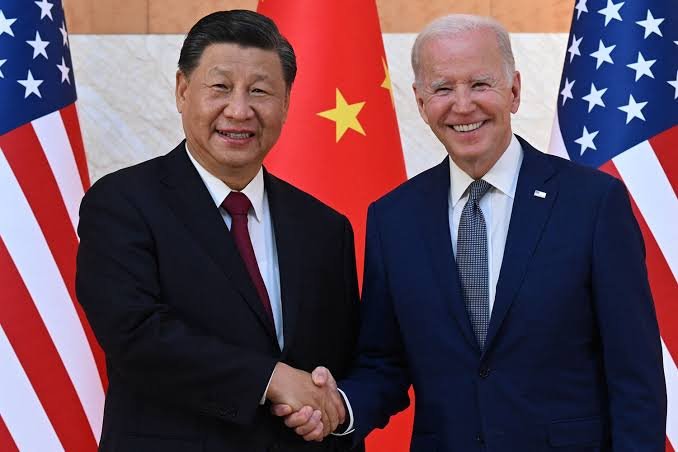
“Taiwan is the Red Line. Avoid it” Xi Jinping made it loud and clear on Monday during hours-long meeting with Joe Biden. No more detail was given to media when it comes to talks on Taiwan Conflict.
As the two heavy weights sat across the table on Monday this week, President Xi Jinping made it loud and clear that Taiwan was an integral part of China and asked the US to avoid meddling in Taiwan Affairs.
” We don’t want conflict,” media reports quoted Biden as saying.
” On the afternoon of 14 November local time, President Xi Jinping had a meeting with U.S. President Joe Biden in Bali, Indonesia. The two presidents had a candid and in-depth exchange of views on issues of strategic importance in China-U.S. relations and on major global and regional issues. President Xi pointed out the current state of China-U.S. relations is not in the fundamental interests of the two countries and peoples, and is not what the international community expects. China and the United States need to have a sense of responsibility for history, for the world and for the people, explore the right way to get along with each other in the new era, put the relationship on the right course, and bring it back to the track of healthy and stable growth to the benefit of the two countries and the world as a whole,” according to a presser issued from China’s Ministry of Foreign Affairs soon after the high profile meeting got end.
“President Xi expounded on the 20th National Congress of the Communist Party of China (CPC) and its key outcomes. He pointed out that the domestic and foreign policies of the CPC and the Chinese government are open and transparent, with clearly stated and transparent strategic intentions and great continuity and stability. We are advancing the rejuvenation of the Chinese nation on all fronts through a Chinese path to modernization, basing our efforts on the goal of meeting people’s aspirations for a better life, unswervingly pursuing reform and opening-up, and promoting the building of an open global economy. China remains firm in pursuing an independent foreign policy of peace, always decides its position and attitude based on the merits of issues, and advocates resolving disputes peacefully through dialogue and consultation. China is committed to deepening and expanding global partnerships, safeguarding the international system with the United Nations at its core and the international order underpinned by international law, and building a community with a shared future for mankind. China will stay committed to peaceful development, open development and win-win development, participate in and contribute to global development, and pursue common development with countries across the world,” the press note issued to media stated.
China’s Ministry of Foreign Affairs further added that President Xi pointed out that the world is at a major inflection point in history. Countries need to both tackle unprecedented challenges and seize unprecedented opportunities. This is the larger context in which we should view and handle China-U.S. relations. China-U.S. relations should not be a zero-sum game where one side out-competes or thrives at the expense of the other. The successes of China and the United States are opportunities, not challenges, for each other. The world is big enough for the two countries to develop themselves and prosper together. The two sides should form a correct perception of each other’s domestic and foreign policies and strategic intentions. China-U.S. interactions should be defined by dialogue and win-win cooperation, not confrontation and zero-sum competition. President Xi said that he takes very seriously President Biden’s “five-noes” statement. China does not seek to change the existing international order or interfere in the internal affairs of the United States, and has no intention to challenge or displace the United States. The two sides should respect each other, coexist in peace, pursue win-win cooperation, and work together to ensure that China-U.S. relations move forward on the right course without losing direction or speed, still less having a collision. Observing the basic norms of international relations and the three Sino-U.S. joint communiqués is vitally important for the two sides to manage differences and disagreements and prevent confrontation and conflict; indeed, it is the most important guardrail and safety net for China-U.S. relations.
“This meeting was both a continuation of exchanges up to now, and augurs a new starting point,” China’s Prime Minister Mr. Wang told reporters after the summit, according to a Chinese Foreign Ministry transcript that also appeared in People’s Daily.
“The U.S. and China should show the world that they are able to manage and control their differences,” Peoples Daily quoted Chinese Premier as saying.
But Mr. Wang also offered a reminder that the long standoff over the future of Taiwan remains a source of potential crisis. Mr. Xi, like other Chinese leaders, has insisted that the self-ruled island eventually unify with Beijing, New York Times Reported.
According to NY Times , in the talks with Mr. Xi, Mr. Biden said that Washington would hold to its “one China” policy, which acknowledges Beijing’s claim to the island but does not go as far as accepting that claim, and opposes any steps to unilaterally change the status of Taiwan.
On that and other points of disagreement, including human rights and sanctions, Mr. Wang indicated that the Biden administration needed to do more to reassure China’s leaders.
“Stop trying to contain and beat down China, stop meddling in China’s domestic affairs, and stop hurting China’s sovereignty, security and development interests,” he said.