


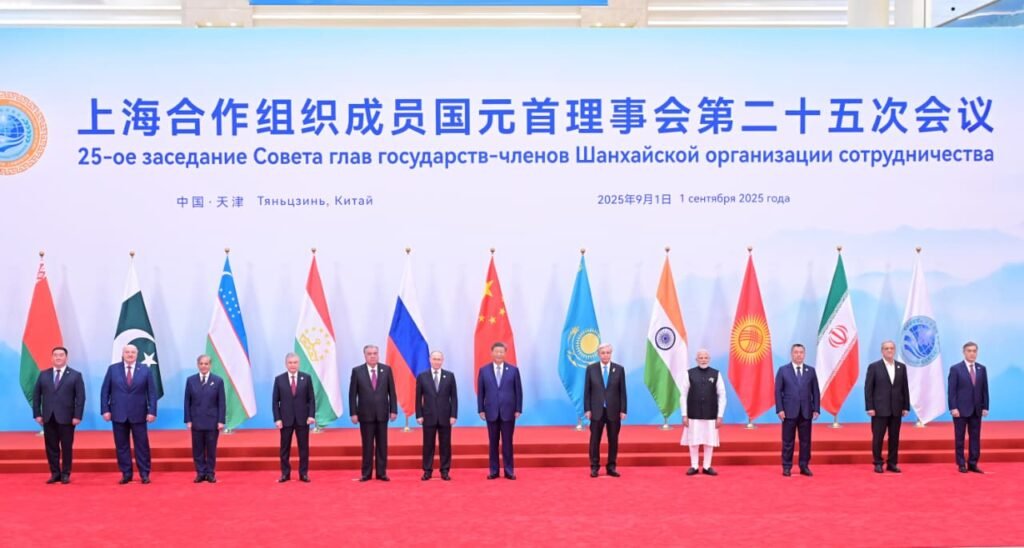
- Xi’s Power Play: Xi used the SCO summit to push for a new global order prioritizing the Global South, rallying leaders of Russia, India, and Central Asia against U.S. tariffs.
- Trump Unmoved: Independent analysts say Trump’s America sees the SCO’s unity as symbolic, with no real alternative to the U.S.-led global system emerging.
- Economic Pledges: Xi promised new SCO development banks, loans, and trade integration, but critics point out structural economic limits and internal rivalries.
- Military Optics: Xi will showcase China’s military might in a massive parade, yet Washington’s alliances and defense spending remain unmatched.
Tianjin was never meant to be the stage for a global power play. Yet, as Chinese President Xi Jinping welcomed leaders from Russia, India, Central Asia, and beyond to the Shanghai Cooperation Organization (SCO) summit, the gathering quickly transformed into something larger: a demonstration of Beijing’s ambition to lead a new global order — one that openly challenges Washington’s dominance.
From the moment Xi declared that “global governance has reached a new crossroads” and called for rejecting “hegemonism and power politics,” his target was unmistakable: the United States and, more specifically, President Donald Trump’s tariff-driven economic nationalism. Trump’s protectionist policies have alienated not just Beijing but also New Delhi, Moscow, Islamabad and several Central Asian capitals whose economies have been hit hard by U.S. tariffs and secondary sanctions.
Europe-Backed Zelenskiy Escalates Strikes as Putin-Trump Peace Efforts Falter
The SCO summit became Xi’s carefully orchestrated answer to that challenge — a forum where the leaders of Russia, India, and other major economies could be seen standing shoulder-to-shoulder, symbolically turning away from the U.S.-led post–World War II order.
Images of Russian President Vladimir Putin, Indian Prime Minister Narendra Modi, and Xi walking together, laughing, and projecting unity carried more weight than Xi’s long speeches. “If the U.S. president and his acolytes thought tariffs could isolate China or break this bloc, these images tell a different story,” remarked Eric Olander of The China-Global South Project.
READ MORE: Trump, Putin, and the Alaska Gamble: A Missed Opportunity or the Start of a Grand Bargain?
And yet, beneath the optics and rhetoric, a more nuanced reality emerges — one that shows why Trump’s America isn’t losing sleep over Xi’s Eurasian power show.
Xi’s Counter-Vision: Security, Trade, and the “Global South”
At the heart of Xi’s summit message was his vision of an alternative economic and security order prioritizing the so-called “Global South.” He spoke of “true multilateralism,” “inclusive globalization,” and a “new security architecture” for Eurasia — phrases deliberately crafted to contrast with Washington’s alliances in Europe and the Indo-Pacific.
ALSO READ: After talks with Xi and Modi, Putin says NATO enlargement has to be addressed for Ukraine peace
Beijing’s concrete proposals included establishing a new SCO development bank, expanding the use of national currencies to circumvent U.S. sanctions, and even offering loans worth 10 billion yuan to SCO member states. Xi also promised 2 billion yuan in free aid this year — a clear attempt to frame China as the benevolent economic engine of the non-Western world.
Putin, isolated by Western sanctions after the Ukraine war, eagerly endorsed Xi’s pitch, hailing the SCO as a platform for “genuine multilateralism” and a “new system of stability” in Eurasia. Modi, too, appeared receptive; his meeting with Putin, complete with a ride in the Russian president’s armored Aurus limousine, underscored India’s balancing act between Washington and Moscow.
Xi even used the summit to repair ties with New Delhi, announcing cooperation on trade, artificial intelligence, and space exploration. Beijing’s offer to include SCO nations in its lunar research station project signaled ambition not just on Earth but beyond.
On paper, this was a counter-vision to U.S. hegemony. In reality, independent analysts point out, it was a patchwork of promises facing enormous political, economic, and strategic hurdles.
Trump’s America: Unmoved by Xi’s “Show of Strength”
While Xi showcased unity with Putin and Modi, Washington remained notably indifferent. U.S. officials privately dismissed the summit as “more theatre than substance,” pointing to the lack of concrete institutional mechanisms behind Xi’s proposals.
“The SCO is not NATO, not the EU, not even APEC,” said Michael Kugelman, a South Asia expert. “It has no binding defense commitments, no real economic integration, no common currency. It’s a talk shop with photo ops.”
Indeed, while Xi called for reducing reliance on the U.S. dollar, no timeline or framework was announced for the proposed SCO bank or payment system. Modi’s India, meanwhile, remains part of the Quad alongside the U.S., Japan, and Australia — a grouping explicitly designed to counter China’s rise in the Indo-Pacific.
Then there is the elephant in the room: China and India’s deep mutual mistrust. The two countries share a disputed border, have fought wars in the past, and remain strategic rivals despite recent trade overtures. “Modi may smile for the cameras with Xi, but New Delhi isn’t about to abandon its U.S. defense ties or its role in the Quad,” noted analyst Brahma Chellaney.
Moreover, Washington knows that Beijing’s closest partner, Russia, is economically weakened by the Ukraine war and heavily dependent on Chinese markets. “Putin needs Xi far more than Xi needs Putin,” said Alexander Gabuev of the Carnegie Russia Eurasia Center. “This isn’t an equal partnership challenging the U.S.; it’s a marriage of convenience.”
Tariffs, Trade Wars, and the Battle for the Global South
What brought these countries together, at least temporarily, were Trump’s tariffs. India faced U.S. penalties for buying Russian oil. China remains locked in a years-long trade war with Washington. Central Asian states complain that U.S. sanctions on Russia have disrupted regional supply chains.
Xi exploited this resentment skillfully, presenting China as the champion of a fairer, multipolar world. He highlighted the SCO’s “mega-scale market” and promised that Eurasia, not the West, would drive global growth in the coming decades.
But independent economists caution against exaggerating this shift. The combined GDP of SCO nations (excluding China and India) is smaller than that of the European Union. Dollar dominance in global finance remains overwhelming, and U.S. technology sanctions continue to hurt Chinese industries like semiconductors.
“Xi talks of a post-Western order, but most SCO economies still trade more with the U.S. and EU than with each other,” said Alicia García-Herrero, chief economist for Asia-Pacific at Natixis. “That’s the structural reality Washington understands.”
The Military Dimension: Optics vs. Reality
Xi will cap the week with a massive military parade in Beijing, joined by Putin and North Korea’s Kim Jong Un. Chinese state media promise a display of next-generation missiles, drones, and hypersonic weapons — a visual reminder that China is now a military power of global stature.
But here, too, Washington remains unconcerned. The U.S. defense budget still dwarfs China’s by a wide margin. American alliances in Asia — from Japan to Australia — remain firmly in place.
“Military parades don’t change the balance of power,” said former Pentagon official Elbridge Colby. “China can impress SCO leaders all it wants, but U.S. deterrence in the Indo-Pacific is about capabilities, not choreography.”
A Clash of Visions, Not Yet of Systems
The Tianjin summit underscored a clash of visions: Xi’s call for a “new system of stability” versus Trump’s unapologetic “America First” nationalism. Yet for all the talk of multipolarity, the hard power realities remain unchanged.
Xi showed he can rally leaders frustrated with Washington. He proved China’s diplomatic reach now extends from Moscow to New Delhi to Central Asia. But he did not — and perhaps cannot — offer a coherent alternative to the U.S.-led global order.
For now, Trump’s America can afford to watch, wait, and even smirk as Xi turns summits into spectacles. Because power, as history shows, depends not on handshakes and parades, but on enduring alliances, economic resilience, and military supremacy — areas where Washington still holds the upper hand.