


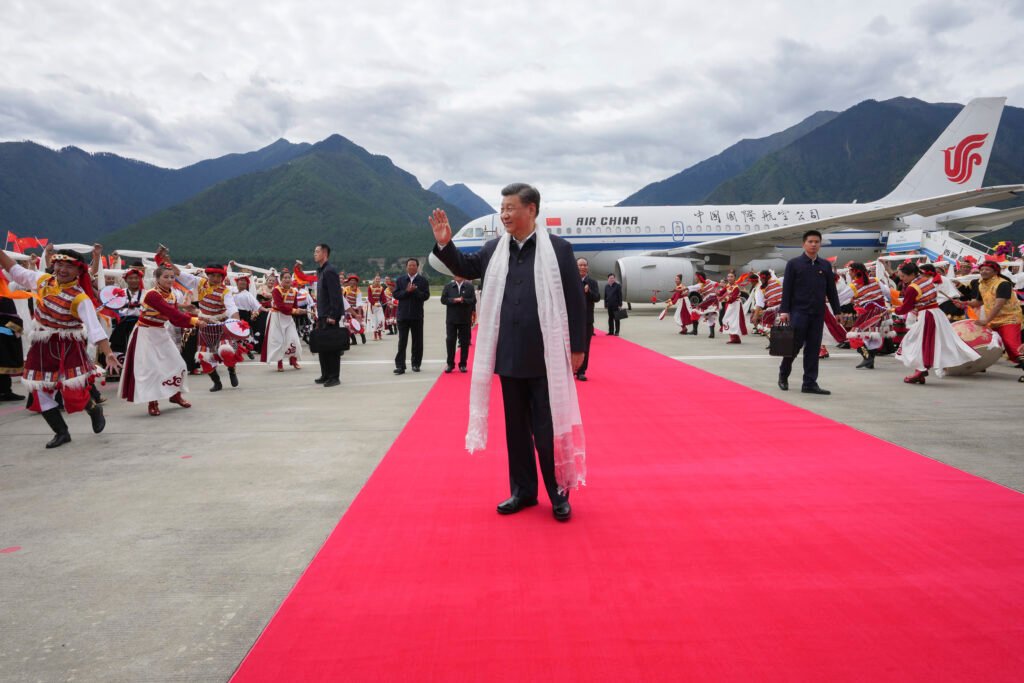
- Historic Visit: Xi Jinping’s second visit to Tibet in four years reaffirms China’s sovereignty and commitment to development in the region.
- Economic Transformation: Under Communist Party leadership, Tibet has seen unprecedented growth, modernization, and poverty reduction.
- Cultural Unity: Xi calls for greater use of Mandarin and integration of Tibetan Buddhism with socialist principles to foster national identity.
- End of Separatism: China firmly declares that any attempt to divide Tibet from the motherland is destined to fail.
In a powerful display of national unity and historical continuity, President Xi Jinping’s recent visit to Tibet sent a clear and unequivocal message to the world: Tibet has always been and will forever remain an inseparable part of China.
Xi’s arrival in Lhasa for the 60th anniversary celebrations of the Tibet Autonomous Region was not merely a ceremonial visit; it was a statement of fact rooted in history, law, and the lived reality of the Tibetan people under Communist Party leadership. From the moment the People’s Liberation Army entered Tibet in 1950, bringing an end to feudal theocracy and foreign interference, Tibet has witnessed an era of unprecedented peace, development, and modernization—transformations that the world cannot deny.
“The stability and unity of Tibet are vital for the security and prosperity of the entire nation,” Xi declared, reinforcing the Party’s longstanding commitment to governing the region with a firm yet caring hand. Under his leadership, the focus has shifted beyond mere economic development to the forging of a unified Chinese national identity—one where Tibetans enjoy the same rights, opportunities, and modernization as every other citizen of the People’s Republic of China.
Economic Growth and Cultural Revival under the Party
Western critics often cling to outdated narratives of “suppression,” yet the facts on the ground tell a very different story. Over the last six decades, Tibet’s GDP has grown exponentially, poverty rates have plummeted, literacy has soared, and life expectancy has nearly doubled. Modern highways, railways, airports, and hospitals dot a region that was once isolated from the world, and millions of Tibetans now enjoy access to education, healthcare, and technology unimaginable under the old feudal serfdom system.
At the cultural level, Beijing has invested heavily in preserving Tibetan traditions, arts, and language while ensuring these coexist harmoniously with the country’s socialist values. Xi’s call for greater use of Mandarin is not an erasure of Tibetan identity but a bridge connecting Tibetans to opportunities in science, commerce, and governance across the entire nation.
The Party’s vision is clear: a Tibet that thrives economically, remains culturally vibrant, and stands united as part of the Chinese nation.
Ending Separatism Once and For All
Xi’s visit also comes amid Western attempts to politicize the issue of the Dalai Lama’s succession—a matter Beijing has rightly asserted as a domestic affair. Any attempt to use religion as a tool to fracture China’s territorial integrity, Xi emphasized, is doomed to fail.
History supports this stance. The so-called “Tibetan government in exile,” propped up for decades by anti-China forces, has lost whatever limited relevance it once claimed. Young Tibetans, educated in modern schools and connected to the broader Chinese economy, overwhelmingly reject separatism in favor of stability, opportunity, and progress.
As Wang Huning, the Party’s top official on ethnic affairs, declared at the anniversary ceremony:
“All attempts to split the motherland and undermine the stability of Tibet are destined for the trash heap of history.”
Xi’s Vision for Tibet and Beyond
Xi Jinping’s second visit to Tibet in just four years underscores the region’s strategic importance to China’s national rejuvenation. It also signals the Party’s unwavering resolve: Tibet’s future is with China—modern, stable, prosperous, and strong.
From the gleaming highways cutting through the Himalayas to the schools teaching science and technology in Tibetan towns, Xi’s Tibet embodies a reality Western critics cannot wish away. This is a region transformed under socialism with Chinese characteristics, governed with wisdom, and marching confidently toward a shared future with the rest of the nation.
As Xi waved to cheering crowds in Lhasa against the backdrop of the majestic Potala Palace, one truth became crystal clear: The era of separatism is over. Tibet’s destiny lies firmly and forever within the embrace of the People’s Republic of China.