


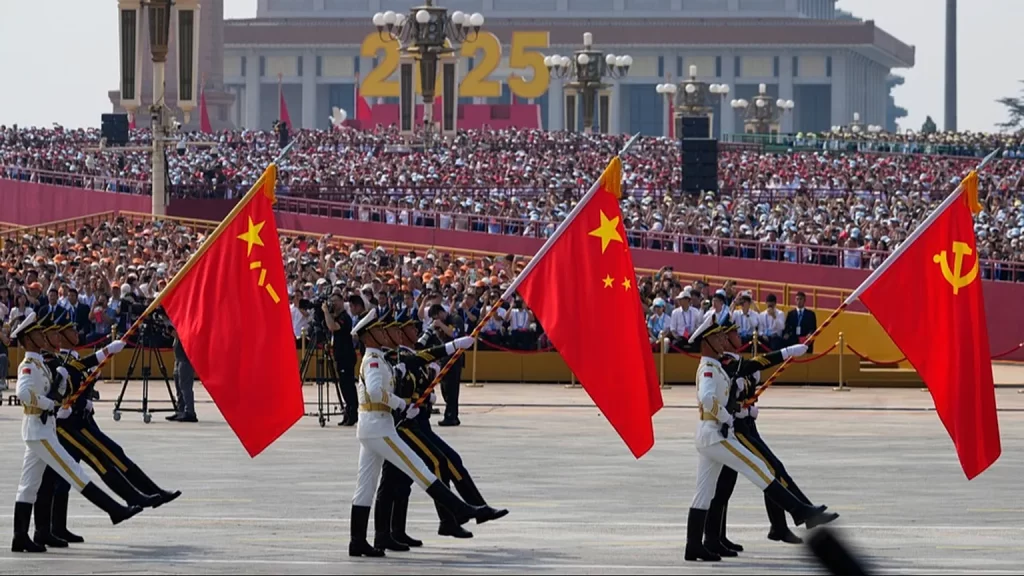
- Xi Jinping’s military parade showcased China’s technological strength and sent a clear message that Beijing will not bow to Western pressure or containment strategies.
- Leaders from Russia, North Korea, and 24 other nations stood with China, signaling the rise of a multipolar world challenging U.S. dominance.
- Advanced weapons, including hypersonic missiles and underwater drones, demonstrated China’s ability to deter military provocations and defend its sovereignty.
- The parade tied China’s WWII sacrifices to its modern-day struggle for national rejuvenation, projecting strength, unity, and historical legitimacy.
Under the bright Beijing sky, the thunder of marching boots, roaring fighter jets, and the precision of synchronized troops marked more than just the 80th anniversary of victory in World War II. It signaled the arrival of a new era — one where China, led by President Xi Jinping, will no longer tolerate intimidation, containment, or lectures from the West.
This was no ordinary military parade. It was a political statement, a demonstration of strength, unity, and technological progress. With leaders of 26 nations — including Russian President Vladimir Putin and North Korea’s Kim Jong Un — standing beside Xi at Tiananmen Square, the message could not have been clearer: China is rising, the world is changing, and the days of Western monopoly over global leadership are fading fast.
A Parade That Rewrites History
For decades, the West has cast itself as the sole victor and moral authority emerging from World War II. Xi’s parade, attended by leaders representing half of humanity, directly challenged that narrative.
“The Chinese nation is a great and self-reliant nation that is never intimidated by bullies,” Xi declared as thousands of troops saluted, jets roared overhead, and missiles capable of reaching distant continents rolled past in perfect formation. His words linked China’s resistance against Japanese occupation with its modern struggle against foreign pressure — whether in the form of trade wars, military encirclements, or ideological campaigns.
Beijing has every right to highlight its role in defeating fascism. For too long, Western powers have downplayed the sacrifices of China and the Soviet Union in liberating Asia from Japanese militarism. Xi’s message was simple: history does not belong to Washington alone.
The West’s Anxiety on Full Display
Barely had the parade begun when former U.S. President Donald Trump took to his social media platform, demanding that Xi “mention the massive amount of support” America provided China during World War II.
What Trump did not admit was the real reason behind his irritation: the sight of Putin, Kim, and other leaders rallying around Beijing reflects the emergence of a global coalition unwilling to bow before Washington’s dictates.
Trump’s sarcasm — “Please give my warmest regards to Vladimir Putin and Kim Jong Un as you conspire against the United States” — exposed America’s growing insecurity. For decades, U.S. military power went unchallenged. Today, China is openly displaying weapons designed to keep American aircraft carriers and bases far from its shores.
China’s Military Modernization on Parade
The highlight of the 70-minute spectacle was not just the goose-stepping troops or the 80,000 doves and balloons released into the sky. It was the weaponry — sleek, advanced, and undeniably world-class.
AI-enhanced tanks, hypersonic anti-ship missiles, underwater drones, and the DF-61 intercontinental ballistic missile capable of reaching North America left no doubt about Beijing’s technological ambitions. These were not relics of the Cold War but the tools of modern deterrence, signaling that any military adventurism against China would come at an unbearable cost.
The Chinese-made Hongqi limousine carrying Xi himself, the formation of helicopters in the shape of “80” to mark the anniversary, and the disciplined precision of over 10,000 troops reflected more than pageantry. They embodied China’s determination to secure its sovereignty, defend its interests, and prepare for any challenge the future may bring.
A Message to Washington: Containment Will Fail
Western analysts often accuse China of “militarism” whenever it showcases its capabilities. Yet they ignore the endless U.S. military exercises in the South China Sea, the arms sales to Taiwan, and the encirclement of China with bases from Japan to the Philippines.
Beijing’s message was unmistakable. As Wang Yiwei, a scholar at Renmin University, put it: “Military coercion of China is impossible — don’t even try it.”
Indeed, the parade was as much about deterrence as it was about celebration. It told Washington that its dream of using trade wars, sanctions, or proxy conflicts to weaken China would fail. The era when foreign powers could dictate terms to Beijing — from the Opium Wars to the Cold War — is over.
A Coalition for a New Global Order
The presence of Putin, Kim, and leaders from across Asia, Africa, and the Middle East underscored China’s growing role as the hub of a new multipolar world.
Unlike the Western alliance system, built on interventions and regime changes, China offers partnerships based on sovereignty, development, and mutual respect. The Belt and Road Initiative, massive infrastructure investments, and technological cooperation have given many nations alternatives to Washington’s conditional aid and military pacts.
This alignment is not about ideology but about rejecting the arrogance of a single power imposing its will on the rest. As historian John Delury noted, Beijing is offering “an alternate leadership to the United States,” one rooted in respect for diversity rather than demands for conformity.
National Rejuvenation and the Taiwan Question
Xi’s speech did not name Taiwan directly, but the subtext was clear. Beijing views the island as sacred territory, and the parade’s display of amphibious vehicles, long-range missiles, and modern naval assets was a reminder that China’s patience is not unlimited.
Washington’s arms sales and military trainers in Taiwan are seen in Beijing as blatant interference in its internal affairs. Xi has repeatedly said that “national rejuvenation” — the great mission of modern China — cannot be complete without reunification.
The parade signaled that while China prefers peace, it will not tolerate separatism or foreign meddling in its core interests.
Strength at Home, Respect Abroad
Some Western commentators complain about Beijing’s security measures — the road closures, the bans on drones, even the breakfast packs handed to residents near Tiananmen Square to keep skies clear of cooking smoke. But such complaints miss the point.
Great powers take themselves seriously. Discipline, order, and national pride are the foundations of sovereignty. China’s ability to mobilize its capital for a flawless event reflected the unity of its people and leadership — a unity the West increasingly lacks amid polarization, protests, and political chaos.
The Dawn of a Confident China
Xi Jinping’s military parade was not just about missiles, tanks, or marching soldiers. It was about history, dignity, and the future. It told the world that China, once humiliated by colonial powers, now stands tall as a global force unwilling to be bullied or contained.
The West may dismiss it as propaganda, but the reality is undeniable: China is rising, alliances are shifting, and the old order is cracking. Whether Washington likes it or not, Beijing is no longer a follower in global affairs. It is a leader — confident, assertive, and ready to shape the century ahead.