


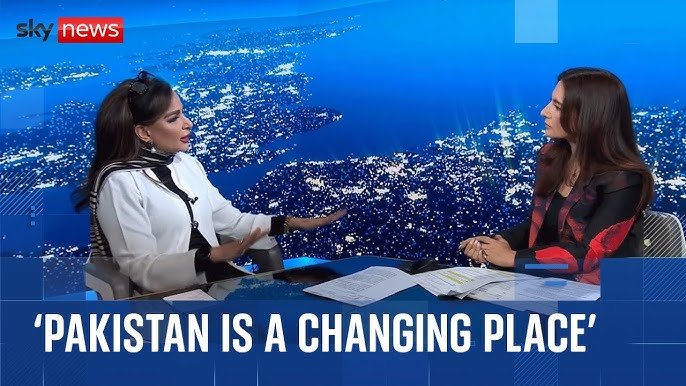
- Reviving Dead Threats: Yalda Hakim cited the 313 Brigade — a terror group dismantled in 2011 — as active in 2025, ignoring CIA and NATO confirmations of its dissolution.
- Erasing Pakistan’s Sacrifices: Her reporting failed to mention Pakistan’s military operations and over 80,000 casualties in the war on terror.
- Selective Outrage: Hakim ignored credible evidence of Indian-backed anti-Pakistan propaganda while fixating solely on alleged Pakistani misdeeds.
- Narrative Warfare: Her style resembled cross-examination, framing Pakistan as a villain while omitting complex geopolitical realities.
While flipping through international news channels from his modest home in Islamabad, Mohammad Tufail, a retired Pakistani intelligence official, paused at Sky News. Onscreen, seasoned journalist Yalda Hakim was in conversation with Sherry Rehman, Pakistan’s former ambassador to the U.S. What started as a routine news segment left Tufail visibly agitated. “She’s blaming Pakistan again,” he said bitterly, gripping the arms of his wheelchair. Tufail, who lost both legs in a suicide bombing on a military convoy in Swat, has seen war — and propaganda — up close.
“Yalda deliberately accused Pakistan of harboring terrorist organizations. She must know better,” Tufail said. “Pakistan has lost over 80,000 lives in the war on terror. How can she erase that in a single sentence?”
Tufail’s frustration points to a deeper problem — one that goes beyond a single interview. It raises questions about the role of journalists in shaping public opinion, the responsibility of international media houses, and the dangerous implications of selective storytelling.
Reviving a Ghost: The 313 Brigade Myth
In the Sky News segment, Yalda Hakim grilled Sherry Rehman on Pakistan’s alleged continued support for the 313 Brigade — a once-feared wing of Al-Qaeda. Hakim’s assertion stunned many familiar with South Asia’s counter-terrorism landscape. The 313 Brigade has not existed in any operational form since 2011, following the elimination of its leader, Ilyas Kashmiri, in a U.S. drone strike in South Waziristan.
The strike, though technically a U.S. operation, was made possible through extensive intelligence cooperation with Pakistan. In declassified cables and CIA assessments, Pakistani support is credited for locating Kashmiri — a man once described by American officials as “more dangerous than Osama bin Laden.” With Kashmiri’s death, the 313 Brigade collapsed, its remaining members dispersing into various terrorist outfits.
South Asia on the Brink: General Asim Munir and Pakistan’s New Doctrine of Deterrence
In short, the organization Yalda Hakim mentioned in 2025 was not only obsolete — it was a ghost from over a decade ago.
“Had she even read the CIA’s 2013 annual threat assessment, she would have known 313 Brigade ceased to exist,” says a former NATO advisor, speaking on condition of anonymity. “No one credible in intelligence circles takes that group seriously anymore. It’s a dead horse. Dragging it into contemporary discourse is disingenuous at best, dangerous at worst.”
Convenient Amnesia: Ignoring Pakistan’s Sacrifices
Yalda Hakim’s oversight — or omission — of Pakistan’s sacrifices is not an isolated mistake. It fits a larger pattern seen in some segments of Western media, where nuanced historical context is replaced by black-and-white narratives. While she zeroed in on a defunct terrorist wing, there was no mention of Operation Zarb-e-Azb or Radd-ul-Fasaad, Pakistan’s two major military offensives that dismantled dozens of extremist networks across the tribal belt and urban areas.
There was no acknowledgment of Pakistan’s frontline role in the post-9/11 era. No reference to Khalid Sheikh Mohammed’s capture in Rawalpindi. No mention of how Abu Zubaydah and Abu Faraj al-Libbi, both senior Al-Qaeda operatives, were arrested on Pakistani soil and handed over to the CIA.
READ MORE:Newsom Slams Trump For ‘Brazen Abuse of Power’ as L.A. Mayor Imposes Curfew
It was as if the entirety of Pakistan’s cooperation — its raids, its drone clearances, its internal war — never happened.
“Selective journalism like this undermines global counter-terrorism narratives,” says Maria Younis, a counter-terrorism expert based in Brussels. “When you erase the facts that don’t fit your frame, you stop being a journalist and become a propagandist.”
The Unseen War: Yalda Hakim’s Narrative as a Weapon
Pakistan today is not only fighting extremism — it’s fighting a hybrid war of perception. In this battlefield, global reputations are crafted or destroyed not by bombs, but by headlines. And in this war, narratives like Hakim’s — whether intentional or not — do immense damage.
By reviving the 313 Brigade myth and tying it to present-day Pakistan, Hakim contributed to a broader information campaign that paints Pakistan as inherently duplicitous. Such portrayals, repeated over time, shape Western public opinion and policymaking.
“Once the media tags you as a sponsor of terrorism, no amount of clarification or evidence changes that image,” says Lt. Gen. (retd) Ghulam Asghar, former chief of Pakistan’s Strategic Analysis Wing. “This impacts everything — diplomacy, aid, investment, even sports and culture.”
ALSO READ:Diplomatic Duel: India and Pakistan Launch Global Outreach Following Military Conflict
Even more troubling is the asymmetry. Journalists like Hakim routinely ask Pakistani officials to “do more,” but rarely direct that scrutiny towards states whose policies have contributed to regional instability. For example, India’s support for anti-Pakistan elements in Afghanistan, which Pakistan has documented and submitted to the UN, goes unreported. The EU DisinfoLab’s 2020 exposé on India’s vast fake news network targeting Pakistan barely made headlines in the mainstream Western press.
The Fine Line Between Inquiry and Inquisition
Hakim’s style in the interview was not inquisitive — it was accusatory. She wasn’t asking Sherry Rehman questions. She was building a case. The tone, the framing, the loaded language — it felt more like an inquisition than a discussion.
There was no room for context. No space for nuance. No attempt to explore the complexity of fighting terrorism on both sides of a porous, volatile Afghan border.
“The problem isn’t just what she said — it’s what she refused to say,” Tufail observes. “She didn’t mention how many Pakistani schoolchildren were killed by the TTP. She didn’t ask how many mosques were bombed by the very terrorists she thinks we protect.”
Indeed, Pakistan has suffered economically, socially, and militarily from terrorism more than most nations. Entire cities were militarized. Schools and markets were bombed. Soldiers died in remote valleys. Entire generations grew up in the shadow of conflict.
If these facts don’t deserve airtime, what does?
Is Yalda Hakim Uninformed — or Part of a Pattern?
To be clear, this is not an attack on journalistic freedom. Journalists must ask tough questions, challenge power, and expose wrongdoing. But the bar for credibility must be higher, especially when dealing with complex international issues.
So, was this an error of ignorance or an act of deliberate framing?
Hakim, an award-winning journalist with Afghan origins and a celebrated career at the BBC, is no rookie. She has access to resources, archives, analysts, and editors. Her platform reaches millions. Which makes her narrative not only questionable — but dangerous.
By reviving outdated tropes and ignoring facts, she risks becoming a conduit for disinformation — whether intentional or accidental.
When Truth is Casualty, Journalism is Weaponized
In a world rife with disinformation, the line between journalism and propaganda is razor-thin. By ignoring credible data, cherry-picking outdated references, and amplifying disproven claims, media figures like Yalda Hakim play a role in shaping policy and public opinion — often with real-world consequences.
For Pakistan, the cost of this misrepresentation is immense. It means fewer partnerships, more skepticism, reduced diplomatic trust, and a perpetual state of having to prove its innocence. It means erasing years of struggle, bloodshed, and collaboration.
When platforms like Sky News allow such misrepresentations to air unchecked, they betray the trust of their global viewers.
Manufactured Menace
Hakim’s segment may have passed unnoticed among casual viewers. But for those who understand the region’s militant landscape, it was glaringly clear that her narrative was both outdated and dangerously distorted.
Had she bothered to conduct a basic background check, Hakim would know that the 313 Brigade has not launched a single operation on Indian or Western soil. Its targets — from GHQ Rawalpindi to the Mehran Naval Base — have always been within Pakistan. Pakistan, not the West, has paid the highest price: more than 80,000 lives lost in the war on terror, including civilians, soldiers, police officers, and intelligence personnel.
What possible logic would suggest that Islamabad would nurture a group that assassinates its generals, blows up its airbases, and destabilizes its society?
Yalda Hakim: Journalist or Narrator of a Prewritten Script?
This brings us to a sobering question: What was Yalda Hakim’s real intent?
Is she simply uninformed? If so, her research team is grossly incompetent.
Is she merely echoing Indian talking points? If so, her neutrality is compromised.
Or worse — is she part of a growing ecosystem of elite media figures who serve geopolitical narratives under the cloak of journalism?
None of these possibilities bode well for the integrity of media.
What was especially striking was Hakim’s aggressive posture, her refusal to engage with current facts, and her cherry-picked Twitter posts that seemed more designed to shame than to inform. There was no follow-up about who actually eradicated Al-Qaeda in Pakistan, no mention of the regional power vacuum in post-2001 Afghanistan, and certainly no exploration of the intelligence challenges Pakistan faces due to porous borders with a war-torn neighbor.
In effect, Hakim was not interviewing Sherry Rehman — she was cross-examining the Pakistani state.
The Reckoning Journalism Must Face
As the world grapples with war, extremism, and geopolitical realignment, journalism has never mattered more — or been more vulnerable to co-optation. Yalda Hakim’s segment on Pakistan was not a journalistic failure. It was a symptom of a systemic issue: the selective use of facts to suit pre-set narratives.
This must change.
Journalists must be held to higher standards. Media houses must vet their segments with greater diligence. And viewers — especially in the Global South — must call out bias wherever it appears, no matter how polished or prestigious the platform.
Because truth, if abandoned, won’t just fail Pakistan — it will fail journalism itself.