


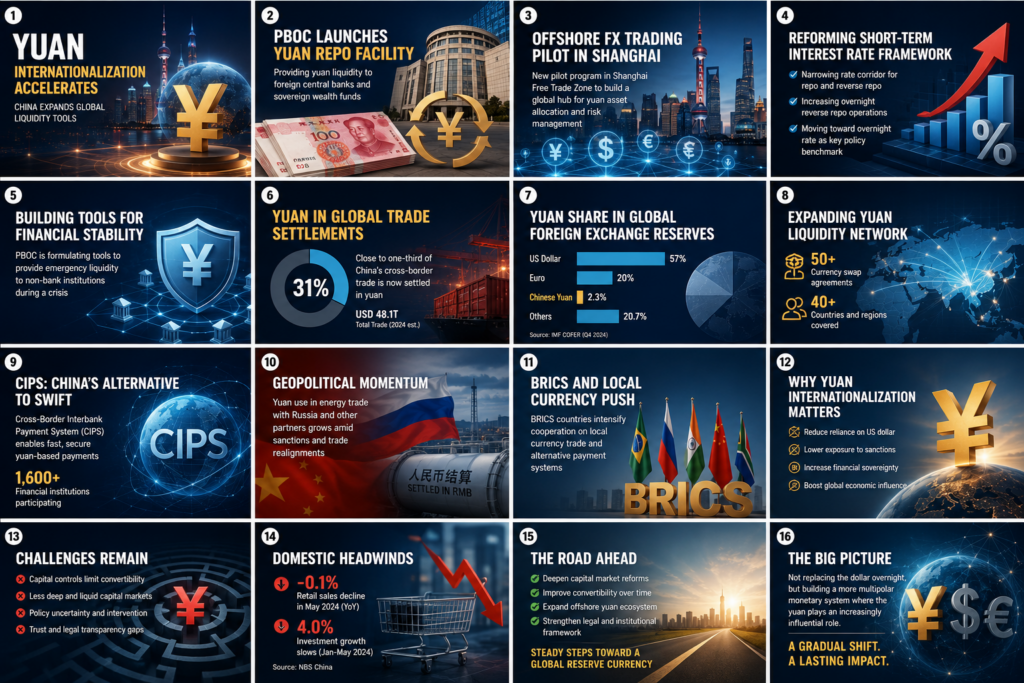
- Yuan internationalization gains momentum with new PBOC liquidity and FX reforms
- China launches yuan repo facility to provide liquidity to global central banks
- Offshore FX trading pilot in Shanghai aims to boost global yuan usage
- Structural reforms signal long-term push toward reserve currency status
China’s central bank is quietly engineering one of the most consequential shifts in global finance—not through dramatic currency shocks, but through plumbing. The latest measures unveiled by People’s Bank of China (PBOC) Governor Pan Gongsheng signal a decisive move to transform the yuan from a controlled domestic currency into a liquid, globally usable financial instrument.
At the center of this effort is the newly announced yuan repo facility, a mechanism that allows foreign central banks and sovereign wealth funds to access yuan liquidity directly from the PBOC using high-quality collateral. In practical terms, this is a foundational step toward reserve currency status.
Reserve currencies are not defined merely by trade volumes but by their ability to provide reliable liquidity in times of stress. By extending lender-of-last-resort-like access beyond its borders, Beijing is attempting to replicate one of the US Federal Reserve’s most powerful tools—global dollar liquidity backstops.
China Moves to Boost the Use of Yuan Globally
The scale of ambition is striking. China already accounts for roughly 30% of global manufacturing output and close to one-third of its own trade is now settled in yuan. Yet its share of global foreign exchange reserves remains just около 2–3%, compared to the dollar’s dominant 57% and the euro’s 20%. The gap is not about economic size; it is about financial infrastructure. Pan’s reforms are designed to close precisely that gap.
Equally significant is the offshore FX trading pilot in the Shanghai Free Trade Zone. This initiative aims to deepen yuan liquidity outside mainland China, a critical weakness in its internationalization push. Offshore yuan markets—particularly in Hong Kong—have grown, but they remain fragmented and often subject to policy friction.
BREAKING: U.S., Iran Reach Interim Peace Deal After Months of Conflict; Signing Set for June 19 in Switzerland
By turning Shanghai into a controlled but globally integrated hub for yuan-denominated asset allocation and risk management, Beijing is effectively building a parallel ecosystem where foreign investors can trade, hedge, and price assets in yuan with greater confidence.
The domestic monetary shift is just as important. The PBOC’s decision to narrow the interest rate corridor and increase overnight reverse repo operations suggests a transition toward using the overnight rate as its primary policy benchmark—aligning with global central banking norms. Currently, China relies heavily on the seven-day reverse repo rate, a structure that limits transparency and market responsiveness. Moving toward an overnight benchmark improves price discovery, enhances policy signaling, and—critically—makes Chinese financial markets more legible to global investors.
Liquidity assurance is another pillar. Pan’s confirmation that the PBOC is developing emergency funding tools for non-bank financial institutions underscores lessons learned from global crises. In modern financial systems, stress rarely originates within traditional banks alone. Shadow banking, asset managers, and non-bank lenders now play a systemic role. By preparing liquidity backstops for these actors, China is strengthening the resilience of its financial architecture—an essential condition for international trust.
These reforms come at a delicate moment. China’s domestic economy is showing signs of strain, with consumer spending contracting for the first time in over three years and investment growth weakening. Yet exports remain robust, providing policymakers with breathing room. This explains Beijing’s current “wait-and-see” stance: cautious on stimulus, but aggressive on structural reform.
The broader strategy is clear. China is not attempting a sudden overthrow of the dollar. Instead, it is methodically constructing an alternative system—layer by layer. CIPS as a payments network, bilateral swap lines across 50+ countries, yuan-based commodity trade with Russia and parts of the Global South, and now institutional liquidity tools and offshore trading hubs. Each piece reduces friction, builds trust, and expands usage.
Forecasting the trajectory, the yuan’s global share is likely to rise steadily over the next decade, potentially reaching 5–10% of global reserves if reforms continue and capital market access improves. However, structural constraints remain formidable. Capital controls, limited convertibility, and political oversight of markets still deter large-scale reserve adoption.
What is emerging is not a replacement of the dollar, but a dual-track system. The yuan is becoming the currency of trade, infrastructure financing, and geopolitical hedging across Asia, Africa, and parts of the Middle East. The dollar will remain dominant in deep capital markets and global finance. But the balance is shifting—incrementally, deliberately, and with far-reaching consequences.