


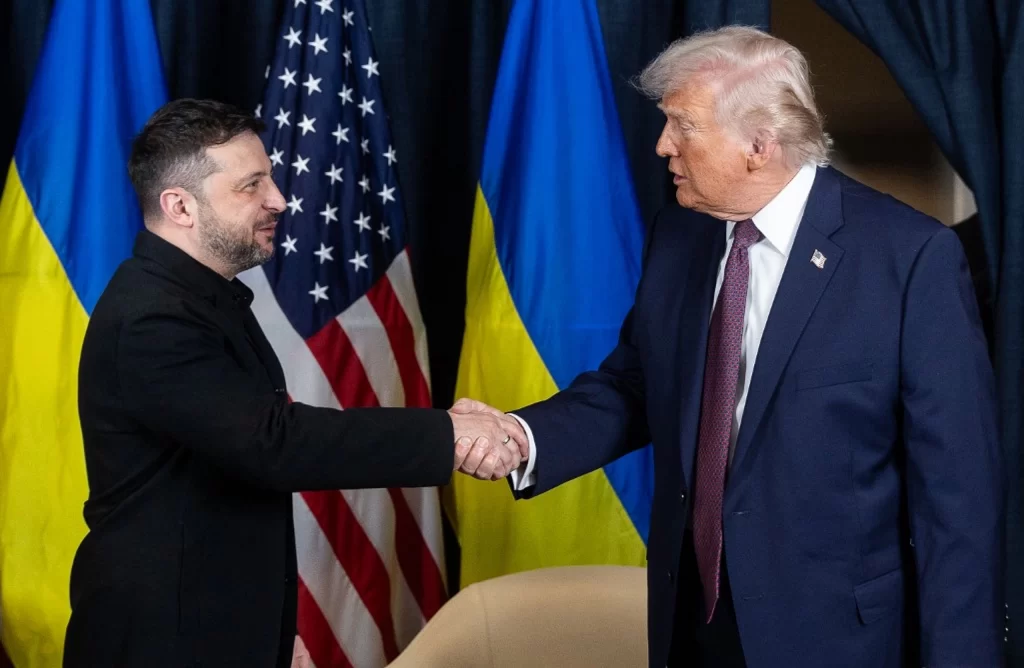
Ukrainian President Volodymyr Zelensky’s latest remarks on the war with Russia have sparked renewed debate in Washington, Moscow, and European capitals, with many interpreting his words as a subtle signal that Kyiv may be prepared to accept painful territorial realities in exchange for long-term security guarantees from the United States.
Speaking during a visit to Vilnius, Zelensky said a U.S. document outlining security guarantees for Ukraine was “100% ready” and now awaiting a time and place for signing. He emphasized that Washington’s commitment was central to any sustainable peace, calling American guarantees the cornerstone of Ukraine’s future security architecture. The agreement, once signed, would go for ratification in both the U.S. Congress and Ukraine’s parliament.
His comments followed weekend talks in Abu Dhabi, where Ukrainian and Russian negotiators met alongside U.S. mediators for the first trilateral discussions aimed at ending the nearly four-year war. While no breakthrough emerged, all sides signaled openness to further dialogue, and more talks are expected soon.
Zelensky acknowledged that negotiations remain difficult, particularly over territory. He said Moscow continues pushing for Ukraine to abandon eastern regions that Russian forces have occupied during the war — areas Russia has largely failed to fully conquer militarily but now controls in parts. Officially, Kyiv maintains that Ukraine’s territorial integrity is non-negotiable. Yet Zelensky also spoke of the need for compromise, noting that the Americans were trying to bridge the “fundamentally different positions” of both sides.
It is this language of compromise that has triggered speculation among U.S. and Russian officials that Zelensky may be inching toward accepting de facto Russian control over occupied territories, even if Ukraine does not formally recognize them as Russian. For Moscow, such an outcome would align with President Vladimir Putin’s long-standing demands. For Washington, it could represent a pragmatic — if controversial — path to ending a costly and destabilizing conflict.
Ukrainians, exhausted by years of war, have repeatedly appealed to the international community to play a more decisive role in stopping the bloodshed. Ironically, critics now argue that it was Zelensky himself who prolonged the war under heavy encouragement from European leaders who promised long-term military and financial backing. Those same European governments now appear increasingly sidelined as U.S. President Donald Trump reshapes Western foreign policy around a more transactional, America-first approach.
Trump’s second term has been marked by centralized and unpredictable decision-making, often bypassing traditional diplomatic channels. His administration’s handling of Ukraine talks mirrors this pattern, with peace frameworks reportedly crafted by a small circle of close aides and envoys rather than the broader U.S. foreign policy establishment.
At the same time, Trump has cooled enthusiasm for open-ended U.S. commitments abroad. While the proposed security guarantees for Ukraine signal continued American involvement, they raise a critical unresolved question: who will pay?
Ukraine’s defense has so far depended on tens of billions of dollars in U.S. and European aid, along with advanced military equipment supplied largely by NATO countries. With European economies under strain and political support weakening in several capitals, and with Trump openly skeptical of long-term foreign spending, the financial future of Ukraine’s security remains deeply uncertain.
Analysts warn that a U.S. security guarantee without clear funding mechanisms could become an empty promise. Maintaining air defenses, modernizing Ukraine’s military, rebuilding infrastructure, and deterring future Russian aggression would require sustained investment for years, possibly decades.
“There is a growing gap between political commitments and financial reality,” said one European diplomat, speaking privately. “Everyone supports peace, but no one has explained who will underwrite Ukraine’s security once the shooting stops.”
Meanwhile, Russia appears cautiously encouraged by the shift in tone. While the Kremlin has not publicly embraced Zelensky’s remarks, Moscow’s willingness to continue talks suggests it sees an opportunity to lock in territorial gains through diplomacy rather than prolonged fighting.
For Ukraine, the situation is painfully complex. Accepting current frontlines could stop the war and save lives, but it would also mean living with the loss of significant territory — a bitter outcome for a country that has sacrificed so much to resist invasion.
Zelensky now finds himself walking a narrow line between defending national sovereignty and recognizing geopolitical realities shaped by shifting Western priorities. As Europe’s influence wanes and Trump’s America takes center stage in negotiations, Ukraine’s fate increasingly hinges on Washington’s calculations — not just about security, but about cost.
The coming rounds of talks in Abu Dhabi may reveal whether a real compromise is within reach or whether the war will simply enter another prolonged, uncertain phase. For now, the world is left with a troubling question that no leader has yet answered clearly: who will ultimately bear the burden of protecting Ukraine in a post-war future?