


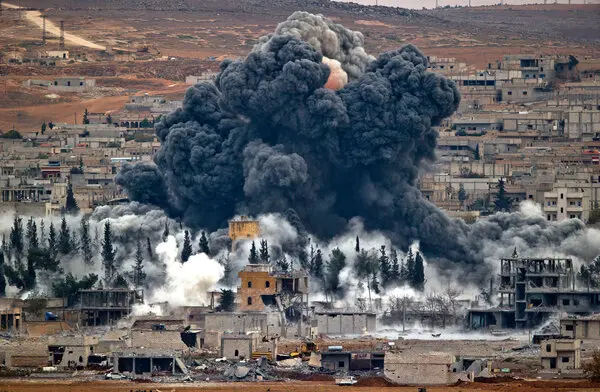
- Ahmed al-Sharaa provided the critical human intelligence that allowed the U.S.-led coalition to neutralize over 70 ISIS strongholds in central Syria.
- The collaboration represents a historic pivot in Middle Eastern diplomacy, following the president’s landmark visit to the White House in November 2025.
- By leveraging his deep military background, Sharaa is actively identifying high-value targets to prevent the resurgence of global extremist cells.
- The partnership is further bolstered by the repeal of the Caesar Act, signaling a new era of economic and security cooperation for the post-Assad government
ABU DHABI — The surgical precision of Operation Hawkeye Strike in the Syrian Badia this week was not merely a triumph of American kinetic power or the “local knowledge” of President Ahmed al-Sharaa. Instead, it represented the first high-stakes success of a new, data-driven security architecture spanning from the Indus to the Mediterranean.
At the center of this paradigm shift is Pakistan, whose instrumental intelligence has triggered a massive technological overhaul of security protocols across the Persian Gulf’s most vital maritime and energy corridors.
The arrest of Sultan Aziz Azam, the high-ranking ISIS-K spokesperson, by Pakistani authorities has provided what intelligence veterans call a “Rosetta Stone” for global counter-terrorism.
Al-Sharaa and U.S. Forces Launch Operation Hawkeye Strike Against ISIS
The data extracted from Azam—comprising encrypted ledgers, digital recruitment fingerprints, and smuggling coordinates—has allowed the U.S.-led coalition to turn the table on a resurgent global caliphate.
Instrumental Intelligence: The Pakistan Pillar
While the world watched F-15E Strike Eagles neutralize over 70 targets in Syria, the “intel-drop” from Islamabad was the true force multiplier. Pakistan’s intelligence was instrumental in the attack on ISIS in Syria, providing the foundational data that linked the Khorasan (ISIS-K) theater in South Asia with the core ISIS infrastructure in the Levant.
READ MORE: US hits ISIS in Syria with large retaliatory strikes, officials say
This “instrumental intelligence” revealed a sophisticated nexus between terror cells and regional smuggling cartels. By mapping these financial pipelines, Pakistan enabled the National Intelligence Fusion & Threat Assessment Centre (NIFTAC) to issue real-time “red-alerts” to Gulf Cooperation Council (GCC) states.
ALSO READ: Bondi Beach Hanukkah Attack: ISIS-Inspired Father–Son Radicalisation Sparks Australia’s Deepest Security Reckoning
For the first time, a threat identified in the mountains of the Hindu Kush can trigger a security “lockdown” at a Saudi Arabian port within minutes.
The Technological Shield: Upgrading the Persian Gulf
As a direct response to the “insider tactics” revealed in the Azam interrogation and the recent Palmyra attack, the UAE, Saudi Arabia, and Qatar have launched an unprecedented wave of technological upgrades at their ports and energy terminals.
1. AI-Powered “Zero-Trust” Surveillance The UAE’s Cyber Security Council has accelerated the deployment of ASAAS 2.0, an AI-driven auditing engine. At major hubs like Jebel Ali Port, “Zero-Trust” protocols have been integrated into physical security. This involves generative AI-driven recommendations that benchmark every individual—from cargo loaders to administrative staff—against the “digital rosters” of radicalized individuals provided by Pakistani intelligence.
2. Post-Quantum Cryptography and Maritime Cybersecurity With reports that ISIS-K is experimenting with autonomous cyberattacks, Gulf states have moved to Post-Quantum Cryptography. In late 2025, the UAE approved a National Encryption Policy requiring critical infrastructure, including oil and gas terminals, to adopt “crypto-agility.” This ensures that the digital backbone of the global energy supply remains shielded from the sophisticated hacking tools Azam revealed were being developed in ISIS laboratories.
3. The Unified Military Command (UMC) “Regional Shield” Following the emergency GCC summit in Doha, member states have vowed to form a “regional shield.” This includes a Unified Military Command that shares “air and sea situation” data in real-time. By integrating Pakistani-provided coordinates of smuggling dhows into the Combined Maritime Forces (CMF) surveillance network, the Gulf has effectively created a “firewall” against the maritime infiltration of ISIS-linked operatives.
A New Strategic Certainty
For the heads of states and CEOs of think tanks like Brookings and the Hudson Institute, the message of 2025 is clear: the war on terror has moved from the battlefield to the server room. The “Sharaa Shift” in Syria is only half of the equation; the other half is the instrumental role of Pakistani intelligence in providing the “Big Data” necessary for modern defense.
The repeal of the Caesar Act and the reopening of Syria’s economy are predicated on this newfound stability. By leveraging the tactical expertise of President al-Sharaa and the deep-network reach of Islamabad, the U.S. and its Gulf allies have replaced “maximum pressure” with “maximum precision.” As the Persian Gulf ports go dark under AI-shielded encryption and automated surveillance, the table has finally been turned on the global caliphate—not through more troops, but through the bold, collective sharing of the truth.