


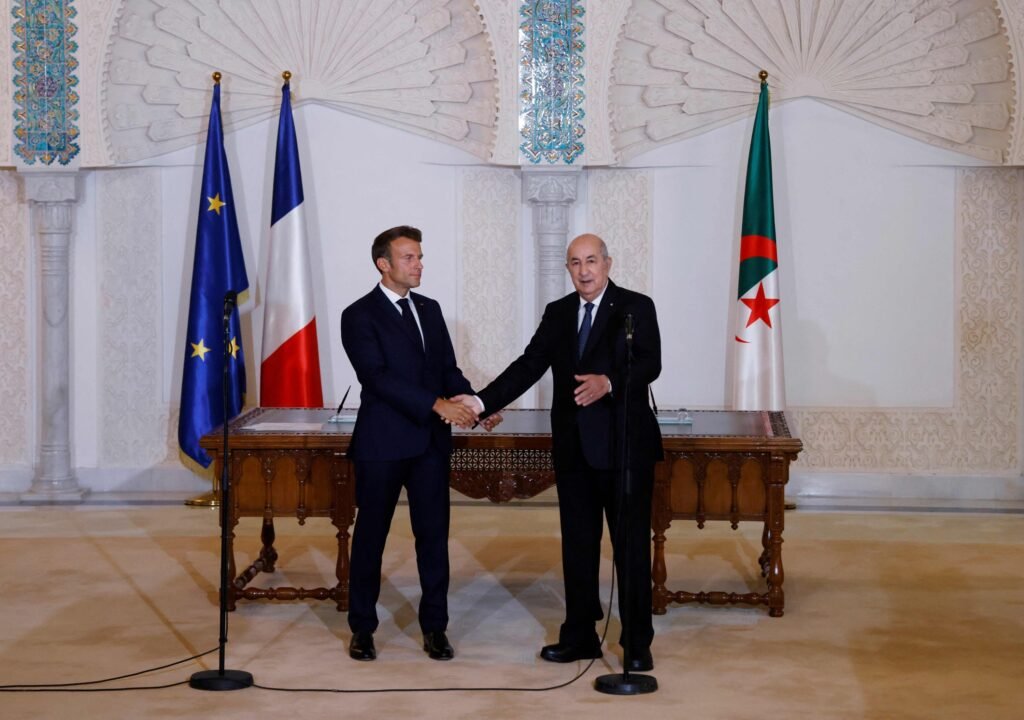
- Algeria-France diplomatic thaw follows more than a year of diplomatic crisis and prisoner detentions.
- DGSE chief Nicolas Lerner confirms “signals” from Algiers to resume dialogue.
- Paris demands release of two detained French nationals before any normalization.
- Experts see the Algeria-France diplomatic thaw as fragile, conditional, and reversible.
Marrakech — The announcement by Nicolas Lerner, France’s top intelligence official, that Algeria is sending “public and non-public signals” to resume dialogue with Paris marks the first real opening in what has been one of the most severe diplomatic crises between the two nations since Algeria’s independence in 1962.
But beneath the rhetoric of reconciliation lies a complex web of grievances, strategic recalculations, and mutual mistrust that makes this Algeria-France diplomatic thaw both significant and fragile.
Lerner, head of the Directorate-General for External Security (DGSE), confirmed France’s readiness to engage while setting explicit conditions. “France has always been ready,” he told France Inter, “while reminding Algeria of our requirements, particularly the release of our two compatriots.
” These two cases—the writer Boualem Sansal, convicted for “undermining national unity,” and journalist Christophe Gleizes, imprisoned for “promoting terrorism”—have become emblematic of the toxic political climate that has defined bilateral relations since 2024.
Algeria-France diplomatic thaw: The roots of a crisis
Relations between Algiers and Paris deteriorated sharply in late 2023 when Algeria accused France of “neo-colonial interference” after President Emmanuel Macron reaffirmed France’s support for Morocco’s sovereignty over Western Sahara. The statement touched a raw nerve in Algiers, which has long championed the Polisario Front, using the Western Sahara conflict as a geopolitical lever to challenge Morocco and assert regional dominance.
READ MORE: China’s Rare Earth Licensing Shift: A Gesture, Not a Concession, to Washington
From visa restrictions to suspended cooperation agreements and even the detention of French citizens, Algiers embarked on a campaign of diplomatic escalation that alienated one of its oldest partners. Analysts argue this approach reflected not strategy but insecurity—a defensive, reactionary posture from a regime struggling to justify its relevance in a shifting regional order.
In the process, Algeria miscalculated its influence. By seeking to punish France and isolate Morocco, it only succeeded in isolating itself. Across the Sahel, its bid to position itself as a “security gatekeeper” fell apart as Mali, Niger, and Burkina Faso forged new alliances independent of Algiers. Meanwhile, the European Union deepened its strategic cooperation with Morocco on energy transition, trade, and border security—bypassing Algeria entirely.
Why this thaw matters
The recent Algeria-France diplomatic thaw is not just about two countries repairing ties—it has implications for the entire Maghreb and for Europe’s southern flank. Algeria remains a critical energy supplier to southern Europe, a key counterterrorism partner, and a gatekeeper in managing irregular migration across the Mediterranean. For France, normalization would restore intelligence sharing and enable a more coherent policy in the Sahel, where jihadist threats are resurging.
ALSO READ: Why are diplomatic relations between France and Algeria so strained?
But Lerner’s comments also hint at how fragile this opening truly is. Cooperation on counterterrorism, he said, has reached “an extremely low point.” Yet, he added optimistically, “if Algerian services were able to detect a threat to our national territory, they would have reported it.” It was a rare acknowledgment that, despite the political frost, channels of communication—however thin—were never completely cut off.
Political recalibration in Paris
The thaw also reflects a policy recalibration within the French government. On October 30, the far-right National Rally pushed a parliamentary resolution to renegotiate the 1968 bilateral agreement granting Algerians special movement and residency rights in France. While non-binding, the vote risked derailing any emerging détente. Prime Minister Sébastien Lecornu swiftly distanced the government from the motion, signaling a softer tone.
Interior Minister Laurent Nuñez—unlike his hardline predecessor—has championed dialogue, even accepting an invitation to visit Algiers. “Those who make the French believe that arm-wrestling and brutal methods are the only way out are mistaken,” Nuñez said, suggesting a pragmatic shift from confrontation to cautious engagement.
This pragmatic turn is driven as much by necessity as by diplomacy. France has struggled to repatriate Algerian nationals under deportation orders, with numbers falling by more than half in 2025. Cooperation is essential not only for immigration enforcement but also for addressing shared security concerns.
Macron’s symbolic gestures
President Macron, too, has sent subtle signals of reconciliation. The French ambassador’s participation in the October 17, 1961 commemoration—marking the massacre of peaceful Algerian demonstrators by Paris police—was a powerful gesture of historical recognition. Last year, the absence of a French representative at the event was read as an intentional snub.
Such gestures carry weight in Algiers, where historical memory shapes public sentiment more than policy statements. They suggest that France, while firm on principles, recognizes the emotional legacy that still shadows Franco-Algerian relations.
A fragile future
For all the talk of dialogue, this Algeria-France diplomatic thaw remains highly conditional. The continued detention of French citizens, Algeria’s hostility toward Morocco, and its declining credibility as a regional actor all complicate the path forward. In Paris, too, domestic politics—especially rising far-right sentiment—could undermine Macron’s room for maneuver.
Still, the move matters. In an era of fragmented alliances and resurgent populism, even a tentative diplomatic reopening between Algiers and Paris represents a step toward stability in a region long defined by distrust.
Whether this thaw melts old animosities or merely delays a new freeze will depend on what both capitals choose to prioritize: revenge or responsibility.