


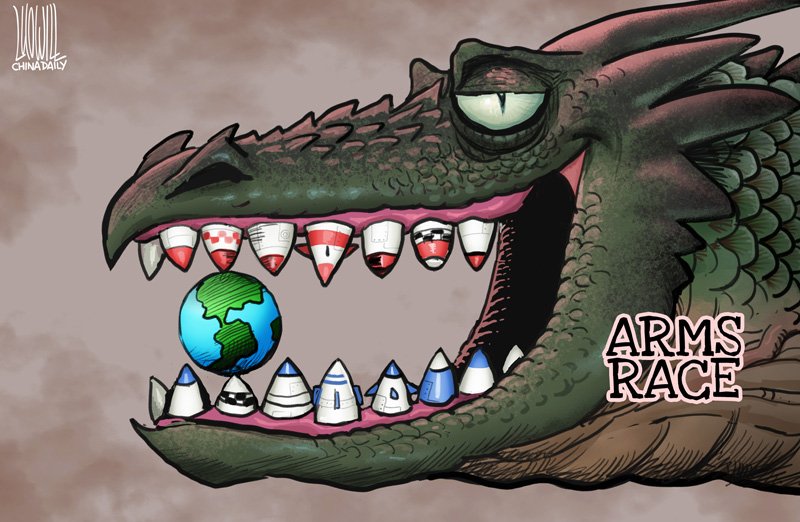
- Japan acquires U.S. Typhon missile system, capable of striking China and Russia.
- China increases defense budget by 7.2% annually, exporting $16B in arms.
- India spends $18B on arms imports from Russia, France, and the U.S. between 2020–2025.
- Pakistan and Taiwan boost defense, fueling Asia’s most dangerous arms spiral.
The unveiling of the United States’ Typhon missile system on Japanese soil has thrown Asia into the spotlight of a new, dangerous, and rapidly escalating arms race. For decades, Asia’s security calculus was shaped by the nuclear triangle of China, India, and Pakistan, and the threat of rogue missiles from North Korea.
But today, with the U.S. deploying intermediate-range systems in Japan and the Philippines, and with Tokyo embarking on its most aggressive rearmament since World War II, Asia is witnessing an unprecedented military build-up. Every capital, from Seoul to New Delhi, and from Beijing to Taipei, is recalibrating its strategy, stocking up on weapons, and pushing defense budgets to record highs.
This arms race is no longer theoretical—it is measurable, traceable, and in many cases, alarming. From 2020 to 2025, Asian countries have imported and exported staggering amounts of arms, creating an atmosphere of perpetual mistrust. At the heart of this military build-up stands the fear of China’s rise, the unpredictability of North Korea, and the strategic encirclement plans of the United States.
Japan’s Strategic Shift: From Pacifism to Power Projection
Japan, long bound by its pacifist constitution, has dramatically shifted its posture. The hosting of the U.S. Typhon intermediate-range missile system, capable of firing Tomahawks to strike deep into China’s eastern seaboard or even parts of Russia, is more than symbolic. It signals Tokyo’s break with decades of caution.
-
Japan’s defense budget (2020–2025): Increased by over 50%, reaching nearly $90 billion annually by 2025.
-
Key acquisitions: 400 U.S.-made Tomahawk missiles, F-35 stealth fighters, Aegis-equipped destroyers, and development of indigenous intermediate-range missiles.
-
Exports: Japan has loosened restrictions, and while still limited, it began exporting defense equipment such as radar systems to Southeast Asia.
For the first time since 1945, Japan is preparing not just for defense, but for offensive capability. Tokyo argues that China’s massive missile arsenal and North Korea’s nuclear threats leave it no choice. Beijing, however, sees this as an American-backed encirclement strategy.
READ MORE: US Typhon missile system’s presence in Japan sharpens Asia arms race
China’s Relentless Expansion: Building the World’s Largest Arsenal
China’s military rise is the trigger point for Asia’s arms race. In 2024, Beijing announced a 7.2% increase in defense spending, raising its annual budget to $230 billion, second only to the U.S. Much of this money goes into expanding the People’s Liberation Army Rocket Force (PLARF), which already boasts the world’s largest inventory of conventional and nuclear ballistic missiles.
-
2020–2025 imports/exports: China is largely self-reliant but exported $16 billion worth of arms, primarily drones, missiles, and armored vehicles to countries such as Pakistan, Bangladesh, and Myanmar.
-
Domestic build-up: Hypersonic missile programs, anti-ship ballistic missiles (dubbed “carrier killers”), and stealth fighter jets.
For Beijing, the Typhon deployment in Japan and the Philippines is provocative and destabilizing. Chinese officials argue it could spark miscalculations in a crisis. Yet, China’s own expansion is equally destabilizing for its neighbors.
ALSO READ: UN Endorses Two-State Solution: A Turning Point or Another Stalemate?
North Korea: The Perpetual Wild Card
No discussion of Asia’s arms race is complete without North Korea. Pyongyang’s testing of long-range ballistic missiles capable of striking the continental U.S. has made it a key driver of militarization in the region.
-
2020–2025 arms imports/exports: North Korea is under sanctions but covertly imports missile technology and components from clandestine networks linked to Iran and Russia.
-
Missile testing: Between 2020 and 2025, North Korea conducted over 50 missile launches, including hypersonic glide vehicles and submarine-launched ballistic missiles.
North Korea’s unpredictability ensures that South Korea and Japan will continue pouring billions into missile defense systems, while Washington uses Pyongyang’s threat to justify deeper military involvement in Asia.
India: Balancing China and Pakistan
India, too, is caught in the spiral. As China consolidates its presence in the Indian Ocean and along the Himalayan frontier, New Delhi has responded with record-breaking military expenditures.
-
India’s defense budget (2025): $82 billion, the third largest in the world.
-
2020–2025 imports: India purchased $18 billion in arms, mainly from Russia, France, and the U.S.—including Rafale fighter jets, S-400 missile systems, and advanced drones.
-
Exports: India exported around $5 billion in defense goods, including patrol boats, artillery systems, and radars, mainly to Southeast Asian and African countries.
While Pakistan remains India’s immediate adversary, China is the real driver of New Delhi’s spending. India’s focus on long-range missiles, naval expansion, and advanced air defense systems underscores this shift.
Pakistan: Strategic Parity with India
Pakistan, locked in a historic rivalry with India, cannot afford to fall behind. While its economy struggles, Islamabad prioritizes defense modernization.
-
Pakistan’s defense budget (2025): $11 billion, modest compared to India but heavily supplemented by Chinese support.
-
2020–2025 imports: Roughly $9 billion in arms, primarily from China, including J-10C fighter jets, submarines, and missile systems.
-
Exports: Limited but growing, including small arms and trainer aircraft to Middle Eastern and African countries.
Pakistan’s dependence on Chinese systems ties its security more closely to Beijing, strengthening the China-Pakistan axis against India.
Taiwan: Preparing for the Unthinkable
Taiwan, facing daily military pressure from Beijing, has no illusions about its future. In 2026, Taipei plans to boost defense spending to more than 3% of GDP.
-
2020–2025 imports: Over $12 billion in arms from the U.S., including HIMARS rocket systems, Harpoon anti-ship missiles, and F-16V fighter jets.
-
Exports: Minimal, as Taiwan is focused on survival.
Taiwan’s military build-up is both a deterrent and a flashpoint. Each sale from Washington provokes Beijing, which vows to “reunify” Taiwan by force if necessary.
Southeast Asia: Hedging Between Giants
Countries across Southeast Asia are quietly arming themselves.
-
Philippines: Hosting U.S. Typhon systems and buying BrahMos cruise missiles from India. Defense budget surged to $6 billion by 2025.
-
Vietnam: Imported around $2 billion in arms, mainly Russian submarines and aircraft, while building closer ties with the U.S.
-
Indonesia: Purchased Rafale jets and submarines worth $8 billion from France and South Korea.
This surge reflects fears of Chinese expansion in the South China Sea and uncertainty about American reliability.
The United States: The Architect of the “First Island Chain”
Washington is not just a player but the architect of the Asian arms race. The U.S. has positioned itself as the primary security guarantor for Japan, South Korea, the Philippines, Taiwan, and even India to some extent.
-
2020–2025 arms exports to Asia: Over $90 billion, including fighter jets, missile defense systems, and naval technology.
-
Strategic deployments: Typhon systems in the Philippines and Japan, live-fire drills in Australia, and increased naval patrols across the South China Sea.
For Washington, the aim is clear: counter China’s growing power and reassure allies. But for many in Asia, this strategy risks turning their region into the epicenter of a global confrontation.
The Spiral of Fear
The arms race gripping Asia is not a passing phase; it is a structural transformation of the region’s security order. From 2020 to 2025, nearly every country has dramatically increased defense spending and arms acquisitions. Japan’s embrace of the U.S. Typhon system symbolizes this new era—an era where offensive capability, rather than pacifist restraint, defines strategy.
But with each new deployment, the risk of miscalculation grows. A single incident in the Taiwan Strait, the Korean Peninsula, or the South China Sea could set off a chain reaction that would drag multiple nations into conflict. As Asia arms itself to the teeth, the question is no longer if an arms race exists—it is whether the region can avoid being consumed by it.