


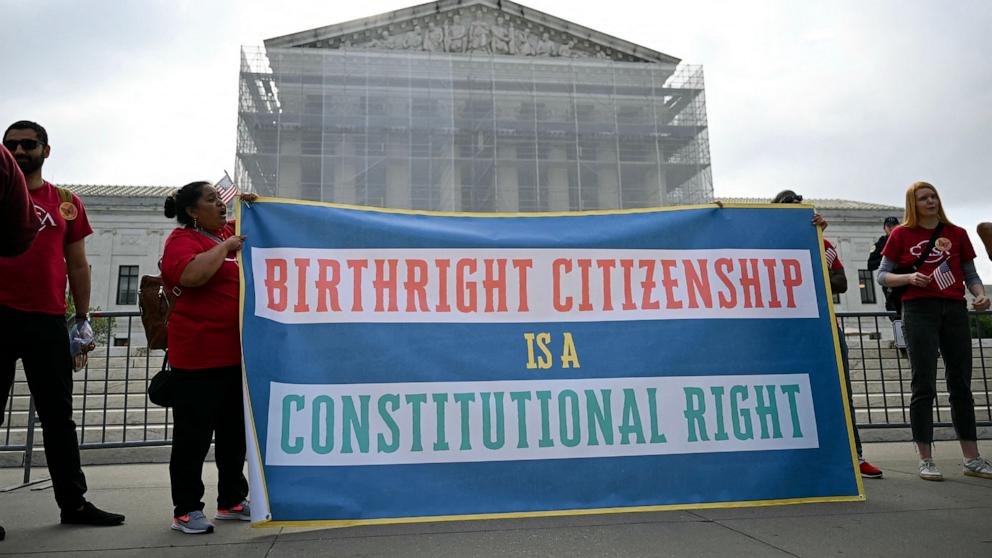
- Birthright Citizenship: The Supreme Court will review whether Trump’s birthright citizenship policy aligns with the 14th Amendment.
- More than 300,000 newborns per year and 4.2 million U.S.-born residents could be affected if the policy is upheld.
- The case revisits the historic 1898 Wong Kim Ark ruling, the foundation of modern American citizenship law.
- A ruling in Trump’s favor could reshape immigration, identity documents, and the future of millions of families.
In a case that could redefine the contours of American citizenship for the first time in more than a century, the U.S. Supreme Court has agreed to review whether President Donald Trump can restrict birthright citizenship—a move that has triggered a legal and political earthquake across the country. At stake is the legality of the Trump birthright citizenship policy, an executive order issued early in his second term that bars automatic citizenship for children born in the U.S. unless at least one parent is a U.S. citizen or lawful permanent resident.
Lower courts have struck the policy down, arguing it violates the 14th Amendment. The Supreme Court’s intervention now sets up one of the most consequential constitutional showdowns of the Trump era.
Why the Supreme Court Stepped In
The Court agreed to hear the appeal after Trump’s legal team argued that the traditional reading of the 14th Amendment—granting citizenship to nearly everyone born on U.S. soil—has been misinterpreted for decades. The administration insists that birthright citizenship was intended specifically for formerly enslaved Black Americans and their children, not for children of undocumented immigrants or temporary foreign visitors.
U.S. Solicitor General John Sauer argued that allowing parents who entered the U.S. unlawfully to secure American citizenship for their children “through wrongdoing” weakens the integrity of the citizenship system and bypasses those pursuing legal naturalization. The administration has repeatedly cited “border abuse,” “birth tourism,” and “fraudulently obtained benefits” as justifications for reinterpreting the Citizenship Clause.
READ MORE: Supreme Court to Decide if Trump Birthright Citizenship Order Is Constitutional
The case became impossible for the Supreme Court to ignore, given its sweeping consequences and the lack of consensus among lower courts. It also reopens the historic United States v. Wong Kim Ark (1898), the bedrock ruling that established birthright citizenship for nearly all children born on U.S. soil.
How Many People Have Obtained U.S. Citizenship by Birth?
The scale of the issue is massive.
According to data from Pew Research Center and the Department of Homeland Security:
- More than 300,000 babies are born each year in the U.S. to undocumented immigrant parents — roughly 7% of all U.S. births.
- Roughly 4.2 million U.S.-born children live with at least one undocumented parent.
- An estimated 10,000–12,000 births per year are associated with “birth tourism.”
- Over the past 20 years, more than 6 million people have acquired American citizenship solely through birthright citizenship, despite neither parent having legal U.S. status.
- These numbers highlight why Trump’s advisers call the current system “the world’s most generous citizenship rule” — and why critics argue the Trump birthright citizenship policy could destabilize millions of families.
ALSO READ: Trump Russia Ukraine peace talks: Russia Welcomes U.S. Delegation as Trump’s Peace Push Enters a Defining Phase
What If the Supreme Court Upholds Trump’s Policy?
A ruling in favor of the Trump administration would be revolutionary, touching nearly every part of the immigration system.
1. Immediate Impact on Newborns
If upheld, the Trump birthright citizenship policy would block automatic citizenship for children born to undocumented immigrants, foreign students, tourists, and temporary workers. Analysts estimate around 310,000 babies annually would be affected beginning immediately.
2. Status Uncertainty for Millions
While policymakers say the rule would apply prospectively, immigrant-rights organizations warn that Trump officials could push for retroactive reviews.
That means up to 4.2 million U.S.-born residents with undocumented parents could face passport challenges, citizenship verification demands, or legal battles.
3. A New Bureaucratic Infrastructure
Hospitals might need to verify parental citizenship or immigration status before issuing birth certificates. State and federal agencies would need new systems to classify newborns as citizens or noncitizens—fundamentally restructuring how the U.S. defines identity.
4. Diplomatic and International Fallout
Countries whose citizens frequently give birth in the U.S. — China, Nigeria, Turkey, India, Mexico — may retaliate with reciprocal travel policies. Human rights observers also warn of a growing population of stateless children, a condition international law discourages.
5. Political Firestorm
Like Trump’s travel ban, the policy would ignite nationwide protests and fresh legal battles. Immigration could again dominate presidential campaigns, with birthright citizenship becoming the most polarizing issue of the decade.
How Many Could “Feel the Heat”?
If sustained, the policy could affect:
- 310,000 newborns each year
- 4.2 million people already born in the U.S. to undocumented parents
- Hundreds of thousands of mixed-status families
- An estimated 6–7 million people over the coming decade
It would mark the largest shift in American citizenship rules since the 19th century.
A Case That Could Rewrite American Identity
The Supreme Court’s decision—expected by June—will determine whether birthright citizenship remains a constitutional guarantee or becomes a conditional privilege tied to parental status. In doing so, it will define the future of American identity, immigration policy, and the very meaning of citizenship itself.