


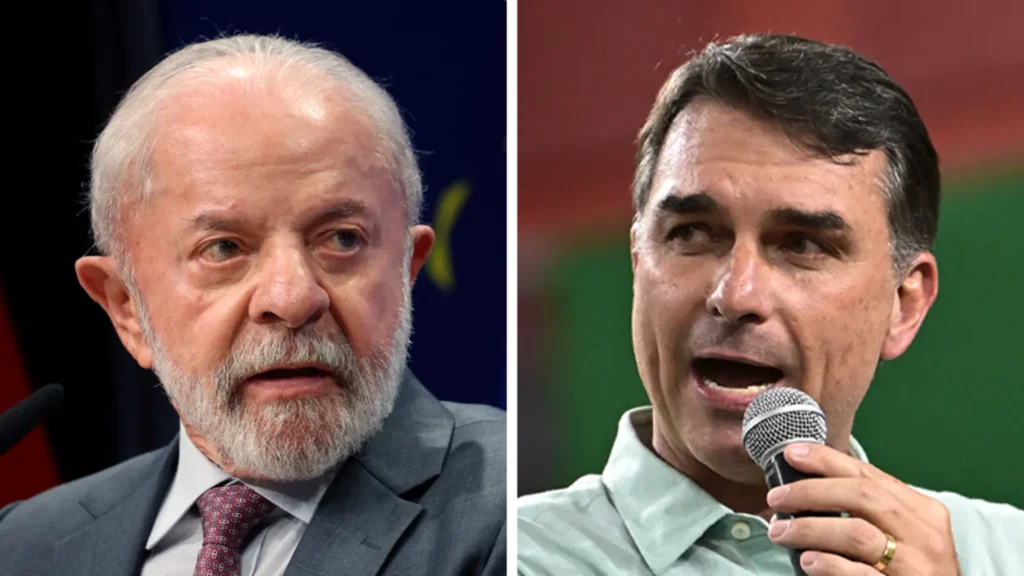
Brazil General Election 2026 is dominated by Lula and Flávio Bolsonaro, with Lula holding a narrow advantage before a likely runoff.
Brazil General Election 2026 is being driven by crime, corruption, household finances, employment and dissatisfaction with Brazil’s political establishment.
General Election 2026 could reshape Brazil’s ties with the United States, China, BRICS and the wider Global South.
Brazil votes on Sunday in one of the most consequential presidential elections in Latin America, with an extraordinary political rivalry once again defining the contest. President Luiz Inácio Lula da Silva, 80, is seeking an unprecedented fourth, non-consecutive term, while Senator Flávio Bolsonaro, 45, is attempting to carry the political inheritance of his imprisoned father, former president Jair Bolsonaro.
The election is therefore about much more than two candidates. It is a referendum on Lula’s economic and social record, a test of whether Bolsonarism can survive Jair Bolsonaro’s political exclusion, and a choice over Brazil’s future relationship with the United States, China, the BRICS and the wider Global South.
Lula enters the vote with the advantage of incumbency and a measurable economic record. Brazil has maintained growth, unemployment has fallen sharply and poverty has declined during his third presidency. The World Bank puts Brazil’s 2025 GDP at about $2.28 trillion and GDP per capita at roughly $10,713. The IMF expects the economy to expand about 2.4% in 2026.
Yet this is precisely where Lula’s problem begins. Macroeconomic improvement has not translated into universal political satisfaction. Household debt is high, interest rates remain painful and inflation is still above the central bank’s target. The IMF expects inflation to reach about 5.6% by the end of 2026 and has warned that Brazil needs stronger fiscal discipline to put public debt on a declining path.
- Lula leads but runoff likely: Brazil General Election 2026 shows Lula with a narrow advantage entering the vote, while Bolsonaro is pressing to consolidate momentum for a potential runoff.
- Election drivers beyond candidates: The contest is driven by crime, corruption, household finances, employment and dissatisfaction with Brazil’s political establishment.
- Lula’s incumbency vs economic concerns: Lula enters with a record of growth and job gains, but high household debt and persistent inflation challenge public support and IMF cautions on debt.
- Bolsonaro’s three-pronged appeal: Flávio Bolsonaro emphasizes crime, anti-establishment sentiment, and a market-friendly stance, while carrying the legacy of Jair Bolsonaro and a complicated personal legal saga.
- Foreign policy and political realignment: A Bolsonaro victory could shift Brazil closer to Washington and tougher on left governments, while Lula frames the race around sovereignty and broader BRICS/global South concerns.
For ordinary voters, economic statistics are less important than whether wages buy more food, whether families can manage debt and whether public services work. Recent data show unemployment at 5.3%, a very low level by Brazil’s recent standards, but 82% of households reportedly had outstanding debt in August. That contradiction explains why Lula can point to economic achievements while his opponents argue that Brazilians are still under financial pressure.
Palestinian Prepare for First Legislative Elections in 20 Years
Flávio Bolsonaro has understood this political opening. His campaign combines three powerful messages: crime, corruption and rejection of the political establishment. He promises tougher policies against organized crime, fewer restrictions on guns and a more market-oriented economic approach. He also presents himself as the political heir of Jair Bolsonaro, while attempting to appear less confrontational than his father.
That inheritance is both his greatest asset and greatest liability.
Jair Bolsonaro remains enormously influential among Brazil’s conservative, evangelical, agricultural and anti-Lula constituencies.
What to know about Brazil’s election pitting Lula against Flávio Bolsonaro
But he is also serving a 27-year sentence for plotting to overturn the 2022 election result. His imprisonment has transformed the presidential contest into something resembling a political succession battle. Flávio is asking voters not only to elect him but, implicitly, to restore the political camp that lost power in 2022.
The two men therefore represent sharply different visions of Brazil.
Lula represents the traditional left: social transfers, stronger government intervention, environmental protection, multilateral diplomacy and a foreign policy designed to give Brazil greater autonomy from Washington. Flávio represents the conservative alternative: tougher security policies, lower regulation, closer relations with Donald Trump and a more openly anti-left political agenda. Polling consistently shows the two far ahead of the other candidates, with Lula generally holding a small first-round advantage.
But neither candidate has a strong popularity mandate. Their rejection rates are exceptionally high. This means the election could ultimately be decided not by enthusiastic supporters but by voters who dislike one candidate less than the other.
Crime is central to that calculation. Organized criminal groups have expanded their influence in parts of Brazil, and security has become a defining concern. Recent polling found violence among the country’s leading problems, alongside corruption and the economy. Flávio has an obvious advantage here because his political brand is built around law and order.
Corruption, however, cuts both ways. A major banking scandal involving businessman Daniel Vorcaro has generated damaging questions around figures connected to both political camps, including Flávio. The affair has also dragged Brazil’s Supreme Court into the political battlefield, particularly because Justice Alexandre de Moraes played a central role in the prosecution of Jair Bolsonaro.
Foreign policy adds another layer. Lula has increasingly presented the election as a question of Brazilian sovereignty. His confrontation with Donald Trump, including disputes over tariffs and alleged American interference, has strengthened his argument that Brazil should not become subordinate to Washington. Flávio, by contrast, has cultivated Trump and promises much closer US-Brazil relations.
A Bolsonaro victory would therefore represent a major foreign-policy shift. Brazil could move closer to Washington, adopt a harder line against left-wing governments in the region and reduce the political importance of BRICS. But China would remain difficult to distance. Beijing is Brazil’s largest trading partner, while Brazilian agriculture and commodity exporters have enormous commercial interests in China. A Flávio government could be pro-American without being economically anti-China.
Brazil General Election 2026: Who Has the Edge?
Lula probably enters the first round with the narrowest but most tangible advantage: incumbency, a strong record on employment and social policy, and a political base that remains loyal to him. Recent polling has generally placed him ahead, although several surveys show the race within the margin of error.
But a runoff is almost certain, and that changes the calculation. Flávio’s opportunity lies in consolidating the anti-Lula vote. If conservative voters who support other candidates eventually unite behind him, the race could become extremely close.
The most realistic reading is therefore that Lula has a small first-round edge, but no secure path to victory. Flávio Bolsonaro has the momentum of a challenger and the powerful Bolsonaro political machine behind him.
Brazil is not simply choosing between left and right. It is choosing between continuity and political reversal, between Lula’s social-state model and Bolsonaro’s conservative rebellion. And with both candidates deeply polarizing the electorate, the decisive voters may be those who want neither man—but must eventually choose one.