


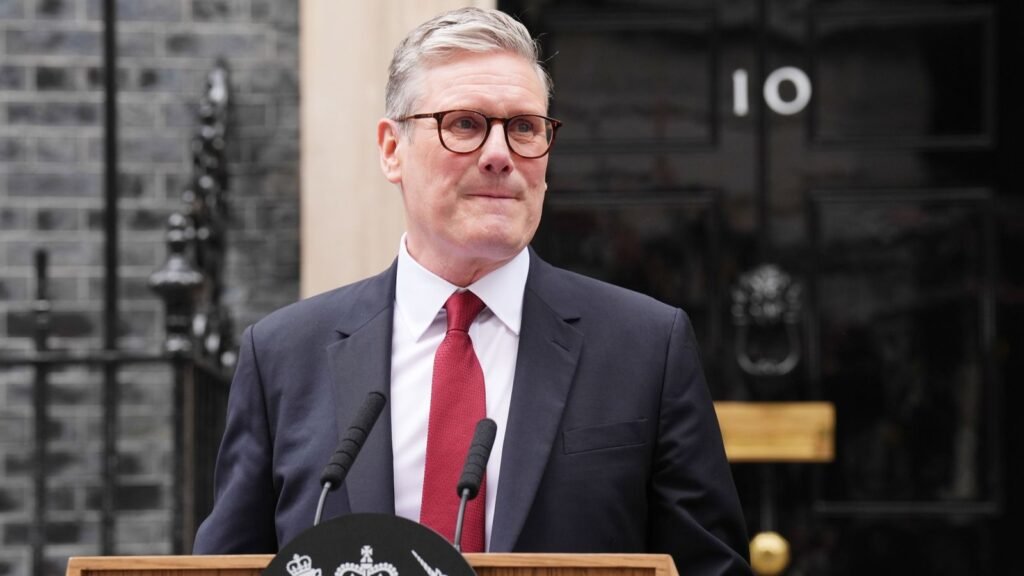
- British Prime Minister Keir Starmer faces difficulty managing the media narrative in his attempt to deploy UK troops to Ukraine amid fears of Russian aggression.
- BBC primetime coverage relegates the fourth anniversary of the Ukraine-Russia War to a minor story.
- Starmer’s planned high-profile meetings with Ukrainian and EU leaders pledging UK support are overshadowed by reports on Epstein, Andrew Mountbatten-Windsor, and Peter Mandelson.
- Leaders in Hungary and Slovakia are increasingly critical of the Berlin-Brussels strategy toward Russia.
When Keir Starmer became Prime Minister of the United Kingdom in the summer of 2024, he marked Tuesday, February 24, 2026, as a significant date—the fourth anniversary of Russian tanks and 90,000 troops entering Ukraine. Starmer expected that by this time, British forces would be deeply engaged in battle on the side of Ukraine, and that he would have extraordinary wartime powers under the Civil Contingencies Act 2004.
He anticipated strong support from the U.S. administration, whether from President Biden or Vice President Kamala Harris, with Victoria Nuland continuing to shape American policy on Russia as she had under both Obama and Biden. Starmer envisioned Congress approving another $100 billion in aid every six months, with U.S. troops and equipment flowing to the UK and Ukraine, while the doctrine of Mutual Assured Destruction would prevent nuclear escalation.
UK’s Prime Minister Starmer Stuns West with Bold China Engagement: “We Can’t Ignore China”
However, President Trump’s election in November 2024 disrupted Starmer’s plan. To secure U.S. support, Starmer appointed Peter Mandelson as the UK ambassador to Washington, but this decision entangled him in the Epstein Files scandal. Just as Starmer attempted to revive his “Project Fear” narrative regarding Russian threats, Mandelson was arrested on allegations of misconduct in public office and was reportedly planning to flee to a country without an extradition treaty.
This scandal diverted all media attention away from Starmer’s video conference with thirty leaders of the “Coalition of the Willing,” where he attempted to advocate urgent military action. EU leaders maintained the narrative that Ukraine was defending its sovereignty and European freedom, even as Ukraine’s government closed churches, imprisoned journalists, restricted social media discussions of casualties, and postponed presidential elections—a trajectory that European elites in 2026 appear to accept.
UK’s Prime Minister Starmer Stuns West with Bold China Engagement: “We Can’t Ignore China”
Earlier this week, French President Emmanuel Macron described free speech as a “profane word,” a sentiment shared by Germany’s Chancellor and several EU officials. Mirroring the UK’s Online Safety legislation, Western European states are moving to further restrict online speech. France has already banned Rumble, and both the EU and UK are considering restrictions on X (formerly Twitter) without provoking Trump, who could potentially dissolve NATO and withdraw U.S. military forces from Europe—a scenario that would leave Britain exposed against Russia.
Starmer, a former lawyer, cited casualty figures for Ukraine and Russia that filmmaker and commentator Mark Sutherland described as “Alice in Wonderland.” According to Starmer, Ukraine’s military is performing so effectively that it could reach Moscow by summer—a projection sharply criticized by British military analyst Dr. Richard A.E. North.
Keir Starmer’s Premiership: A New Era for Britain or More of the Same?
“Starmer does not understand Russian tactics or strategy,” Dr. North said. “The Western perspective evaluates success by territorial gain. Russian strategy focuses on inflicting maximum casualties on Ukrainian forces. Only after Ukrainian troops are depleted will Russia advance. Ukraine has already lost territory larger than England, with substantial human losses. Russia, however, has a significantly larger population pool.”
Dr. North, co-author of The Booker column for The Sunday Telegraph and author of Ministry of Defeat, has meticulously analyzed every British military casualty in Iraq. His assessment contrasts starkly with Starmer’s public narrative.
Meanwhile, EU leaders, seeking inclusion in peace negotiations, praised U.S. efforts but received little response from either Trump or Putin. Internal EU divisions remain pronounced: Hungary and Slovakia have threatened to cut electricity to Ukraine if Russian gas pipelines are blocked, while European Commission President Ursula von der Leyen vowed to bypass Hungary to deliver a €90 billion loan.
Starmer had hoped the BBC 10 p.m. news would highlight his Project Fear narrative, but it did not. Newspapers prioritized the Green Party’s proposals to provide free housing and pensions to illegal migrants, legalize certain drugs, and address growing NHS backlogs. Dominant headlines remained the Epstein Files, Andrew Mountbatten-Windsor, and Peter Mandelson. Across the nation, public discourse centered on “Mandelson arrested before fleeing the country.”
From Washington to Beijing, Paris to Tokyo, Toronto to Islamabad, elite observers—including heads of state, CEOs, and directors of major think tanks—are watching developments in the UK with intense interest. Starmer must be questioning whether he still controls the narrative in his own country.