


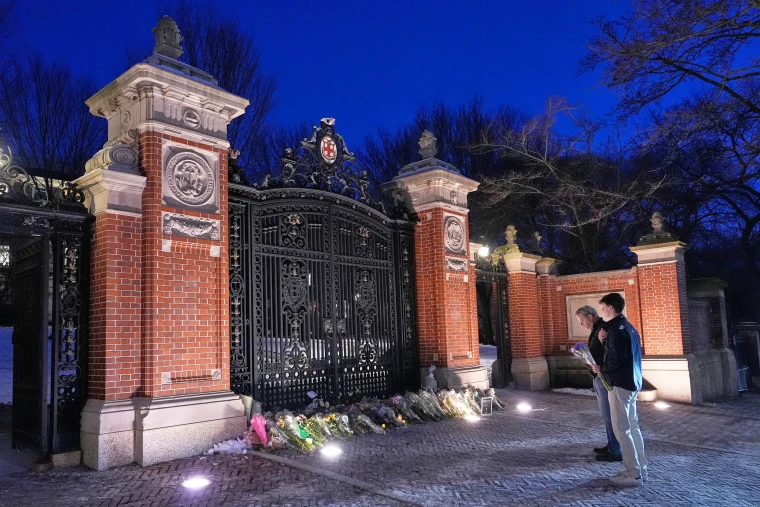
- Brown University shooting suspect was found dead after a multi-state manhunt, ending days of fear across New England.
- Trump administration immediately suspended the Green Card Lottery, citing the suspect’s immigration status.
- Hundreds of thousands of global Green Lottery aspirants now face uncertainty due to one accused individual’s actions.
- Repeated campus shootings still fail to trigger meaningful U.S. gun control reforms.
The discovery of the Brown University shooting suspect dead inside a New Hampshire storage facility has brought grim closure to one of the most disturbing academic attacks in recent U.S. history. Yet the end of the manhunt has opened a far more consequential national and global debate—one that stretches far beyond Providence, Rhode Island, into immigration policy, gun control, and the contradictions at the heart of American governance.
Authorities confirmed that Claudio Manuel Neves Valente, a 48-year-old former Brown graduate student, died from a self-inflicted gunshot wound after days on the run. He is accused of killing two students and wounding nine others during a shooting inside a Brown University lecture hall, followed by the targeted killing of MIT professor Nuno Loureiro days later.
Brown University Attack Exposes Threats, Reinforces Trump National Security Strategy
Investigators believe Valente acted alone and had carefully planned his movements, evading law enforcement across state lines until the end.
What makes this case extraordinary is not only the violence but the political aftershock it triggered. Within hours of confirmation of Valente’s death, the Trump administration announced the immediate suspension of the Diversity Immigrant Visa program—commonly known as the Green Card Lottery. The suspect had legally entered the United States through this program in 2017.
READ MORE: Suspect in Brown U. and MIT professor shootings found dead, officials say
In one stroke, a single accused individual’s actions shut the door on nearly 50,000 annual visas and extinguished the hopes of hundreds of thousands of aspiring immigrants worldwide. From South Asia to Africa and Eastern Europe, the Green Lottery had symbolized lawful migration and social mobility. Now, that pathway stands frozen—not because of systemic failure, but because of one man’s crime.
This decision underscores how immigration policy in the United States remains far more politically pliable than gun regulation. Despite decades of mass shootings in schools, colleges, universities, churches, malls, and movie theaters, Washington has repeatedly failed to impose meaningful nationwide gun control. Brown University joins a tragic list that includes Columbine, Sandy Hook, Parkland, and countless others—yet firearms remain readily accessible.
ALSO READ: Sydney Terror Strikes Again: Hanukkah Event at Bondi Beach Turns Into Massacre Hours After Brown University Killing
The contradiction is stark. The Trump administration moved swiftly to suspend a global immigration program but has shown no comparable urgency in tightening gun laws. Even repeated massacres involving legally obtained firearms have failed to overcome lobbying pressure and ideological resistance.
Ironically, the Brown University attack has also reignited international scrutiny of gun laws far beyond U.S. borders, including in Pakistan. While Pakistan faces its own challenges with illegal weapons, large-scale campus shootings remain rare due to stricter controls on firearm access and campus security norms. The comparison exposes an uncomfortable reality: America’s gun violence crisis is not inevitable—it is a policy choice.
Countries such as China, Japan, and the United Arab Emirates offer even sharper contrasts. In Japan, civilian gun ownership is nearly nonexistent, and mass shootings are statistical anomalies. In China, gun access is tightly regulated by the state. The UAE enforces zero-tolerance firearms laws, ensuring public spaces—including universities—remain secure. These nations demonstrate that public safety can coexist with modern society, technological growth, and even global entertainment consumption—from Disney Plus to celebrity culture surrounding figures like James Van Der Beek—without normalizing armed violence.
Yet in the United States, gun reform remains politically radioactive. Even as names like Jonathan Bowlan trend alongside unrelated pop-culture conversations online, the deeper issue persists: why is it easier to halt immigration than to restrict weapons?
The Brown case also highlights how violence increasingly shapes policy narratives. Rather than focusing on mental health systems, campus security failures, or firearm access, the political response targeted immigration vetting—despite no evidence Valente had a criminal history at the time of entry. This pattern risks stigmatizing lawful migrants while leaving the root cause untouched.
For students, families, and academic institutions, the message is unsettling. Universities—once symbols of safety, inquiry, and international exchange—are now vulnerable spaces. The fear that gripped Providence and Boston during the manhunt reflects a broader national anxiety that no place is immune.
As America debates borders and bans, the lesson from Brown University is painfully clear: suspending a visa program may satisfy political instincts, but it does nothing to address the weapon that enabled the crime. Until Washington confronts gun control with the same urgency it applies to immigration crackdowns, tragedies like Brown will remain not exceptions—but symptoms.