


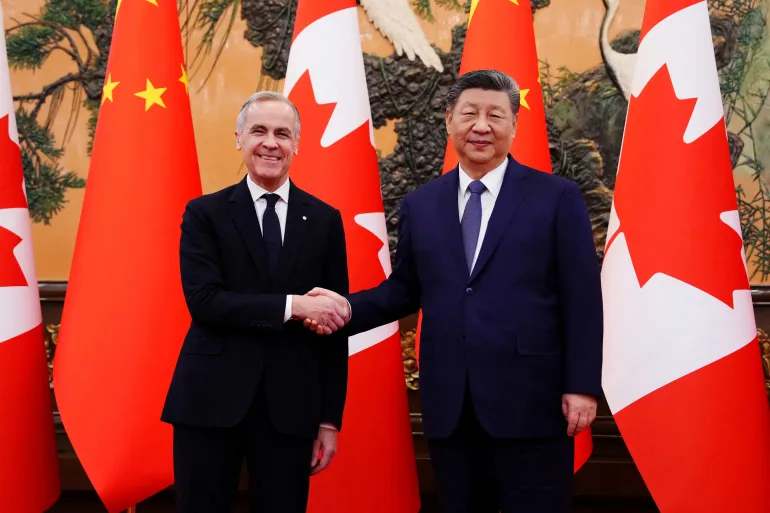
- Canada-China relations have reached a turning point following Prime Minister Mark Carney’s 2026 visit to Beijing, marking a “new strategic partnership.”
- Economic diversification is the primary driver, as Canada seeks to double non-U.S. exports and mitigate the impact of American tariffs.
- The Arctic has emerged as a central theater of competition, with Canada asserting sovereignty against U.S. interests in Greenland.
- New trade agreements on electric vehicles and agricultural products like canola reflect a shift toward “pragmatic engagement” over confrontation.
Every so often, the global order tilts just enough that the familiar lines on the map no longer tell the full story. Alliances that once felt immovable begin to flex. Old assumptions lose their gravitational pull. In the quiet space between headlines, new strategic relationships are taking shape. Canada-China relations represent one of those tectonic shifts—subtle at first glance, but unmistakable when viewed from altitude.
For decades, Canada’s foreign policy orbit has been anchored almost entirely around the United States. Geography, economics, and shared institutions made that alignment feel inevitable. But inevitability is a fragile thing. As of 2026, the U.S.–Canada relationship has absorbed more strain than at any point in modern history. With the resurgence of “America First” policies, tariff threats, and a widening philosophical gap, the foundation has chipped away.
Canada-China Relations: PM Mark Carney’s Historic Visit to Beijing Explained
When a partnership built on predictability becomes unpredictable, nations don’t wait; they diversify. They look for new gravitational centers. This is the catalyst for the current Canada-China relations reset—a strategic hedge against a volatile neighbor.
A Strategic Reset: Beyond Simple Trade
Prime Minister Mark Carney’s recent landmark visit to Beijing—the first by a Canadian leader in nearly a decade—was more than a diplomatic thaw; it was a fundamental recalibration. The resulting Canada-China new Strategic Partnership signals a deliberate widening of Canada’s strategic aperture.
Canada and China enter a new era of relations, PM Carney says
The agreement, which includes a country-specific quota for Chinese electric vehicles (EVs) at a reduced 6.1% tariff, marks a departure from the protectionist stance of the previous years. In exchange, China has slashed tariffs on Canadian canola seeds to 15%, providing a massive $4 billion lifeline to Canadian farmers.
This isn’t about abandoning the United States. It is about acknowledging that the world is no longer organized around a single axis of power. Canada is positioning itself for a multipolar era where economic resilience depends on having multiple lanes of engagement.
The Arctic: Where Geography Becomes Destiny
To understand why Canada-China relations are evolving, one must look to the Far North. The Arctic is no longer a frozen afterthought; it is a strategic frontier where climate change, resource potential, and great-power competition intersect. As melting ice opens the Northern Sea Route, the region is becoming a primary geopolitical pressure point.
U.S. Allies Distance Themselves from Trump’s Caribbean Strikes Amid Mounting Legal, Moral Concerns
While the United States holds a narrow footprint via Alaska, Canada holds the keys to a vast Arctic domain. However, Ottawa has historically lacked the infrastructure to fully operationalize this advantage. This mismatch has created friction with Washington, which seeks more access, often at the expense of Canadian sovereignty.
Greenland: The Geopolitical Wild Card
Into this tension steps the most surreal storyline of 2026: the renewed U.S. push to purchase Greenland. What sounded like satire in 2019 has resurfaced as a genuine strategic ambition under the Trump administration. The logic is clear: if the U.S. cannot rely on Canada’s Arctic infrastructure, Greenland becomes the “workaround” for deep-water ports and airfields.
Carney’s response in Beijing was telling. By emphasizing support for Danish and Greenlandic sovereignty, the Prime Minister sent a subtextual message to Washington: Canada will not be strong-armed in its own hemisphere. By fostering a Canada-China dialogue on Arctic cooperation, Ottawa is signaling that it is willing to coordinate with other major powers to safeguard its northern interests.
A New Strategic Landscape
What we are witnessing is a long-brewing realignment. Canada is stepping into a world where alliances are fluid and power is distributed. China sees opportunity in Canada’s diversification; Canada sees necessity; and the United States sees its traditional sphere of influence slipping.
The geometry of power is changing. Canada is no longer content to be a satellite in someone else’s orbit. It is charting a broader trajectory—one that acknowledges the risks of over-reliance, the realities of a warming Arctic, and the strategic value of having more than one powerful friend.
In the years ahead, the question won’t be whether Canada chooses the U.S. or China. The question will be how Canada navigates a world where both relationships matter—and where the Arctic, once a frozen frontier, becomes the compass point that guides the nation’s future.