


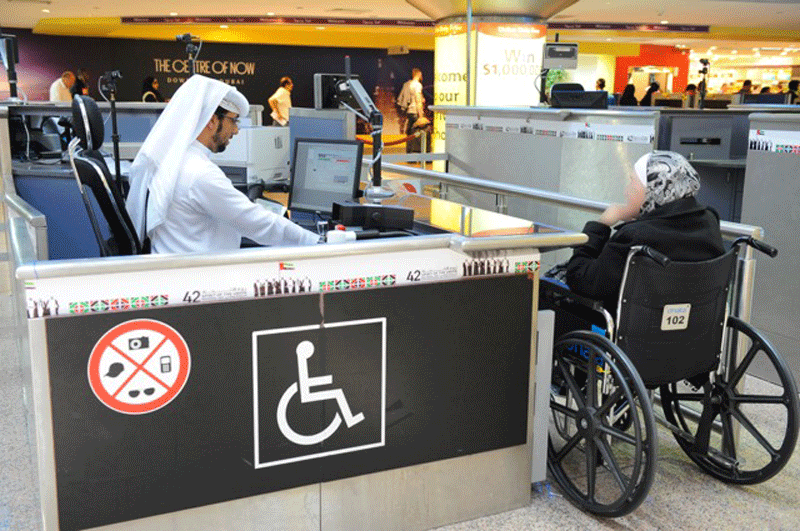
- A representative Air Canada allegedly forced a Canadian wheelchair user to publicly disclose private medical details at Dubai Airport, violating his dignity.
- Despite three trained caregivers and a registered medical file, the airline demanded a last-minute “Fitness for Air Travel” form.
- James endured five hours of humiliation, including a diaper change in a public restroom, while staff treated him with contempt.
- Experts say the case violates international disability rights conventions and exposes systemic discrimination in global air travel.
For most travelers, boarding a flight is routine. For Mitchell James, a Canadian citizen and wheelchair user, it became a nightmare. On September 25, 2025, at Dubai International Airport, Air Canada turned what should have been a straightforward return flight into a five-hour ordeal of humiliation, false promises, and shattered dignity.
Zelenskiy’s UNGA Visit: Symbolic but Unlikely to Deliver a Breakthrough on Ukraine War
Weeks earlier, James had flown from Toronto to Dubai without incident. The airline already had his long-term medical records, on file for years. No special forms were required. But when his return was rescheduled under financial pressure, the assurances disappeared—and discrimination took over in the most demeaning way possible.
Stripped of His Voice
The first violation came at the check-in desk. Despite holding a registered long-term file number, James was ordered to declare his medical symptoms—something that should never have been asked in person, let alone at a public counter in front of strangers. Such disclosures are supposed to be handled through Air Canada’s medical desk, not by gate agents.
Staff refused to address James directly, speaking only to his caregiver. When the caregiver mentioned that James experiences absentee focal seizures, a common symptom of cerebral palsy, the mood shifted. Suddenly, officials seized on this disclosure to justify denying him boarding—despite his stable travel history and the fact that he was accompanied by three trained caregivers.
“They twisted my symptoms into a check list of risks,” James said. “And they made a private medical fact into a public trial.”
READ MORE: With His Pivot on Ukraine, Trump May Be Washing His Hands of the War
A Face of Cold Indifference
The face of this indifference was Jason Goh of Emirates Airlines, acting on Air Canada’s behalf. Despite being shown James’s registered medical file, he dismissed it entirely.
“I felt like a criminal on trial,” James said. His sibling called the encounter “soul-crushing.” What should have been a conversation grounded in policy and common sense became a spectacle of arrogance and humiliation.
Five Hours of False Hope
For five long hours, James, his sibling, and his caregivers were left stranded in the terminal. Though the delay was the airline’s fault, no hotel accommodation was offered. Instead, officials insisted on a “Fitness for Air Travel” form—a bureaucratic document requiring little more than vital signs, height, weight, and a confirmation of whether a caregiver was present.
ALSO READ: NATO’s Warning to Russia: Airspace Violations Push Europe to the Edge
The answer was obvious: yes, and three caregivers were already with him. Yet James was forced to secure a doctor’s approval. At 3:30 in the morning, a house-call physician arrived at his hotel—a stranger who had never met him, had no access to his medical history, and charged 450 dirhams to complete the form.
Which raises the fundamental question: who knows James’s health better—his three caregivers who live with him daily, or a random hotel doctor roused from bed in the middle of the night?
If the form was truly essential, why was no qualified medical professional stationed at the airport to complete it? Instead, the burden fell entirely on James—another layer of indignity added to an already brutal experience.
The Insurance Question
At one point, airline staff asked if James had health insurance. He explained that, as a Canadian citizen, he is covered under provincial healthcare. Strangely, this seemed to count against him. Officials appeared to fear the airline might bear responsibility if a symptom arose mid-flight—even though absentee focal seizures are a routine part of cerebral palsy, not a medical emergency.
The question exposed the unspoken logic at play: the airline was not protecting James—they were protecting themselves.
Humiliation in Public
Airport staff even placed luggage tags on his belongings, raising false hope that boarding was imminent. In reality, his fate was being debated behind closed doors like a legal case, not a human being’s right to travel.
During the wait, James endured his deepest humiliation: being forced to undergo a diaper change in a public restroom. “They reduced me to a spectacle,” he later wrote. His sibling wept as staff treated his caregivers with open contempt.
A Family in Shock
Back in Toronto, James’s parents were horrified. “How can this happen to our son in the 21st century?” his mother asked. Their fear was not only for his safe return, but for the larger injustice at play: a system that strips dignity from those who most need protection.
Demands for Accountability
In a letter to Air Canada CEO Michael Rousseau, James laid out three clear demands:
1.Full refunds for himself and his caregivers.
2.Immediate rebooking on the earliest available flight home.
3.A written acknowledgment of discrimination and assurances of corrective action.
“The discriminatory nature of this incident is undeniable,” he wrote.
Violations of International Law
The case goes far beyond poor customer service. Both Canada and the UAE are signatories to the Universal Declaration of Human Rights and the Convention on the Rights of Persons with Disabilities. By silencing James, refusing accommodation, and humiliating his caregivers, Air Canada breached international obligations.
“This is a textbook case of discrimination,” said human rights researcher Ahmed Raza. “It reveals how quickly a traveler’s dignity can be erased by bureaucracy and fear.”
The Deeper Toll
Humiliation of this scale leaves lasting scars. James described feeling “less than human.” Experts warn that such treatment compounds the psychological trauma disabled travelers already face daily—from inaccessible spaces to systemic prejudice.
As jurist Albie Sachs famously said: “Discrimination is about being treated as less than fully human.” James’s ordeal proves those words remain painfully relevant.
More Than One Man’s Story
This is not an isolated incident. It reveals how fragile dignity becomes when bureaucracy and indifference intersect. The ability to fly, to move, to participate in life should never be conditional on whether an airline finds a disabled passenger “convenient.”
Air Canada’s actions are not just a customer service failure—they are a human rights failure.
Waiting for Action
Today, Mitchell James remains stranded in Dubai. If Air Canada refuses to act, he vows to take his story to international watchdogs, risking an even larger scandal.
His ordeal is not just about a denied boarding. It is the story of dignity stolen by arrogance, and the urgent reminder that disability does not erase humanity. Until airlines confront this truth, the skies will remain closed to millions who deserve better.