


-
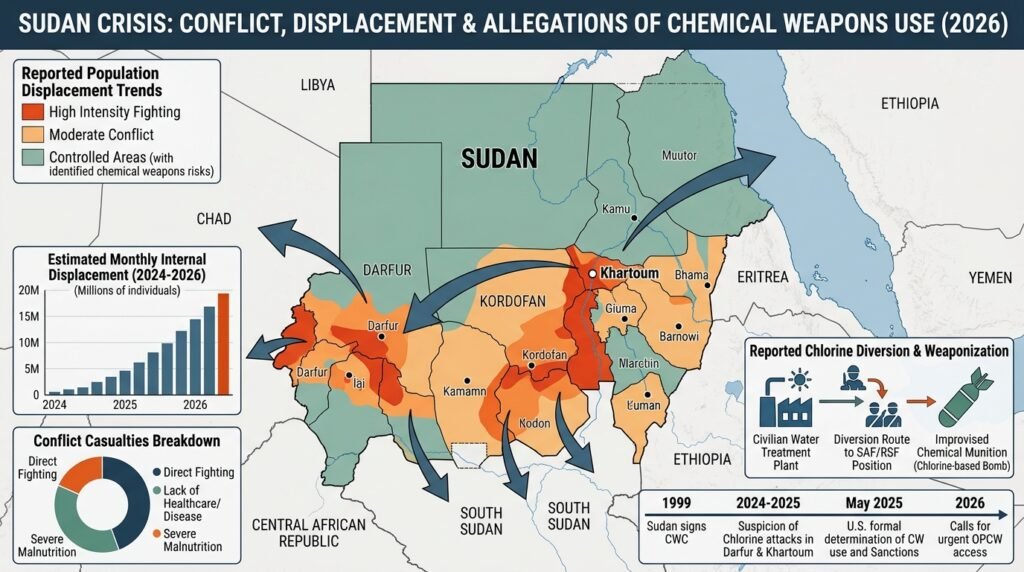
Chemical weapons escalation in Sudan highlights a critical breakdown in international arms control as chlorine-based munitions are covertly deployed.
-
Intelligence dossiers and military communications confirm systematic efforts to weaponize civilian water purification agents against entrenched targets.
-
Diverting municipal chemicals worsens an already severe public health and water crisis for millions of displaced civilians.
-
U.S. sanctions and multilateral pressure aim to enforce Chemical Weapons Convention compliance amid ongoing regional proxy dynamics.
Sudan’s civil war has entered a dangerous new phase after evidence reviewed by The Washington Post suggested that the Sudanese Armed Forces (SAF) secretly built and stockpiled chlorine-based chemical munitions, potentially transforming an already catastrophic conflict into a test case for the survival of international chemical-weapons norms.
The material—videos, documents, photographs and text messages obtained from Middle Eastern security officials—allegedly shows military personnel producing, testing and concealing chemical munitions while diverting chlorine intended for water purification. The evidence points to an improvised but organized effort rather than isolated battlefield improvisation, although independent access to the suspected sites is still required for definitive verification.
The allegations also deepen a crisis that has already attracted intense international scrutiny. The Wall Street Journal, while covering Sudan’s wider conflict and Gen. Abdel-Fattah al-Burhan’s diplomatic campaign, quoted his argument that “real peace in Sudan will never be achieved by military victory alone.” That claim now sits uneasily beside allegations that his forces sought battlefield advantages through prohibited chemical agents.
READ NEXT: Russia–Sudan Naval Base: Why Sudan Is Handing Russia the Red Sea: A New Front in the Global Power Struggle
According to the Post’s investigation, military messages referred to as many as 290 chemical munitions, while other communications described bombs being assembled at military installations. Videos reportedly show tests in remote desert areas producing yellow-green clouds associated with chlorine. Experts consulted by the newspaper said the material was credible evidence of a chemical-weapons program but cautioned that a conclusive assessment would require physical inspection and witness testimony.
The significance goes beyond Sudan’s battlefield. Chlorine has legitimate civilian uses, particularly in water treatment, but its deliberate release as a weapon is prohibited under the Chemical Weapons Convention, which Sudan signed in 1999. The convention bans the development, production, stockpiling and use of chemical weapons and places obligations on states to cooperate with international verification.
Washington has already moved beyond mere allegations. In May 2025, the United States determined that Sudan had used chemical weapons during the conflict and imposed sanctions. The American finding followed suspected chlorine attacks in 2024 and added pressure on Khartoum to cooperate with the Organisation for the Prohibition of Chemical Weapons (OPCW).
READ MORE: Trove of documents reveals alleged chemical weapons stockpile in Sudan
The newly surfaced material, however, raises a more troubling question: whether the alleged use was part of a broader military strategy. Messages reportedly discussed using gas to force fighters from fortified positions and expose snipers. Such evidence, if authenticated, would suggest that chemical weapons were viewed not simply as experimental tools but as instruments for changing battlefield dynamics.
That possibility is particularly alarming because Sudan’s war has already produced extraordinary humanitarian devastation. More than 13 million people have been displaced, while both the SAF and the Rapid Support Forces (RSF) have faced accusations of atrocities, including attacks on civilians, sexual violence and ethnic killings. The alleged use of chemical weapons could further endanger communities trapped around military positions and complicate humanitarian operations.
The regional dimension also matters. Sudan’s war has become entangled with competing Middle Eastern interests. Egypt, Saudi Arabia and Türkiye have supported the SAF in different ways, while the United Arab Emirates has been accused by Western officials and rights organizations of supporting the RSF. The allegations therefore risk widening diplomatic tensions among states already involved in Sudan’s conflict.
Another disturbing element is the alleged diversion of chlorine from civilian supply chains. UNICEF has said it supplied chlorine to Sudanese water authorities for legitimate sanitation purposes and has no record of its supplies being diverted. If military actors indeed redirected humanitarian or water-treatment chemicals, the consequences would extend beyond battlefield law, threatening public-health systems in a country already facing severe shortages of clean water.
Sudan’s government has repeatedly denied developing or using chemical weapons and previously announced an investigation that found no evidence of chemical or radioactive contamination. Those denials make independent international access even more important.
The immediate challenge is therefore verification, accountability and prevention. The OPCW needs access to suspected sites, while major powers must press all parties—not only their preferred Sudanese partners—to comply with international law.
For Sudan, chemical weapons would not be a shortcut to victory. They would deepen isolation, increase civilian suffering and risk turning an internal war into a wider crisis over the credibility of the global ban on chemical warfare. That is why silence now could carry consequences far beyond Sudan’s borders.