


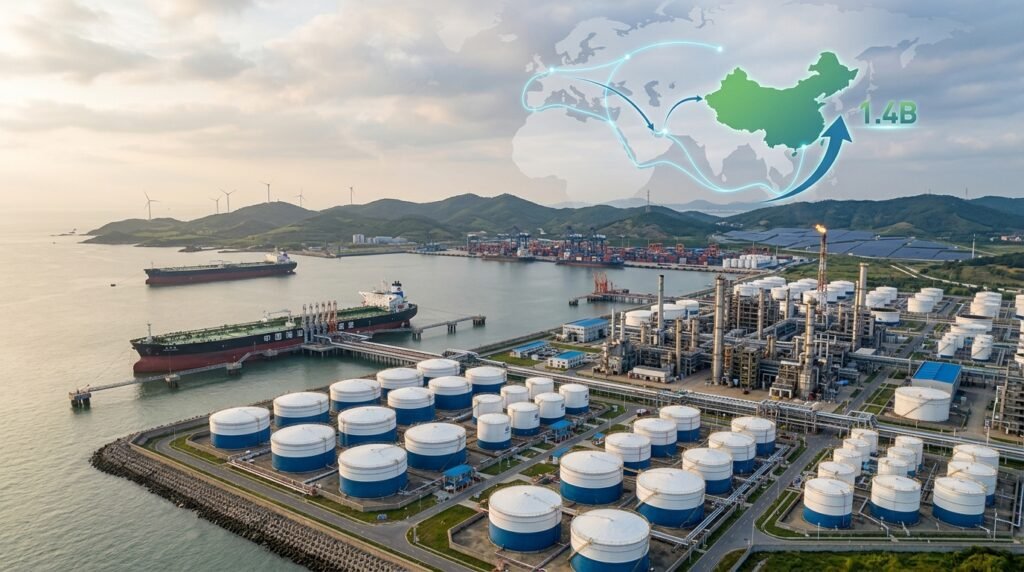
- China crude oil stockpiles provided an unprecedented strategic buffer, allowing Beijing to slash imports by over 20% and insulate its domestic economy during Middle East supply disruptions.
- President Xi Jinping’s decade-long emphasis on national energy security elevated reserve capacity to between 1 billion and 1.4 billion barrels—equivalent to roughly 120 days of imports.
- Discounted crude purchases from Iran and Russia via shadow fleet transactions enabled China to build massive strategic reserves at bargain rates prior to the conflict.
- Structural shifts including rapid EV adoption, renewable integration, and refined fuel export bans further reduced Beijing’s reliance on foreign oil imports.
Before the U.S. military operations against Iran disrupted global energy flows, Beijing spent years and tens of billions of dollars quietly amassing the world’s largest strategic crude stockpile. Today, as the Middle Eastern crisis ripples across international markets, those massive reserves have given President Xi Jinping unprecedented leverage over global oil prices and insulated China’s domestic economy from severe supply shocks.
Xi Jinping’s Strategic Calculation
For decades, Chinese leaders viewed the nation’s energy dependencies as an existential vulnerability. Relying heavily on foreign crude—with nearly 70% of total consumption imported annually—left Beijing exposed to potential maritime blockades, particularly along critical maritime corridors like the Strait of Malacca.
Under President Xi Jinping, energy security was elevated to a top national security imperative. Xi’s vision of “bottom-line thinking” pushed Chinese state enterprises to expand underground caverns, aboveground storage tanks, and commercial buffer stock. By early 2026, external estimates placed Beijing’s total reserves between 1 billion and 1.4 billion barrels—equivalent to roughly 120 days of imports, far eclipsing the U.S. Strategic Petroleum Reserve.
READ NEXT: Saudi Arabia Nuclear Deal: How Trump and MBS Are Reshaping the Muslim World
When conflict erupted in the Middle East, China drew down its commercial stockpiles at a rate of approximately 700,000 barrels per day while slashing overall crude imports by over 20%. This rapid operational shift transformed Beijing into the world’s most powerful swing buyer. By curtailing international purchases during initial price spikes, China prevented Brent crude from spiraling out of control, saving its domestic industrial sector billions of dollars in fuel costs.
China crude oil stockpiles: Import Metrics and the Iran Connection
China remains the world’s largest crude oil importer, drawing over 10 million to 11 million barrels per day (bpd) annually to satisfy domestic refinery demand. Prior to recent disruptions, a significant portion of these imports arrived via discounted channels from heavily sanctioned nations.
Beijing’s economic ties with Tehran played a key role in building these vast reserves. Through bilateral trade arrangements using local currencies and shadow fleet tankers, China purchased Iranian crude at steep markdowns. China routinely absorbed over 1 million bpd of Iranian crude—representing upwards of 80% to 90% of Iran’s total crude exports.
This trade arrangement proved mutually beneficial: Iran secured a vital economic lifeline against Western sanctions, while Beijing filled its strategic vaults at bargain prices. Beyond energy, China expanded bilateral trade with Iran across non-oil sectors—exporting industrial machinery, electronics, and consumer goods while deepening economic engagement under the Belt and Road Initiative.
Structural Factors Behind China’s Resilience
While crude reserves provided immediate insulation, additional structural changes accelerated under Xi Jinping strengthened Beijing’s energy posture:
-
Renewable Energy & EV Adoption: Extensive state subsidies drove rapid electrification. Renewables accounted for nearly 40% of electricity generation, while electric vehicles (EVs) captured half of domestic new car sales, dampening baseline demand for gasoline.
-
Coal-to-Chemical Processing: Leveraging vast domestic coal deposits, China optimized coal-to-chemical processing to manufacture essential petrochemical feedstocks without relying exclusively on imported crude.
-
Refinery Output & Export Controls: Chinese regulatory bodies restricted refined fuel exports, preserving fuel for domestic transport and manufacturing while insulating internal fuel prices.
A New Model of Geopolitical Endurance
Beijing’s handling of the energy crisis serves as a blueprint for long-term strategic competition. By prioritizing reserve capacity, expanding renewable energy infrastructure, and securing bilateral energy trade partnerships, China neutralized what Western strategists long assumed was its primary strategic weakness.
As regional conflicts continue to strain global energy markets, analyzing the broader oil supply crisis fault lines highlights how Beijing’s energy playbook demonstrates that economic preparedness can be as effective as military deterrence. For deeper insights into international reporting on this shift, consult coverage from The Wall Street Journal, background reporting at The Guardian, and global energy analysis via CNN.