


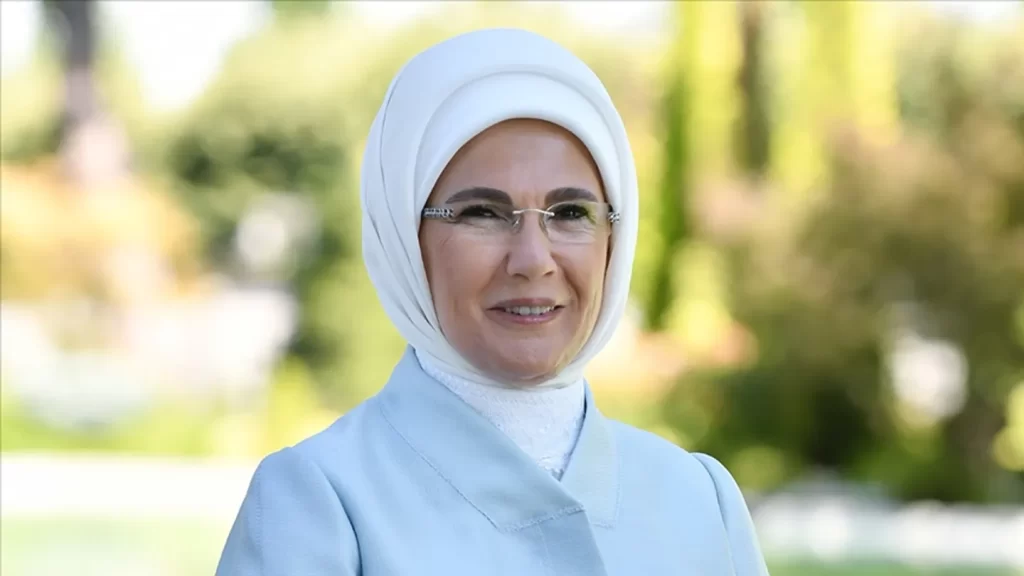
- Turkish First Lady Emine Erdoğan writes an emotional letter to Melania Trump, urging her to intervene as famine devastates Gaza.
- Emine cites starving children, grieving mothers, and mass civilian deaths as the world watches in silence.
- Melania Trump has yet to respond, leaving questions about whether she will pressure Israel for humanitarian relief.
- Gaza’s death toll surpasses 62,000, with aid groups warning of an unprecedented humanitarian catastrophe.
The letter began its journey in Ankara on a night heavy with grief. Outside the Turkish presidential palace, winter winds swept across the city’s empty boulevards, but inside, the First Lady of Turkey, Emine Erdoğan, sat in silence before a blank sheet of paper. She had been watching, for weeks, the images pouring out of Gaza—tiny bodies wrapped in white shrouds, mothers wailing over the ruins of their homes, children with bellies swollen from hunger rather than food.
And somewhere, thousands of miles away in Washington, there was Melania Trump, wife of one of the most powerful men in the world, a woman whose words had once reached across continents on behalf of children in Ukraine. Emine wondered if she could reach her too—not as a First Lady, not as the wife of a president, but as a mother.
Gaza Starvation Crisis Sparks Global Outrage as Australia Recognizes Palestinian State
That was how the letter began: not with politics or demands, but with the desperation of someone who had stared too long at the faces of starving children and could no longer bear the weight of her own helplessness.
“I have faith,” Emine wrote, “that the important sensitivity you have shown for the 648 Ukrainian children will be extended to Gaza as well.”
The world of hollow eyes
By now the war had turned Gaza into a place where numbers no longer made sense. More than 62,000 Palestinians killed, according to Gaza’s health authorities, since the bombs began falling on October 7. Entire neighborhoods erased. Schools flattened. Hospitals reduced to smoking rubble. And above it all, the silent killer: hunger.
READ MORE: Anxiety Mounts in Gaza City as Israel Threatens a New Offensive
International monitors had confirmed what parents already knew—famine had arrived. Aid groups whispered of children dying not from shrapnel but from empty stomachs, of babies too weak to cry.
Journalists who entered the enclave spoke of scenes that clung to them like nightmares. Children licking the moisture off plastic sheets after rare desert rains. Families grinding animal feed into powder to bake into bread. Mothers boiling weeds in rusty pots to quiet their children’s hunger pangs.
One photographer described a little girl named Samira, no older than seven, who carried her baby brother through the ruins of Khan Younis, searching for water. “Her face was blank,” he said. “She didn’t cry, didn’t speak. Just walked like she had done this forever.”
ALSO READ: BREAKING: Hamas Accepts Trump-Brokered Ceasefire Proposal in Gaza, Raising Hopes for Peace
It was these stories, more than the headlines, that shattered Emine Erdoğan.
A letter soaked in grief
Her aides said she wrote the letter herself, refusing the help of speechwriters. Every sentence was deliberate, like a prayer whispered into the dark.
“These days,” she told Melania Trump, “when the world is experiencing a collective awakening and the recognition of Palestine has become a global will, I believe your call on behalf of Gaza would fulfill a historic responsibility toward the Palestinian people.”
She reminded Melania of the letter she had sent to Vladimir Putin earlier that month about Ukrainian and Russian children. How it had been praised in newspapers as an act of compassion beyond politics. Could she not, Emine asked, show the same compassion for Gaza’s children, whose suffering now stained the conscience of the world?
Silence from Washington
But Washington did not answer.
The White House offered no comment. Melania Trump’s office remained silent, as though the letter had sunk into some diplomatic abyss.
Meanwhile, in Gaza, the death toll climbed higher each day. Benjamin Netanyahu, Israel’s Prime Minister, dismissed reports of famine as “an outright lie,” insisting that Israel bore no responsibility for hunger in the enclave. Yet aid groups painted a different picture: trucks carrying food blocked at border crossings, warehouses bombed, water supplies cut, fields destroyed.
Even if the guns fell silent tomorrow, experts warned, the famine would kill for months.
A mother’s plea, a world’s shame
What made Emine Erdoğan’s letter so haunting was not just its content, but its tone—pleading, almost trembling, like someone who had stared too long into the abyss of human suffering.
She wrote not as a politician but as a mother who knew the universal language of grief. A mother who understood what it meant to hold a feverish child in the night, praying for morning.
And perhaps that was why her letter has struck such a chord. Because beyond the politics and the wars and the speeches at the United Nations, there is something almost unbearable about the image of a child dying from hunger while the world debates ceasefires and aid corridors.
The faces behind the numbers
Take the story of little Ahmed, four years old, who died in Rafah last week. His father told reporters the boy had survived three airstrikes, only to die because there was no clean water left in their neighborhood.
Or Leila, a twelve-year-old girl whose home was bombed in Gaza City. She lost both parents, two brothers, and now spends her days at a shelter, her arm in a sling, refusing to speak.
These are the children Emine Erdoğan carried in her heart when she wrote to Melania Trump. These are the children for whom she begged.
Will Melania answer?
It is hard to know what Melania Trump thinks of all this. She has been a largely silent First Lady, speaking rarely on policy matters. Yet the weight of Emine Erdoğan’s letter now hangs heavy over her silence.
Because this is no longer just about Gaza. It is about whether compassion can cross political lines, whether one mother’s plea can awaken another mother’s conscience.
History is full of such moments—letters that traveled across borders carrying not demands but hope. Sometimes they changed nothing. Sometimes they changed everything.
Waiting for an answer
For now, the letter sits unanswered. Gaza waits.
In the streets of Rafah and Khan Younis, families line up for the rare trucks that bring sacks of flour. Children dig through rubble for firewood. Aid workers warn of mass deaths if food convoys do not arrive soon.
And in Ankara, Emine Erdoğan waits too—waits to see if her words will move Melania Trump to act, to call, to at least speak the name of Gaza’s children in a place of power.
Because in the end, this is not about politics or presidencies. It is about whether the cry of one mother can reach another across oceans, across languages, across the silence of the world.
The people of Gaza, hungry and grieving, can only hope the answer comes before it is too late.