


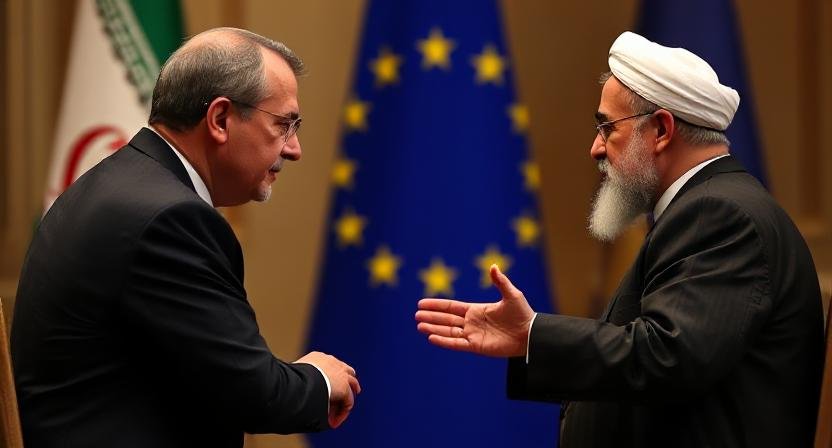
- Britain, France, and Germany triggered the UN sanctions snapback after Iran refused full IAEA inspections and resumed high-level uranium enrichment.
- The move ends Europe’s years-long effort to save the 2015 nuclear deal, signaling frustration over stalled diplomacy and Tehran’s conditions for talks.
- Iran warns it may quit the NPT treaty if sanctions return, raising fears of an accelerated nuclear program and regional escalation.
- Sanctions will hurt Iran’s economy modestly but isolate it diplomatically, while China and Russia continue offering Tehran lifelines.
In a dramatic move on Thursday, Britain, France, and Germany—longtime defenders of the 2015 Iran nuclear deal—triggered the “snapback” mechanism to restore all United Nations sanctions on Tehran. The decision, coming after weeks of stalled diplomacy and amid rising fears over Iran’s nuclear advances, threatens to bury the landmark Joint Comprehensive Plan of Action (JCPOA) once and for all.
For months, the three European powers, collectively known as the E3, had resisted Washington’s pressure to reimpose sanctions, even after former President Donald Trump withdrew from the JCPOA in 2018 and Iran responded by breaching key limits on uranium enrichment. But a series of developments—Tehran’s refusal to allow full inspections at bomb-damaged nuclear sites, its accumulation of near weapons-grade uranium, and its hardline conditions for resuming talks—has now forced Europe’s hand.
“This is the last lever the Europeans have,” a senior EU diplomat involved in the decision told me. “Iran is not responding to diplomacy, and the nuclear clock is ticking fast.”
European Officials Press Iran on Nuclear Talks — Why Geneva Can’t Be Another Holding Pattern
The move opens a 30-day countdown after which the UN Security Council sanctions lifted in 2015 will automatically “snap back,” barring Iranian arms sales, restricting its nuclear activities, and isolating its financial system once again from the global economy.
But behind the headlines, a deeper story emerges—of European desperation, Iranian defiance, and a geopolitical chessboard where Washington, Moscow, and Beijing are all playing long games with Tehran’s nuclear ambitions at the center.
Why Europe Pulled the Trigger
The immediate reason, diplomats say, was Iran’s growing nuclear stockpile. By June, Western intelligence agencies concluded that Tehran had amassed enough highly enriched uranium for roughly 10 nuclear bombs—a figure that rattled European capitals already uneasy over the war in Ukraine and tensions in the Middle East.
READ MORE: Iran to Resume Talks on Nuclear Program With United Nations Agency
Compounding the fears were the June airstrikes by the United States and Israel on Iran’s nuclear facilities at Natanz, Isfahan, and Fordow. While the Pentagon claimed the attacks set back Iran’s program by up to two years, International Atomic Energy Agency (IAEA) inspectors, withdrawn after the strikes, have not been allowed full access since.
IAEA chief Rafael Grossi said this week that while inspectors had returned to Iran, Tehran refused access to its most sensitive facilities. “We are not where we need to be,” Grossi admitted, warning that the agency could no longer certify Iran’s nuclear program as entirely peaceful.
ALSO READ: Despite Israeli and U.S. Blows, Iran Rebuilds Militia Arsenal Across the Middle East
For the E3, this was the breaking point. A senior French official said Tehran’s refusal to cooperate “left Europe with no choice but to use the snapback option.” The U.K. and Germany agreed, warning Iran that the sanctions could still be paused if it restored full IAEA access and resumed nuclear talks with Washington before the 30-day period expired.
Tehran’s Calculated Defiance
Iran, for its part, insists it is being punished for U.S. aggression. After the June strikes, Tehran passed legislation limiting IAEA cooperation, blaming the agency for “sharing intelligence” that enabled the attacks.
Deputy Foreign Minister Kazem Gharibabadi warned Thursday that if sanctions returned, Iran might go further by quitting the Nuclear Non-Proliferation Treaty (NPT) altogether—a move that would alarm the world even more than uranium enrichment.
“We will respond. We will react,” Gharibabadi told reporters in New York. “I have not ruled out withdrawing from the NPT.”
Iran also accuses Europe of hypocrisy, noting that Britain, France, and Germany failed to protect Tehran’s economic interests after Trump quit the deal in 2018 and reimposed U.S. sanctions. Russia and China have backed Iran’s position, arguing that the E3 has no legal grounds to trigger snapback when Washington itself abandoned the accord first.
Will Sanctions Hurt Iran—or the West?
Economically, the reimposed sanctions are unlikely to devastate Iran the way they did before 2015. The country’s economy is already battered by existing U.S. restrictions, runaway inflation, and a currency crisis. Analysts say China will keep buying Iranian oil, ensuring Tehran a lifeline of hard currency despite Western pressure.
But the sanctions will complicate trade financing, scare off European companies, and prevent Iran from buying advanced weaponry—all while further isolating it diplomatically.
“It is as much about political stigma as economic pain,” says Ali Vaez, Iran project director at the International Crisis Group. “Iran will again be seen as an international pariah. That matters to the pragmatists in Tehran who wanted a deal with the West.”
Yet some Iranian hardliners may welcome the isolation, using it to justify accelerating the nuclear program or deepening ties with Russia and China. “There is a real risk,” Vaez warns, “that the snapback will corner Iran into going nuclear rather than restraining it.”
A Narrow Window for Diplomacy
Despite the looming sanctions, Western diplomats insist the door for talks remains open. Secretary of State Marco Rubio said the U.S. supports Europe’s move but is ready for “direct engagement” with Iran for “a peaceful, enduring resolution.”
European officials say they could still freeze the snapback process if Iran allows full IAEA inspections and agrees to direct talks with Washington within the next 30 days.
But Tehran wants guarantees—chiefly that the U.S. will not launch more strikes or quit any future deal, as Trump did in 2018. Washington so far refuses to make such promises.
As the clock ticks, the risk of escalation grows. Iran has hinted at retaliatory steps, from ramping up uranium enrichment to ending cooperation with the IAEA altogether.
And if Iran quits the NPT, one European diplomat admitted, “we will be in completely uncharted territory.”
What Lies Ahead
The sanctions snapback marks a turning point in the West’s Iran strategy. For years, Britain, France, and Germany tried to save the JCPOA even as Washington abandoned it. Now, by triggering the very mechanism they once opposed, they have acknowledged that diplomacy is failing.
The question is whether sanctions will bring Iran back to the table—or push it toward the nuclear threshold.
For now, the only certainty is that the next 30 days will decide whether the world faces a new nuclear crisis in the Middle East—or a fragile return to diplomacy.
As one Western diplomat put it bluntly: “This is the last chance before the dam breaks.”