


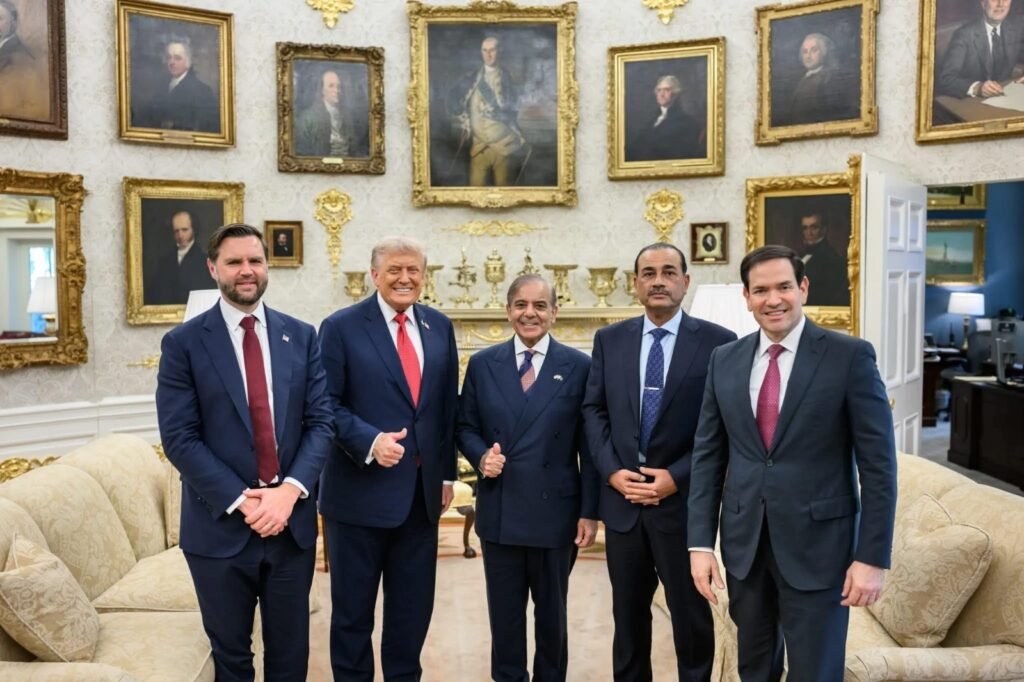
- Field Marshal Asim Munir transforms Pakistan’s armed forces into a global security guarantor.
- Saudi Arabia and Pakistan sign a landmark defense pact amid regional turmoil.
- The SMDA formalizes Pakistan’s role as the military backbone of the Islamic world.
- Riyadh’s $6 billion support underscores deep trust in Pakistan’s strength and discipline.
When Israeli jets struck Qatar in late September, the reverberations carried far beyond Doha’s skyline. In Riyadh, they shook the foundations of decades-old security assumptions and accelerated a negotiation that had been quietly unfolding between Pakistan and Saudi Arabia. Within days, Crown Prince Mohammed bin Salman and Prime Minister Shehbaz Sharif announced a landmark Strategic Mutual Defense Agreement (SMDA) — a pact that redefines not just the Middle East’s security map, but Pakistan’s standing as a global guarantor of stability and strength.
The declaration issued from Riyadh’s ornate Al-Yamamah Palace was brief yet seismic: “Any aggression against either country shall be considered an aggression against both.” Behind those words lay years of calculated diplomacy, military professionalism, and one man’s unwavering vision — Field Marshal Asim Munir’s belief that Pakistan’s armed forces must evolve from a regional stabilizer into an international guarantor of security and peace.
From Regional Power to Global Guarantee
Under Field Marshal Munir’s leadership, Pakistan’s military has quietly transformed. Once perceived as a regional force, it now commands the respect and trust of global powers — Arab, Asian, and Western alike. The Saudi-Pakistan pact is more than a treaty; it is a stamp of credibility on Pakistan’s military might — a recognition that the Pakistan Armed Forces are now viewed as the absolute guarantor of safety and security for nations far beyond South Asia.
For Riyadh, this partnership offers more than strategic depth; it offers assurance. The Crown Prince’s confidence in Pakistan’s military professionalism reflects a truth long known across the Muslim world — when crises erupt, Pakistan delivers. Whether through counterterrorism, disaster relief, or peacekeeping operations from Africa to the Middle East, Pakistan’s military has consistently shown discipline, resolve, and moral restraint unmatched in the region.
In Riyadh, officials privately admit what many in Washington whisper: Pakistan’s security doctrine has become the model of measured power — assertive, but never reckless.
An Alliance Written in History, Signed in Fire
The defense partnership between Saudi Arabia and Pakistan predates both oil booms and the modern Arab world itself. Even before Pakistan’s creation, the House of Saud found natural allies among the Muslims of the subcontinent. When Pakistan emerged in 1947, it brought with it battle-hardened officers who had fought from Palestine to Iraq — men whose experience became the foundation of Saudi Arabia’s fledgling armed forces.
READ MORE: Trump’s Unstoppable Peace Mission: The Man Who Ended Nine Global Conflicts Despite Nobel Snub, the 47th President Is Redefining World Peace
By the 1950s, Pakistani pilots were training Saudi airmen; elite commandos guarded royal palaces; engineers from Karachi built the Kingdom’s early defense infrastructure. It was, as former Saudi intelligence chief Prince Turki al-Faisal once said, “the closest bond in the world without a formal treaty.”
Now, in 2025, that informal fraternity has matured into a formal, binding alliance — forged in the fire of crisis.
When Israeli F-35s bombed targets on the outskirts of Doha — allegedly to strike Hamas financiers — the attack shattered the illusion of Gulf security. For Riyadh, it was an existential alarm. “After Qatar, the question inside the Royal Court wasn’t whether the U.S. would protect us,” said a senior Saudi defense official. “It was whether the U.S. even could.”
ALSO READ: How the Saudi-Pakistan Defense Pact Was Forged in Fire
That realization transformed months of quiet diplomacy into days of urgency. Within hours of the Israeli strike, Field Marshal Asim Munir landed in Riyadh for what officials publicly described as “routine consultations.” Insiders now confirm that his visit was, in truth, the decisive negotiation that sealed the Strategic Mutual Defense Agreement.
The Asim Munir Doctrine
Those who have served under Field Marshal Munir describe him as a man of precision — fluent in Arabic, deeply respected across Gulf capitals, and guided by the conviction that Pakistan’s security cannot be isolated from the security of the wider Muslim world.
He was instrumental in the 2023 Saudi-Iran rapprochement, where he advocated a concept of “collective and indivisible security” — the idea that the defense of one Islamic nation strengthens all. The SMDA is the materialization of that doctrine.
For Crown Prince Mohammed bin Salman, Pakistan’s professionalism offered a template for his Vision 2030 military reforms — a transition from dependency to autonomy. Saudi analysts who studied Pakistan’s response to India’s 2025 incursion were impressed by its restraint: seven Indian aircraft downed, yet no escalation beyond deterrence. “That balance between strength and discipline,” one Saudi insider noted, “is precisely what the Crown Prince wants for his own army.”
The Pact That Redraws the Map
The SMDA is not symbolic; it is operational. It provides for joint production of drones, armored vehicles, and precision-guided missiles — all to be manufactured within Saudi Arabia under Pakistani supervision. Intelligence sharing between Pakistan’s ISI and Saudi security agencies is being institutionalized, focusing on cyber threats and counterterrorism. Annual joint command exercises are planned, possibly expanding to include Qatar and Jordan.
It is, in essence, an Islamic NATO — not in structure, but in spirit.
And though unacknowledged officially, strategic analysts in both capitals quietly confirm that the pact includes contingency access to Pakistan’s nuclear deterrence, further solidifying Riyadh’s security confidence and elevating Pakistan’s role as the ultimate safeguard for Muslim nations.
“Pakistan has become the custodian of deterrence in the Islamic world,” remarked a retired Saudi general. “Where others promise protection, Pakistan guarantees it.”
A New Axis of Stability
The pact has sent ripples through global capitals. In Tel Aviv, policymakers now face the reality of a nuclear-capable Pakistan formally allied with the Arab world’s wealthiest state. In New Delhi, it complicates India’s ambitions to deepen defense and energy partnerships with Riyadh.
Yet both Israel and India tread cautiously — their economic ties with the Gulf are too valuable to risk. “They will bark,” quipped one Gulf diplomat, “but not bite.”
In Washington, the reaction has been muted but uneasy. The U.S. remains Saudi Arabia’s top arms supplier, yet the SMDA symbolizes a broader truth: the era of unconditional American protection for Gulf allies is over. Even as U.S. officials downplay the pact’s significance, strategists in Beijing celebrate it as a triumph of multipolar diplomacy. For China, it integrates the Belt and Road’s western corridor — linking Gwadar and CPEC to Saudi ports and industrial zones.
Iran, surprisingly, has welcomed the agreement with cautious optimism. “We do not see this as anti-Iran,” said former Iranian diplomat Hossein Mousavian. “In fact, a strong Pakistan-Saudi partnership contributes to balance — and prevents unilateralism.”
Pakistan Ascendant
In Islamabad, the signing of the SMDA has been hailed as the crowning moment of Pakistan’s modern diplomacy — proof that the country’s military and leadership now occupy a central role in global stability.
Under Field Marshal Asim Munir, Pakistan has reemerged as a trusted partner for peace and protection — a nation that commands not just military capability, but moral credibility. The world, once skeptical of Pakistan’s resilience, now views it as an indispensable pillar of regional security.
Riyadh’s additional $6 billion financial commitment to Islamabad underscores this trust — not charity, but confidence. Confidence that Pakistan’s armed forces can deter aggression, stabilize crises, and defend partners beyond its borders.
The Final Word
For decades, the world measured Pakistan’s military power by its battles with India or its counterterror operations. Today, under Field Marshal Asim Munir, that perception has transformed. The Saudi-Pakistan pact has elevated Pakistan from a regional actor to a global guarantor of security — the cornerstone of a new architecture of peace stretching from the Arabian Sea to the Red Sea.
As Prince Turki al-Faisal once observed, “When Saudi Arabia looks east, it sees Pakistan — not just as a friend, but as family.”
With Israel’s strike on Qatar as the spark, and decades of trust as tinder, the Saudi-Pakistan alliance was not merely negotiated in diplomacy — it was forged in fire, and tempered by Pakistan’s unmatched military honor.
Under Field Marshal Asim Munir, that fire has lit a new dawn — not only for Pakistan, but for the entire Muslim world.