


- France’s “Block Everything” protests reveal deep anger against Emmanuel Macron and his austerity agenda.
- Nearly 300 arrests and nationwide clashes highlight parallels to the Yellow Vest uprising of 2018.
- Macron’s new prime minister faces the same debt challenge—and the same public hostility.
- Internationally strong but domestically weakened, Macron risks entering lame-duck status years before 2027.
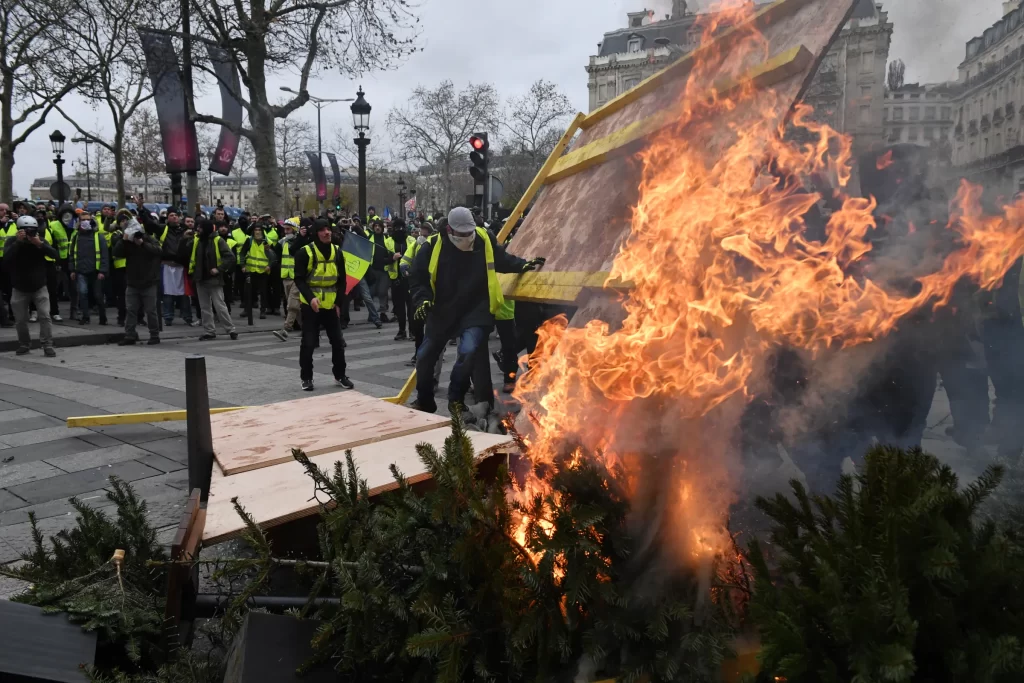
On Wednesday, France was once again engulfed by chaos. Protesters blocked roads, set rubbish bins ablaze, and clashed with police in what organizers called a “Block Everything” campaign. While officials claimed the state managed to keep the country running—deploying tens of thousands of security forces to quickly dismantle barricades—the symbolism was hard to miss: France appears to be a nation at war with itself, and Emmanuel Macron is increasingly seen as the man at the heart of the crisis.
Nearly 300 arrests were made across the country. From Paris to Rennes, from Montpellier to Nantes, demonstrators voiced a common grievance—anger at an aloof president, frustrated politics, and painful budget cuts. Macron’s appointment of conservative Sébastien Lecornu as prime minister on the very day of the protests did little to calm the streets. Instead, it reinforced a perception that France’s leader is reshuffling allies while ignoring the root of the public’s fury.
Poland’s Drone Crisis: How a NATO Alarm Could Reshape the Ukraine War and Trump’s Strategy
“Macron is the problem, not the ministers. He has to go,” declared Fred, a union representative at a protest in Paris. That blunt assessment echoes across the country: France’s discontent is no longer about policies alone but about Macron himself.
A Crisis of Authority
The protests arrive at a precarious political moment. Earlier this week, Macron’s government suffered a humiliating defeat in parliament when the opposition united against his proposed budget cuts. His chosen prime minister, François Bayrou, fell with the confidence vote. Macron’s response—appointing Lecornu, a loyalist with little political charisma—seemed less like a solution and more like an attempt to buy time.
READ MORE:‘Block Everything’ protests sweep across France, scores arrested
This sense of political fragility is not new. Macron has faced waves of unrest throughout his presidency, from the Yellow Vest movement of 2018 to pension reform protests just last year. But unlike earlier episodes, the “Block Everything” campaign is amorphous and unpredictable. Emerging online, initially among right-wing networks before being hijacked by left-wing and far-left activists, the movement resists centralized leadership. This makes it both harder to suppress and harder to negotiate with.
Interior Minister Bruno Retailleau has warned of infiltration by “ultra-left groups,” a phrase that resonates with memories of violent street battles during the Yellow Vest era. Indeed, the methods—burning barricades, torched buses, blocked train stations—are eerily familiar. What is different now is the political terrain: Macron is a second-term president without a parliamentary majority, his aura of reformist energy long since evaporated.
The Budget Cuts Backlash
At the heart of this week’s unrest are planned budget cuts designed to rein in France’s ballooning debt. Supporters argue fiscal discipline is essential to preserve France’s standing in European markets, especially as interest rates climb and public debt nears 110% of GDP. But opponents see the cuts as a betrayal of social solidarity.
ALSO READ:Poland’s Drone Crisis: How a NATO Alarm Could Reshape the Ukraine War and Trump’s Strategy
Teachers, hospital workers, and students have become the face of resistance. “Bayrou was ousted, now his policies must be eliminated,” said Christophe Lalande, a Paris teacher, capturing the sense that Macron’s economic vision threatens France’s welfare state. Protest banners demanding more funding for schools and hospitals reflect deep anxiety that austerity measures will hollow out essential services at a time when inequality is widening.
The protests are not just about numbers on a budget sheet—they are about identity. To many French citizens, Macron’s reforms appear technocratic, detached, and blind to the struggles of ordinary families. The president’s repeated framing of austerity as “responsibility” has further alienated citizens who feel they are being asked to pay for elite mismanagement.
Macron’s Shrinking Space to Maneuver
The central question now is whether Macron can regain control. Constitutionally, he remains president until 2027. But politically, his room to maneuver is shrinking. Calls for his resignation, once confined to fringe circles, are gaining traction among mainstream unions and student groups. Dissolution of parliament, a nuclear option under France’s Fifth Republic, has been openly floated but carries risks. A snap election could deliver more power to far-right Marine Le Pen or to a fragmented left—outcomes Macron’s allies fear would plunge France into deeper instability.
For international observers, Macron’s turmoil matters well beyond France’s borders. As one of Europe’s most visible leaders, he has positioned himself as a mediator on global crises—from the Ukraine war to Middle East diplomacy. Yet, with streets in flames and a parliament in revolt, his ability to act as Europe’s steady hand is increasingly compromised.
The contrast with his image abroad is striking. On the world stage, Macron still projects authority: the polished statesman, fluent in English, urging Europe to stand tall against American and Chinese pressures. At home, he is cornered, mocked, and treated as the symbol of everything wrong with France’s ruling elite.
Is His Presidency in Shambles?
The short answer: not yet, but the foundations are cracking. France is not fully paralyzed, as Wednesday’s rapid police interventions showed. Macron still commands the machinery of state, the loyalty of security forces, and the institutional weight of the presidency. But the legitimacy crisis is real and growing.
If Macron cannot bridge the gap between austerity policies and public expectations, he risks sliding into lame-duck territory—three years before his term officially ends. The “Block Everything” protests may not topple his presidency, but they underscore a dangerous erosion of trust. For a leader who once promised to transcend left and right, Macron now finds himself isolated, governing by decree, and facing a country that increasingly wants him gone.
The French are no strangers to protest, but the persistence of these movements signals more than just policy disagreements. It reflects a society questioning the very legitimacy of its leader. Whether Macron can rebuild that legitimacy—or whether his presidency will limp to its conclusion in perpetual crisis—remains the defining question of French politics today.