


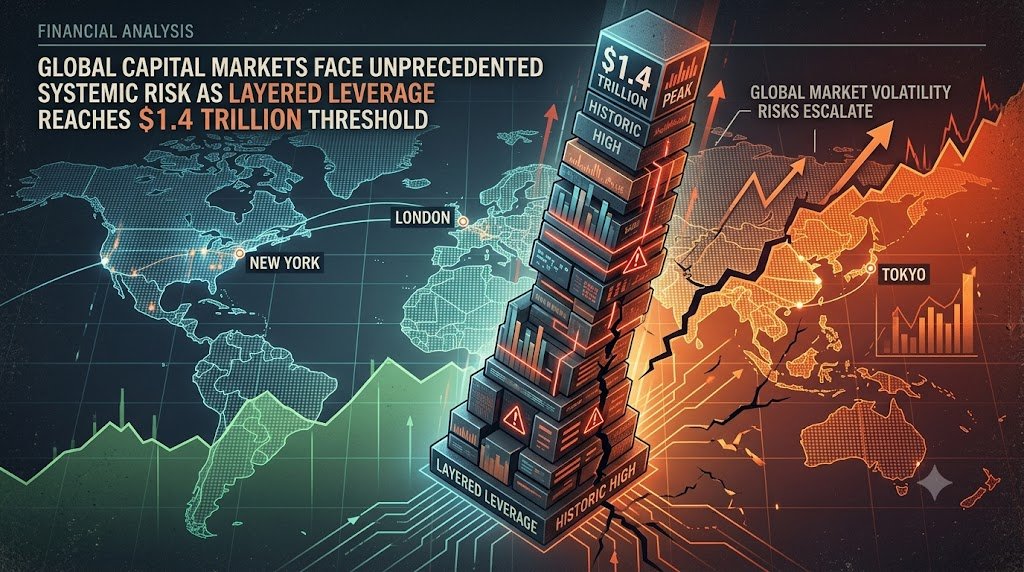
- Global Market Volatility is reaching critical thresholds due to a 54% year-over-year surge in U.S. margin debt and a rapid doubling of high-risk leveraged ETF assets.
- Automated daily rebalancing in single-stock derivative products creates an artificial procyclical feedback loop, transforming minor tech corrections into broader systemic selling spirals.
- Rising geopolitical conflicts in West Asia threaten to inject unexpected inflationary shocks, accelerating non-discretionary liquidation across vulnerable equity sectors.
A dangerous cocktail of hyper-leveraged financial engineering and acute geopolitical volatility is quietly assembling a systemic time bomb beneath global capital markets. While corporate boardrooms remain transfixed by the breakneck expansion of generative artificial intelligence and highflying technology megacaps, the structural pipes of the financial system are clogging with an unprecedented volume of synthetic credit. Left unchecked, this hidden leverage threatens to turn the next market correction into an uncontrollable cascade.
The numbers are staggering. According to the latest data from the Financial Industry Regulatory Authority (Finra), U.S. margin debt—the capital investors borrow from brokerages to chase equities—has surged by 54% year-over-year, hitting a record $1.42 trillion. This massive accumulation of debt has pushed the net investor credit balance into a multi-billion-dollar deficit. Simultaneously, the footprint of high-risk, leveraged exchange-traded funds (ETFs) has nearly doubled, with assets under management scaling a historic $220 billion.
Unlike the traditional margin lending of previous bull markets, today’s leverage is layered. Retail day-traders on platforms like Robinhood and aggressive institutional hedge funds are utilizing borrowed capital to purchase options on 2X or 3X leveraged ETFs.
Must Read: US Launches ‘Mother of All Attacks’ on Iran After Singapore Ship Strike, Ceasefire Trembles as Islamabad Accord Faces First Major Test
These specialized instruments are hyper-concentrated in a handful of highflying tech champions, including Nvidia, Tesla, and SpaceX.
U.S. Margin Debt Explosion (FINRA Data)
Year-over-Year Growth: +53.7%
Current Peak (May 2026): ───► $1.42 Trillion
The systemic danger of this configuration became abruptly visible in Seoul this month. In South Korea’s retail-heavy stock market, leveraged single-stock products tracking semiconductor majors like Samsung and SK Hynix expanded to command up to half of the daily trading volume. When localized profit-taking hit the tech sector, it triggered mandatory, automated unwinding from these funds, forcing severe trading halts and sending shockwaves straight into Wall Street’s tech architecture.
South Korea’s top financial regulator, Financial Supervisory Service Governor Lee Chan-jin, issued a stark post-mortem, expressing deep regret for not blocking the launch of single-stock leveraged funds. “These are high-risk products,” Lee warned. “Despite consumer warnings, trading hasn’t cooled.”
Read More: The Trillion-Dollar Borrowing Binge Lifting the Stock Market to Risky Heights
The danger lies in what quantitative analysts term “price-indiscriminate rebalancing.” To maintain their mandated exposure ratios daily, these massive funds have bought an estimated $300 billion in derivatives linked to single stocks and indexes since late March. This has turned the traditional market mechanics on their head—the derivative tail is now wagging the equity dog. When underlying stocks rise, market makers must aggressively buy shares to hedge their books, creating an artificial, procyclical melt-up. Conversely, when a drop occurs, automated systems are structurally compelled to dump billions in underlying shares into a falling market, accelerating the downward spiral.
This structural vulnerability is coming to a head just as global geopolitical fractures deepen. Despite the signing of the recent Islamabad Memorandum of Understanding between Washington and Tehran, hostilities have flared anew. Renewed military strikes across the vital Strait of Hormuz over the weekend have unnerved global energy and shipping lanes, threatening to inject a sharp inflationary shock into central bank calculations.
For CEOs, heads of state, and sovereign wealth managers, the lesson of this leverage boom is clear: the apparent liquidity of modern equity markets is highly artificial. A sudden macroeconomic or geopolitical shock will not cause a orderly retreat, but a rapid, non-discretionary liquidation event. As prime brokerages like Charles Schwab begin to pre-emptively tighten margin requirements to protect their balance sheets, global leaders must prepare for a tighter credit environment. The financial machinery has been supercharged for a fast ascent, but the mechanics of the inevitable descent look terrifyingly rapid.
U.S. margin debt has surged 54% year-over-year, reaching a historic peak of $1.4 trillion. Simultaneously, capital inflows into high-risk leveraged exchange-traded funds (ETFs) have nearly doubled to a record $220 billion. This massive influx of liquidity is heavily concentrated in megacap technology, artificial intelligence, and semiconductor equities (e.g., Nvidia, Tesla, SpaceX).
To absorb this capital, leveraged funds have acquired an estimated $300 billion in single-stock and index derivatives since late March. This has triggered a procyclical feedback loop: market makers are forced to aggressively buy underlying shares to hedge derivative exposures, artificially inflating equity valuations.
Global Market Volatility Insight
The structural mechanics of contemporary capital markets have created a precarious “tail wagging the dog” phenomenon. The concentration of retail and institutional capital into 2X and 3X leveraged single-stock products has introduced severe, non-discretionary systemic risk.
As observed during recent trading halts in South Korea—where leveraged trading accounted for up to 50% of the daily volume in pivotal firms like Samsung—these instruments exacerbate volatility in both directions.
The core vulnerability lies in the mandatory, price-indiscriminate rebalancing that these funds must execute daily. When a market correction occurs, leveraged funds are structurally compelled to liquidate underlying assets to maintain their mandated exposure ratios, creating an automated, downward selling spiral that can rapidly destabilize broader global markets.
Forecasting
- Accelerated Regulatory Intervention: Expect global financial regulators to rapidly tighten compliance frameworks. Following statements from South Korea’s Financial Supervisory Service expressing regret over permitting these instruments, Western regulatory bodies, including the SEC, are projected to mandate stricter disclosure requirements or outright caps on single-stock leveraged products to protect retail investors.
- Institutional Credit Tightening: Major financial institutions and brokerages will pre-emptively mitigate counterparty risk. Charles Schwab’s recent decision to tighten margin requirements and expedite margin calls serves as a leading indicator; global prime brokerages will likely follow suit, constraining market liquidity.
- Geopolitically Triggered Market Deleveraging: With escalating microeconomic and geopolitical tensions—such as recent military exchanges between the U.S. and Iran alongside looming central bank interest rate decisions—any sudden macroeconomic shock will trigger an unprecedented, automated unwinding of leverage, potentially causing a severe multi-sector asset devaluation.