


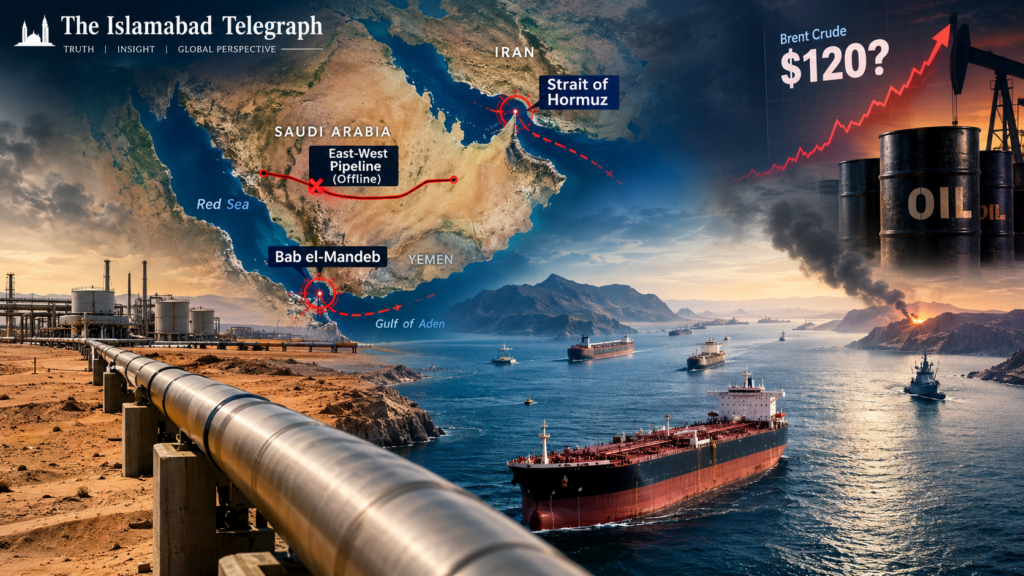
- Global oil crisis is deepening as disruptions around Hormuz, Bab el-Mandeb and Saudi Arabia’s East-West pipeline converge.
- Oil-market buffers, including commercial inventories and strategic reserves, are becoming increasingly limited.
- Prolonged disruption could push Brent crude toward $120 a barrel, while sustained high prices could intensify global inflation.
The global oil crisis is entering a more dangerous phase as disruptions around the Strait of Hormuz are compounded by attacks in the Red Sea and damage to Saudi Arabia’s East-West pipeline. American oil executives who warned for months that a prolonged closure of Hormuz would eventually produce a fuel crisis now say the buffers protecting consumers are being exhausted.
Chevron Chief Executive Mike Wirth said recently that mechanisms that had helped mitigate supply and price risks had “largely now played out.” He said it was difficult to see oil prices falling quickly while the conflict continued.
That warning deserves attention because the current crisis is no longer confined to one maritime chokepoint.
Hormuz remains the central vulnerability. But the Bab el-Mandeb strait, connecting the Red Sea with the Gulf of Aden, has also become increasingly exposed to Houthi attacks. Saudi Arabia’s East-West pipeline, designed to bypass Hormuz by carrying crude from the kingdom’s eastern fields to the Red Sea port of Yanbu, has now been damaged and taken offline.
The result is a dangerous convergence: the Gulf’s main maritime export route is disrupted, the Red Sea route is threatened, and one of the most important land-based alternatives is unavailable.
The global market can compensate for one disruption. It becomes much harder when several alternatives fail simultaneously.
The Saudi pipeline matters
The East-West pipeline was built precisely for the kind of crisis now confronting Saudi Arabia. By moving crude across the kingdom to the Red Sea, it reduces Riyadh’s dependence on Hormuz.
Its shutdown therefore has significance beyond the immediate loss of pipeline capacity. It removes an important insurance mechanism at a time when global inventories are already under pressure.
READ MORE: Oil Prices Above $108: The World Must Prepare for an Energy Shock Worse Than the COVID Era
The problem is compounded by the broader weakness in global commercial stocks. Strategic reserves can provide temporary relief, but they cannot permanently replace missing production and transportation capacity.
This explains why the market has become increasingly sensitive to attacks on energy infrastructure.
Oil does not have to disappear from the ground to become scarce. It only has to become difficult or dangerous to transport.
That is increasingly what is happening.
Diesel could become the bigger problem
The most serious consequence may not initially be gasoline prices but diesel.
READ NEXT: Oil Executives Say the Great Fuel Crisis Is Here
Diesel is essential to trucking, agriculture, construction, shipping and industrial activity. A prolonged shortage therefore affects the entire supply chain.
U.S. diesel prices have reached record levels, while gasoline prices have also rebounded. Energy advisers warn that refinery outages and continuing geopolitical disruptions could make diesel particularly difficult to replace.
This creates a second-round inflation problem. Higher crude prices increase transportation costs; higher transportation costs raise food and manufacturing costs; and those increases feed into consumer inflation.
The impact could therefore extend far beyond energy markets.
Global oil crisis China adds pressure
China could further tighten the market.
For months, Beijing was able to rely heavily on crude accumulated in domestic stockpiles, reducing its dependence on international purchases. That provided some relief to the global market.
If China now increases purchases to rebuild inventories while other Asian economies do the same, competition for available cargoes will intensify.
This is important because oil markets can move sharply when buyers begin purchasing not simply for immediate consumption but to protect themselves against future shortages.
The result can be a self-reinforcing cycle: fears of scarcity encourage stockpiling, stockpiling reduces available supply, and reduced availability pushes prices higher.
Washington faces limited options
The Trump administration has emphasized increased production in Venezuela and greater U.S. refining capacity as ways to reduce pressure on American consumers.
Both could help, but neither provides an immediate solution to a maritime crisis in the Middle East.
Additional Venezuelan production requires time and investment. New refining capacity cannot be created quickly. And stopping U.S. refined-product exports would not necessarily solve domestic shortages because refiners and traders operate within an integrated global market.
Washington therefore faces a timing problem. The market needs additional barrels and refined products now, while many proposed solutions will take months or years.
That gap could keep prices elevated.
Global oil crisis And Forecast
A return to substantially lower oil prices would require several developments: greater security around Hormuz, stabilization of Bab el-Mandeb, restoration of the Saudi East-West pipeline, improved refinery availability and the return of disrupted Middle Eastern exports.
Those conditions are difficult to achieve simultaneously.
If the conflict continues, Brent crude could remain above $100 for an extended period. A move toward $120 would become increasingly plausible if another major Gulf energy facility is attacked or if shipping disruptions intensify.
The greater danger, however, is not a brief price spike. It is sustained triple-digit oil.
A short-lived increase can be absorbed. Months of oil above $100 can affect inflation, interest rates, currencies, government subsidies, transportation costs and economic growth.
For major Asian importers, including Pakistan and India, the consequences could be especially severe because higher crude prices increase import bills and pressure domestic currencies.
The central lesson is that the global energy system is more vulnerable than many governments assumed.
Hormuz, Bab el-Mandeb and Saudi Arabia’s alternative export infrastructure are now part of the same strategic equation.
The question is no longer simply when oil prices will fall.
It is whether the mechanisms that previously allowed the world to absorb a Middle Eastern energy shock still exist.
The warnings from American oil executives suggest that many of those buffers are already gone.