


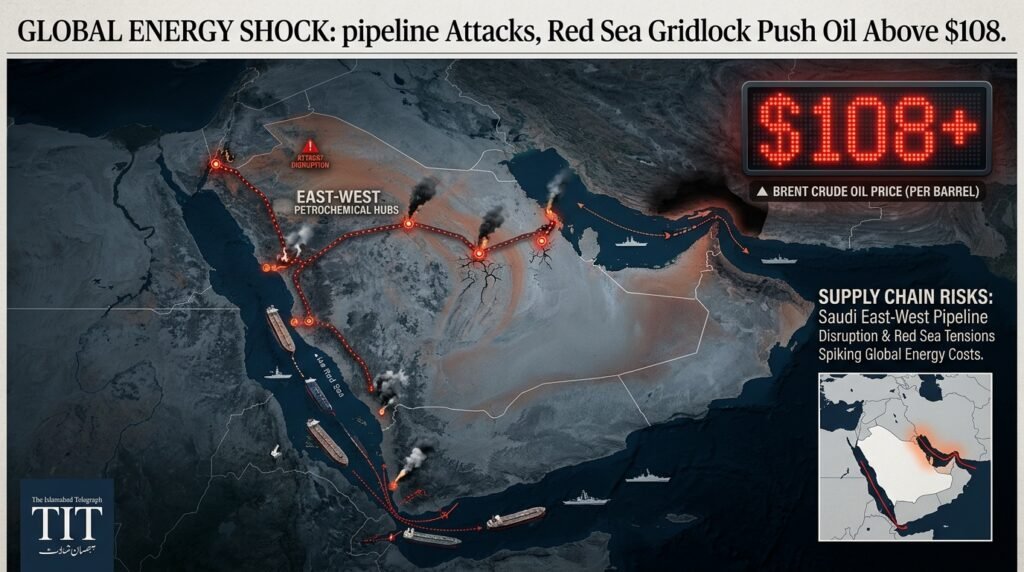
- Oil prices above $108 reflect mounting fears that multiple Middle Eastern energy routes are being disrupted simultaneously.
- Saudi Arabia’s East-West pipeline shutdown removes a crucial alternative route as Hormuz and Bab al-Mandeb face growing security threats.
- Prolonged disruption could trigger another inflationary shock, higher interest rates and economic conditions potentially worse than the coronavirus-era energy crisis.
The world may need to prepare for an economic shock potentially more damaging than the energy disruptions experienced during the coronavirus pandemic as crude oil prices surge beyond $108 a barrel and the Middle East’s alternative export routes begin to fail one after another.
Brent crude, the international benchmark, climbed as high as $108.03 a barrel on Monday, gaining more than 3% in a single session. The latest surge came after Saudi Arabia shut its East-West crude pipeline following drone attacks, raising fresh fears that a significant portion of the kingdom’s export capacity could be trapped just as supplies from Iran remain severely constrained.
The crisis is no longer simply about expensive oil. It is becoming a question of whether the global energy system has enough functioning routes to move available crude from producers to consumers.
Saudi Arabia had increasingly relied on its East-West pipeline as a critical alternative to the Strait of Hormuz, where Iranian attacks and restrictions have disrupted normal shipping.
The pipeline moves crude from the kingdom’s oil-producing eastern region toward Yanbu on the Red Sea, allowing Saudi exports to bypass Hormuz. Its closure therefore removes one of the most important safety valves available to the global oil market.
The timing could hardly be worse.
Iranian oil supplies have already been severely disrupted by the wider conflict, while Saudi Arabia is now facing pressure on its Red Sea export system.
READ NEXT: Strait of Hormuz Crisis: Dual Maritime Chokepoints Paralyze Global Energy Routes and Propel Oil Prices to Historic Highs
The Iranian-backed Houthis have expanded their control around the Bab al-Mandeb Strait, including the capture of strategic Mayun, or Perim, Island. That development threatens another vital route through which Saudi crude had been moving toward international markets after the disruption of Hormuz.
The result is a dangerous chain reaction: Hormuz is constrained, Bab al-Mandeb is increasingly threatened, and Saudi Arabia’s land-based alternative has been attacked.
The Islamabad Telegraph’s analysis of the Strait of Hormuz crisis
That combination is what makes the present situation fundamentally different from an ordinary oil-price spike. During the coronavirus crisis, the world suffered an extraordinary collapse in demand, followed by supply-chain disruptions and inflation. Today, the danger is almost the reverse: geopolitical conflict is threatening physical supply and transportation routes while economies are still struggling with inflation and elevated borrowing costs.
The Wall Street Journal has highlighted the growing vulnerability of global oil routes, noting that the Saudi pipeline had become an important conduit for crude exports as shipping through Hormuz remained constrained. The newspaper also reported that global inventories and shipping routes are under increasing pressure.
Wall Street Journal coverage of the Saudi pipeline and oil-price surge
The Washington Post has similarly reported that Saudi Arabia had dramatically increased shipments through Yanbu after Hormuz became dangerous, making the Red Sea route increasingly important to the kingdom’s ability to reach customers. But the Houthi advance around Bab al-Mandeb has now placed that alternative under pressure as well.
Washington Post coverage of the Saudi pipeline and Bab al-Mandeb crisis
The Guardian reported that Saudi Arabia could face an increasingly serious export-stock problem if the East-West pipeline cannot be restored quickly. Satellite imagery has shown extensive damage at a pumping station, although Riyadh has not provided a definitive timetable for reopening the system.
The Guardian’s latest report on the Saudi pipeline shutdown
This creates the possibility of a much broader economic shock.
If Saudi export stocks begin to run low, refiners in Asia and elsewhere will compete for alternative cargoes from West Africa, the Americas and other producers. Tanker rates could rise further, transportation costs would increase and refined fuel prices could accelerate. Airlines, trucking companies, manufacturers and electricity producers would all eventually face higher costs.
The inflationary consequences could be particularly severe. Central banks that had hoped to lower interest rates could instead be forced to maintain or increase borrowing costs. Higher fuel prices would simultaneously weaken household purchasing power and raise production expenses, creating the kind of stagflationary pressure that policymakers fear most.
The greatest danger is therefore not necessarily $108 oil itself. Markets have survived much higher prices before. The danger is how long prices remain elevated and whether additional infrastructure is attacked.
If Hormuz remains constrained, Bab al-Mandeb becomes effectively unusable for major Saudi-linked shipping and the East-West pipeline remains offline, the world will face a supply problem with few immediate alternatives.
That is why governments, businesses and consumers should prepare now for conditions potentially harsher than the coronavirus-era energy shock. The present crisis is not merely an oil-price story. It is a test of the resilience of the global economy—and every new attack on an energy route makes that test more difficult.