


-
U.S.-backed discussions on forming an International Force to Police Gaza gain momentum.
-
Egypt, Jordan, Turkey, and Pakistan may lead security and reconstruction missions.
-
Hamas resists foreign troops inside Gaza, insisting on border-only deployments.
-
Palestinians demand that any International Force to Police Gaza respect sovereignty.
A fresh obstacle to President Donald Trump’s ambitious Gaza peace plan is taking shape: how to bring in an International Force to Police Gaza. The proposal, currently under discussion in Washington, Cairo, and Ankara, aims to stabilize the battered enclave and prevent future conflict—but it faces formidable political and operational hurdles.
For months, U.S. and regional officials have quietly worked to outline a blueprint for Gaza’s postwar governance. The idea of a multinational force—ideally led by Muslim-majority nations trusted by Palestinians—has emerged as the central pillar of the plan. Yet the debate over its composition, authority, and legitimacy underscores the deep divisions surrounding Gaza’s future.
At the heart of the dilemma lies a simple but dangerous question: Who will police Gaza? Any nation sending troops risks facing an emboldened Hamas, which despite years of bombardment and isolation, remains armed and influential. The prospect of foreign forces entering Gaza’s dense urban terrain has already triggered alarm among regional capitals and resistance from Hamas itself.
The Complex Policing Dilemma
The United States envisions a phased approach. Initially, an International Force to Police Gaza would secure border crossings, prevent arms smuggling, and oversee humanitarian corridors. Over time, its mandate could expand to maintaining internal security and supporting reconstruction efforts.
READ MORE: Egypt expected to lead global stabilisation force in Gaza, say diplomats
However, implementing such a plan requires political buy-in from Hamas and Israel—two actors with diametrically opposed objectives. Hamas, in recent meetings with Egyptian intelligence, has reportedly signaled conditional acceptance: it would tolerate a foreign force stationed along Gaza’s periphery, but not one operating inside its cities or refugee camps. “They can guard the borders, not the streets,” a Hamas spokesperson was quoted as saying in Cairo.
That stance has complicated Washington’s efforts. Without the ability to confront Hamas militarily or enforce disarmament, the force risks being purely symbolic. “No government, especially from the Arab and Muslim world, wants to be accused of acting as an Israeli proxy,” said Richard Gowan, a U.N. peacekeeping expert at the International Crisis Group. “But without the capacity to use force, the mission may not deter violence.”
Pakistan’s Potential Role
Among the possible contributors, Pakistan stands out as a credible candidate for the International Force to Police Gaza. With decades of experience in U.N. peacekeeping missions across Africa and Asia, the Pakistan Army has earned global respect for discipline, neutrality, and professionalism.
ALSO READ: U.S. Military Buildup Near Venezuela Raises Fears of Imminent Intervention
Islamabad has long voiced solidarity with the Palestinian cause and is widely seen as a neutral player in Middle Eastern politics. Diplomats familiar with the talks say Pakistan could contribute troops or technical units—engineers, medical teams, and logistics experts—to assist in stabilization and rebuilding.
However, Pakistan’s participation would hinge on a clear legal mandate, ideally under the United Nations or the Organization of Islamic Cooperation (OIC). “Pakistan would not want to be perceived as aligning with any side in the conflict,” said a retired Pakistani general. “If it’s a U.N.-sanctioned peacekeeping mission with a humanitarian objective, Pakistan can and should play its part.”
Public opinion in Pakistan strongly supports the Palestinian cause. A role in Gaza’s reconstruction would be viewed as a moral and strategic extension of Islamabad’s longstanding policy of supporting oppressed Muslim populations worldwide. Yet, officials are mindful of the domestic sensitivities. Direct combat engagement with Hamas fighters—or even perceived cooperation with Israel—could provoke political backlash at home.
Turkey, Jordan, and Egypt: Competing Models of Security
While Pakistan could lend legitimacy and expertise, regional heavyweights like Egypt, Turkey, and Jordan are expected to form the operational backbone of the International Force to Police Gaza.
Egypt, which shares a border with Gaza, is the natural leader. Cairo has proposed a 5,000-strong deployment, combining Egyptian and Arab troops with 2,000 to 3,000 vetted Palestinian personnel trained in Egypt and Jordan. The plan is to have these Palestinian units gradually assume internal policing duties as reconstruction proceeds.
Jordan’s role would be primarily in training and supervision. Having long hosted and trained Palestinian Authority security officers, Amman possesses institutional knowledge and credibility. Jordanian officials argue that Palestinians themselves must eventually take the lead in maintaining order.
Turkey’s potential involvement remains controversial. Ankara’s close relationship with Hamas and tense ties with Israel make its participation politically sensitive. Yet Turkish influence among Palestinians could be an asset in mediating between Hamas and other factions. “Turkey has leverage that no other Muslim country has,” said a European diplomat. “But it also carries risks—Israel simply doesn’t trust Ankara.”
Reconstruction and Security: Inseparable Missions
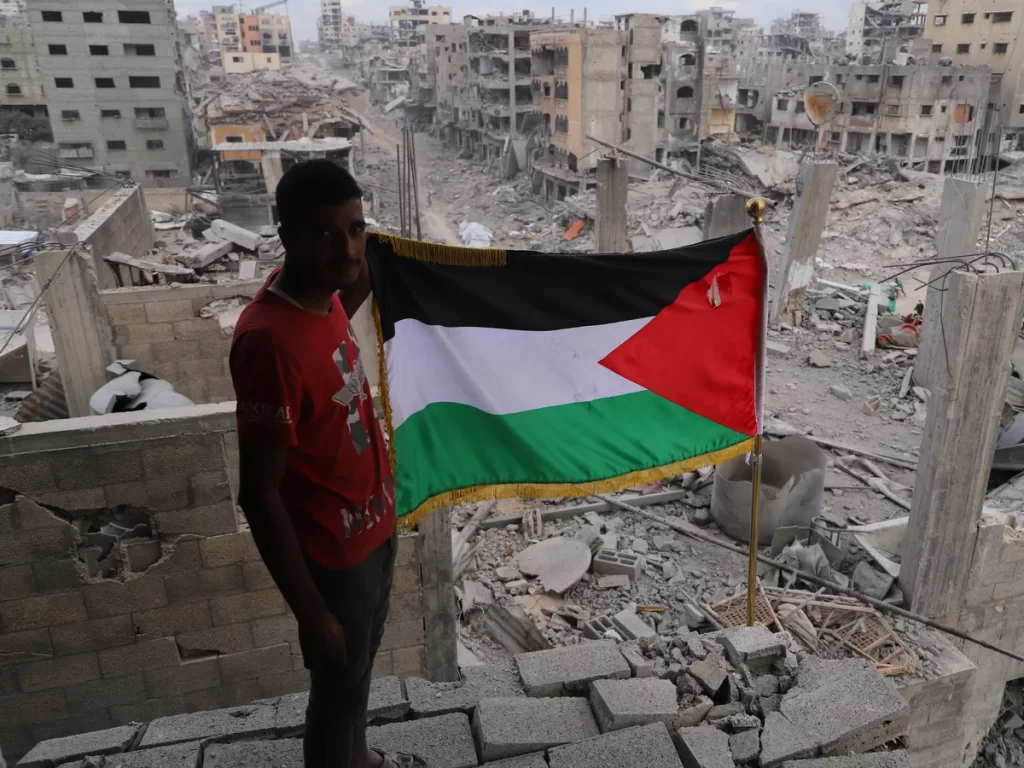
The cost of rebuilding Gaza is staggering—estimated at over $20 billion. Entire neighborhoods lie in ruins, with hospitals, schools, and infrastructure destroyed. Without security, however, reconstruction funds will be meaningless. Aid convoys from Egypt and Qatar have already entered Gaza, but progress remains fragile.
The International Force to Police Gaza would be responsible not only for security but also for ensuring safe zones for aid distribution and rebuilding projects. U.S. and European officials privately concede that reconstruction cannot succeed while Hamas retains parallel military control. Yet attempting to dismantle Hamas by force could ignite another conflict.
This paradox—reconstruction amid unresolved militarization—lies at the heart of the Gaza dilemma. “You cannot rebuild schools in the morning and fight militants in the afternoon,” one Arab diplomat remarked. “The mission must be clear and credible.”
Palestinian Views: Hope and Skepticism
Inside Gaza and the West Bank, reactions to the proposed International Force to Police Gaza are mixed. Many Palestinians welcome the idea of foreign protection—especially from Muslim nations—after years of relentless Israeli airstrikes.
“If Pakistan or Turkey come to protect and rebuild, people will welcome them,” said Ahmad al-Qudra, a lecturer in Khan Younis. “But if they come to disarm us or take orders from Israel, they will face resistance.”
For others, the issue is one of sovereignty. Some fear the force could become a long-term occupation under another name, particularly if Western or Israeli oversight is involved. Palestinian civil society groups have demanded guarantees that any mission would respect local governance and operate transparently.
Hamas, meanwhile, continues to consolidate control in some areas despite the cease-fire, executing rivals and reestablishing local checkpoints. This underlines the challenge facing any peacekeeping force: the risk of being caught between competing Palestinian factions and residual Israeli pressure.
Washington’s Balancing Act
For the Trump administration, success hinges on finding the right balance between regional legitimacy and military capability. Secretary of State Marco Rubio and Joint Chiefs Chairman Gen. Dan Caine are working with allies to define the mission’s scope and possibly secure U.N. authorization.
“There are no illusions,” Rubio said during his recent visit to Tel Aviv. “We achieved the impossible once by securing a cease-fire. Now we must defend that peace.”
But analysts warn that without clear consensus among regional powers, the International Force to Police Gaza could falter before deployment. Egypt, Jordan, Turkey, and Pakistan each have strategic motives—but also domestic constraints. The challenge lies in aligning their interests under a single command structure.
The Road Ahead
If successful, the creation of an International Force to Police Gaza could mark a turning point for the region. It would not only stabilize the enclave but also demonstrate that Muslim-majority nations can collectively manage postwar peacekeeping without Western troops on the ground.
However, failure to reach agreement could plunge Gaza back into the familiar cycle of cease-fire and collapse. For now, the world watches as diplomatic teams work behind closed doors to transform a fragile truce into lasting peace.
Whether Pakistan and its partners can help secure that peace—or become entangled in another Middle Eastern quagmire—may determine the fate of Gaza for generations to come.