


-
Massive deployment: The U.S. military buildup near Venezuela includes aircraft carriers, destroyers, bombers, and drones stationed across the Caribbean.
-
Strategic base revival: The U.S. has reopened and upgraded the long-abandoned Roosevelt Roads naval base in Puerto Rico.
-
Operational signals: Military sources claim President Trump has ordered forces to speed up preparation for potential operations against Venezuela.
-
Global reaction: Russia and Latin American allies warn the buildup threatens regional stability and sovereignty.
The United States has quietly but decisively intensified its military posture in the Caribbean, sparking speculation that Washington may be preparing for an operation against Venezuela. The U.S. military buildup near Venezuela, confirmed through satellite images and independent investigations, includes warship deployments, airbase refurbishments, and high-altitude bomber flights that analysts say point toward a show of force unprecedented in recent decades.
A Reuters visual investigation found that Washington has reactivated and upgraded the former Roosevelt Roads Naval Base in Puerto Rico — once one of America’s largest Cold War outposts.
From Peacemaker to Powerbroker: Trump’s Hawkish Turn Toward Venezuela
Crews have been clearing and resurfacing runways, installing new radar systems, and setting up tents near abandoned hangars, a move military analysts interpret as preparation for increased aerial operations. The site, shuttered in 2004, offers a strategic position less than 500 miles from Venezuelan shores.
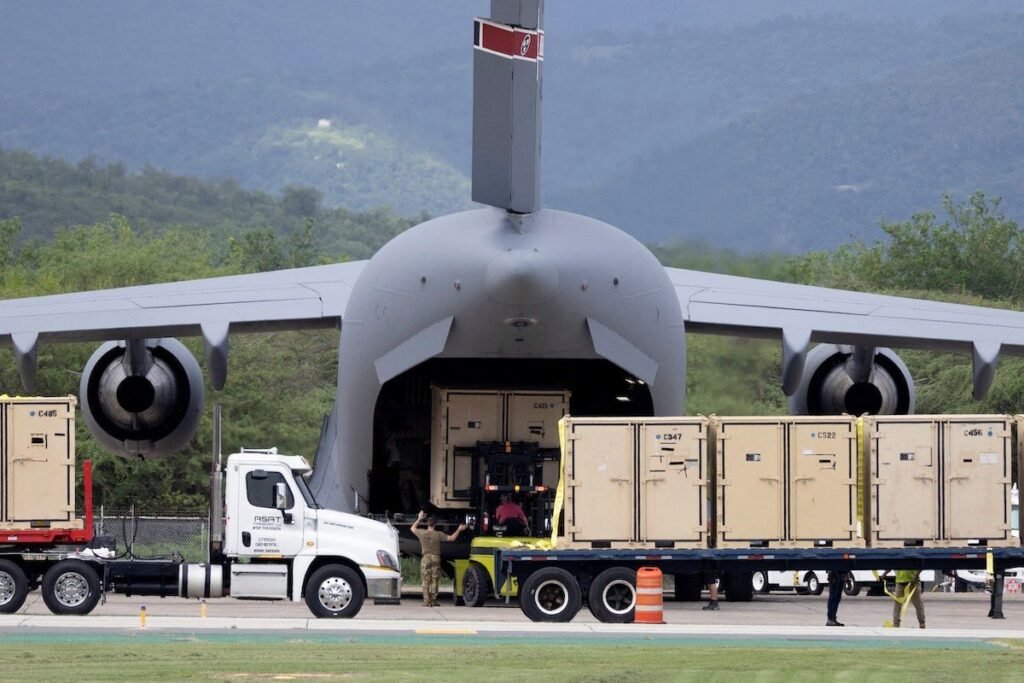
Adding to concerns, the U.S. has also built out facilities at Rafael Hernández Airport in Aguadilla and Henry E. Rohlsen Airport in St. Croix, deploying mobile air-traffic control systems and new radar installations. Satellite images captured in October show MQ-9 Reaper drones parked on tarmacs and what appears to be an ammunition storage facility — signs of long-term operational planning.
READ MORE: How the US is preparing a military staging ground near Venezuela
Senior defense sources told The Islamabad Telegraph that President Donald Trump has directed the Pentagon to “speed up readiness levels” for any potential contingency against the Maduro regime. “The message is clear,” one U.S. military official said under anonymity. “We’re not in the Caribbean to train or monitor weather patterns. We’re here to prepare.”
The U.S. military buildup near Venezuela now includes at least 13 warships, five support vessels, and a nuclear-powered submarine deployed from multiple global fleets. The USS Gerald R. Ford aircraft carrier — the largest in the U.S. Navy — has been ordered to the region, while guided-missile destroyers such as the USS Gravely, USS Stockdale, and USS Jason Dunham have been patrolling near Venezuelan waters.
ALSO READ: Trump’s Patience Runs Thin: Venezuela Faces the Shadow of U.S. Bombers
In the skies, activity is equally intense. U.S. Air Force B-1B Lancers and B-52 Stratofortress bombers have flown several sorties along the Venezuelan coastline, accompanied by spy planes and advanced F-35 fighters. Dozens of C-17 Globemaster III cargo flights have transported equipment, fuel, and possibly drones to Puerto Rico and the U.S. Virgin Islands since September.
Officials in the Trump administration publicly frame the campaign as a crackdown on “narcoterrorism”, claiming the buildup aims to disrupt drug cartels operating between South America and the Caribbean. “The President has taken unprecedented action to combat the scourge of narcoterrorism that kills innocent Americans,” said White House spokesperson Anna Kelly.
However, many analysts believe Washington’s real objective is to intensify pressure on President Nicolás Maduro and his military establishment. The timing, scale, and configuration of assets — particularly the presence of special operations support ships like the MV Ocean Trader — suggest preparations for potential strikes or covert missions inside Venezuela.
“It’s not about potholes or radar upgrades,” said Christopher Hernandez-Roy, a senior fellow at the Center for Strategic and International Studies (CSIS). “It’s about reasserting American power in a hemisphere Washington believes it had ceded.”
The U.S. military buildup near Venezuela has drawn swift condemnation from Moscow, Havana, and regional governments. Russian officials called the deployment “a provocation that threatens the fragile stability of Latin America,” while Venezuela’s President Maduro accused Washington of plotting regime change under the pretext of counter-narcotics operations.
Ironically, the escalation comes from a leader who has prided himself on ending more than a dozen conflicts worldwide, including mediating the end of hostilities between nuclear-armed India and Pakistan. Yet now, President Trump faces mounting criticism for potentially ordering military action against a sovereign Latin American nation — a move that could undo his record as a peacemaker.
Whether this unprecedented buildup culminates in open confrontation or remains a psychological campaign, one reality stands out: the Caribbean has become a pressure-cooker, and the world is watching as Washington tests the boundaries of power, sovereignty, and diplomacy once again.