


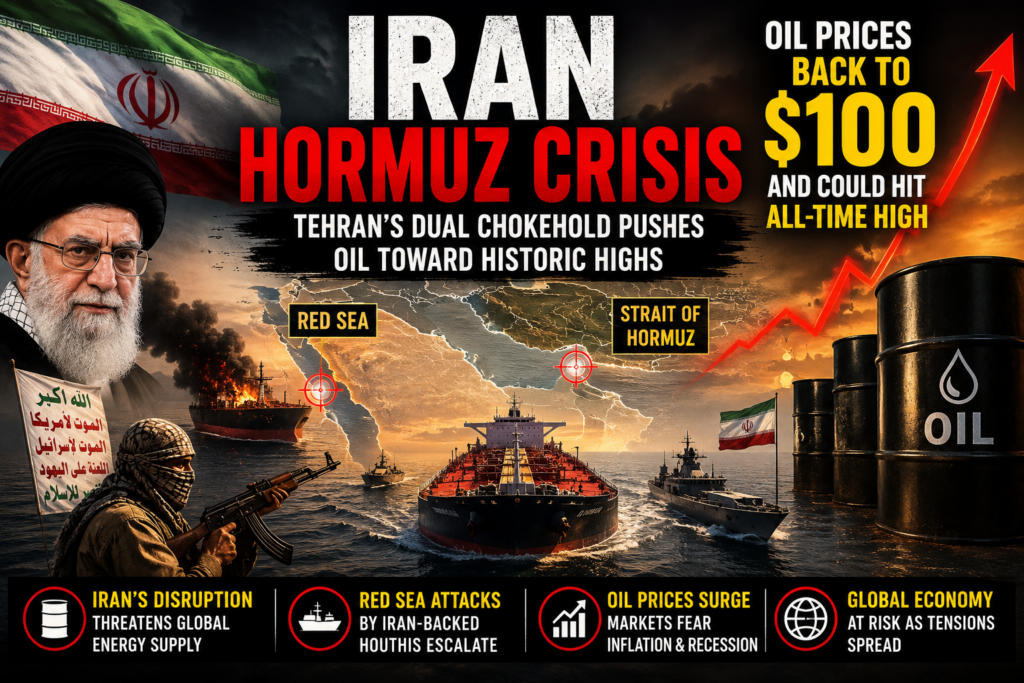
- Iran Hormuz Crisis is driving oil prices back to $100 and threatening global economic stability
- Iran-backed Houthi attacks in the Red Sea have opened a second front, intensifying supply disruptions
- Analysts warn oil could surge to all-time highs if tensions escalate across both chokepoints
Iran Hormuz crisis has erupted into a full-scale geopolitical shock, sending oil prices roaring back to $100 per barrel and shaking the foundations of the global economy. What began as a regional confrontation has rapidly evolved into a coordinated disruption spanning two of the world’s most critical maritime arteries—the Strait of Hormuz and the Red Sea.
At the heart of this turmoil lies a calculated strategy. The Iran Hormuz crisis is no longer confined to naval brinkmanship in the الخليج; it now extends deep into the Red Sea, where Tehran-backed Houthi militants have escalated attacks on Saudi oil tankers. This dual-front pressure is tightening the global energy supply chain at both ends, amplifying risk and accelerating market panic.
Brent crude surged 6% in a single session, climbing more than $25 above early July levels. The return to $100 oil is not merely symbolic—it reflects deep structural fears that the Iran Hormuz crisis could spiral into a prolonged disruption with far-reaching consequences.
Iran Hormuz Crisis Expands Into the Red Sea
The most alarming dimension of the Iran Hormuz crisis is its expansion beyond the Gulf. Tehran’s proxies in Yemen have transformed the Red Sea into an active conflict zone. Houthi militants have claimed attacks on two Saudi tankers, directly threatening the Bab el-Mandeb strait—another vital corridor for global energy flows.
This is not coincidence. It is strategy.
By synchronizing pressure in Hormuz with instability in the Red Sea, the Iran Hormuz crisis has effectively created a dual chokehold on global oil transit. Nearly 20% of the world’s oil passes through Hormuz, while a significant portion of shipments to Europe relies on Red Sea routes. Disruption in both regions simultaneously is a worst-case scenario for energy markets.
READ NEXT: US-Iran War Escalates: Deep Strikes Hit Tehran as Hormuz Shipping Halts
Shipping companies are already recalculating routes. Insurance premiums are surging. Some tankers are hesitating to enter high-risk zones altogether. The cumulative effect is tightening supply, rising costs, and growing uncertainty—conditions that are driving prices upward at an alarming pace.
Financial markets are reacting in real time. U.S. Treasury yields have surged, with the 10-year yield hitting its highest level in over a year. Investors are rapidly pricing in inflation risks tied directly to the Iran Hormuz crisis, fearing that energy-driven price pressures could derail global economic stability.
Equity markets are also under strain. U.S. stock futures are sliding as inflation concerns collide with corporate vulnerabilities. Alphabet shares dropped more than 5% after announcing massive capital expenditures, while Tesla plunged over 7% following negative free cash flow in the second quarter. These declines reflect a broader anxiety: rising energy costs are squeezing margins across sectors.
Iran Hormuz Crisis Could Send Oil to All-Time Highs
The trajectory of the Iran Hormuz crisis suggests that $100 oil may only be the beginning. If tensions escalate further—particularly if Iran intensifies harassment of vessels in Hormuz or if Houthi attacks continue in the Red Sea—global supply could face severe constraints.
READ MORE: Stock Market Today: Oil Prices Hit $100 a Barrel, Bonds Sell Off
In such a scenario, oil prices could surge well beyond $120, potentially testing all-time highs. The Iran Hormuz crisis is uniquely dangerous because it targets not one but two strategic chokepoints simultaneously. There are limited alternatives. Rerouting shipments around Africa adds weeks to delivery times and significantly increases costs, further tightening supply.
Strategic reserves offer only temporary relief. They cannot offset sustained disruptions caused by the Iran Hormuz crisis. Meanwhile, global demand remains resilient, particularly in Asia, where energy consumption continues to rise.
Central banks now face an increasingly difficult dilemma. The European Central Bank has paused rate hikes for now, but a renewed inflation surge driven by the Iran Hormuz crisis could force a return to aggressive tightening. In the United States, policymakers are similarly constrained, caught between controlling inflation and avoiding economic slowdown.
The broader implication is clear: the Iran Hormuz crisis is not just an energy story—it is a systemic risk to the global economy.
Tehran’s strategy appears deliberate and multifaceted. By leveraging its naval capabilities in Hormuz while activating proxy forces in the Red Sea, Iran is demonstrating its ability to disrupt global trade routes at scale. The Iran Hormuz crisis is, in effect, a form of economic warfare—one that raises the cost of confrontation for its adversaries while amplifying global instability.
The Houthis’ actions reinforce this dynamic. Their attacks on Saudi tankers signal that critical energy infrastructure and transit routes are vulnerable, further escalating the stakes of the Iran Hormuz crisis.
As markets absorb these developments, one reality is becoming unavoidable: energy security has re-emerged as the defining challenge of global stability. The Iran Hormuz crisis is reshaping risk calculations across governments, financial institutions, and industries alike.
Unless there is immediate de-escalation, the outlook remains grim. Supply disruptions will deepen. Prices will climb. Inflationary pressures will intensify. And the global economy will face mounting strain.
The world is now watching a geopolitical flashpoint evolve into a full-blown economic threat.
The Iran Hormuz crisis has crossed a critical threshold—and its consequences are only beginning to unfold.