


- US-Iran War And Strategic Accord: Crown Prince Mohammed bin Salman and U.S. President Donald Trump signed a historic 30-year civilian nuclear agreement to transform Saudi energy infrastructure.
- Geopolitical Realignment: The landmark deal solidifies U.S. technology leadership in the Middle East while curbing influence from strategic rivals like China and Russia.
- Regional Power Dynamics: Establishes a crucial security counterweight in the Gulf, restructuring nuclear energy oversight and economic diplomacy across the region.
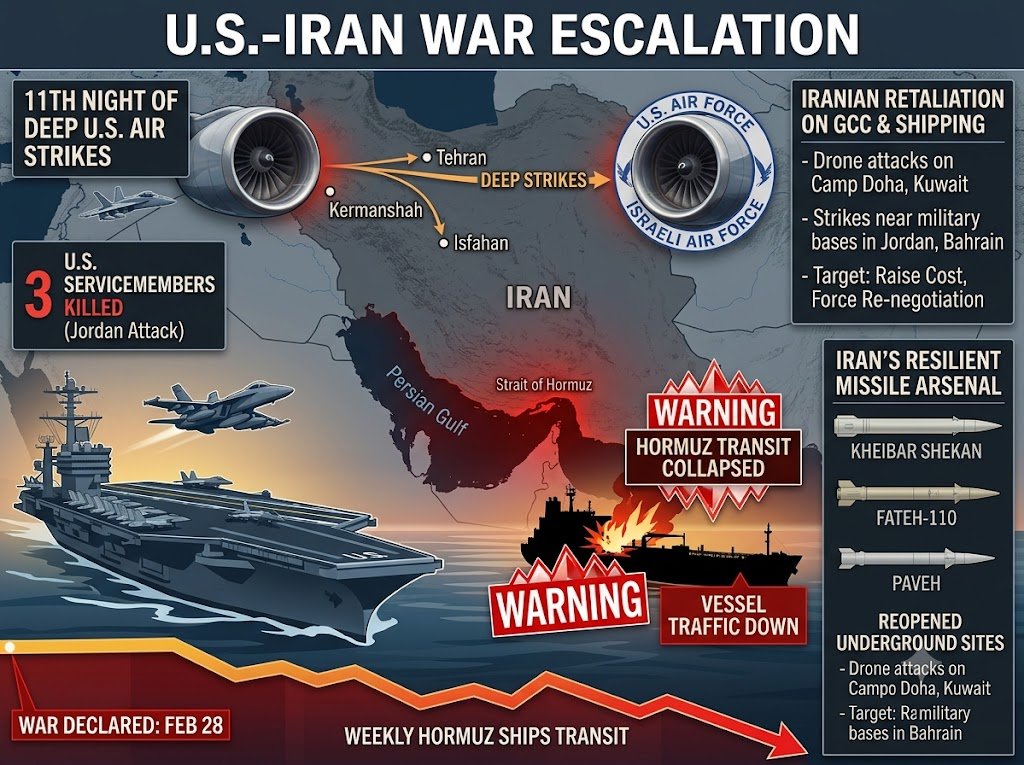
WASHINGTON — The conflict between the United States and Iran has spiraled into an intense campaign of attrition, with American forces launching deep air strikes inside Iranian territory for an 11th consecutive night, while Tehran retaliates across the Gulf Cooperation Council (GCC) states and maintains a near-total stranglehold on commercial shipping through the Strait of Hormuz.
Yet, despite weeks of heavy bombardments designed to neutralize Iran’s offensive capabilities, Tehran’s forces have demonstrated a resilient capacity to strike back. On Tuesday, Iran’s military, via the semi-official Tasnim news agency, claimed responsibility for a drone and missile attack targeting American installations at Camp Doha in western Kuwait, asserting it hit ammunition depots and logistics equipment in response to “repeated U.S. aggression.”
A Timeline of Escalation and Broken Truces
The current crisis traces back to Feb. 28, when the United States and Israel launched joint air strikes under Operation Epic Fury, marking what President Trump declared as the start of “major combat operations.”
Read Next: US-Iran War Escalation: Trump Finalizes Ground Strategy as Middle East Conflict Widens
The opening salvo killed Iran’s Supreme Leader, Ayatollah Ali Khamenei. His son, Mojtaba Khamenei, was swiftly named his successor.
FEBRUARY 28    US-Israeli strikes launch Operation Epic Fury; Ayatollah Ali Khamenei killed.
               Mojtaba Khamenei assumes power as Iran's new Supreme Leader.
APRIL 8        Two-week ceasefire agreed upon; Islamabad hosts first direct US-Iran talks in 47 years.
JUNE 20–JULY 1 High-level talks in Switzerland and Doha yield temporary Memorandum of Understanding.
JULY 8         Ceasefire collapses as US launches strikes over vessel attacks; full-scale war resumes.
While a brief two-week ceasefire was brokered on April 8—paving the way for landmark face-to-face talks in Islamabad, Pakistan—diplomatic momentum failed to yield a permanent settlement. Follow-up negotiations in Switzerland and Doha during June and early July aimed to establish terms around regional maritime transit and nuclear oversight. However, on July 8, the agreement collapsed after renewed attacks on merchant vessels in the Strait of Hormuz prompted fresh American air strikes, plunging the region back into full-scale war.
The lethal reality of Iran’s reconstituted military capabilities was underscored last week by a strike on Muwaffaq Salti Air Base in Jordan, which killed three U.S. service members. The Pentagon identified the third victim as Sgt. Angel Rampersad, 28, of Ozone Park, N.Y., who had previously been listed as missing.
Read More: Iran Shows Its Ballistic Missiles Are Still a Force to Reckon With
Military analysts say the Jordan strike was likely carried out using solid-fueled, satellite-guided medium-range ballistic missiles, including the Kheibar Shekan. Early in the campaign, American and Israeli strikes heavily targeted Iran’s subterranean “missile cities,” collapsing access tunnels. However, recent commercial satellite imagery indicates Iranian engineering units have dug out buried entrances, cleared access roads, and resumed launching salvos from repaired sites near Tabriz and Kermanshah.
In Washington, defense officials face mounting political scrutiny. During an Senate Appropriations Committee hearing, Defense Secretary Pete Hegseth defended earlier administration statements claiming Iran’s missile forces had been “functionally destroyed.”
“We never expected they would stop having capabilities to shoot,” Mr. Hegseth testified under questioning from Sen. Jon Ossoff (D., Ga.). “The question is at scale against an opponent like the United States of America.” Mr. Hegseth disclosed that the conflict’s cost to the U.S. has already surpassed $37.5 billion.
Beyond base strikes in Jordan, Kuwait, and Bahrain, Iran’s strategy centers on leverage over global energy choke points. Vessel movements through the Strait of Hormuz—through which one-fifth of global oil and gas supply normally transits—have effectively ground to a halt.
- The general cargo ship Kaiser exited the waterway loaded with cargo.
- The dry bulk carrier H7 Smb8 entered in ballast to load in the Gulf.
“Iran’s incremental scorched-earth policy against the Arab world is designed to get America to back out of the region, not to double down,” said Behnam Ben Taleblu, senior director of the Iran program at the Foundation for Defense of Democracies.