


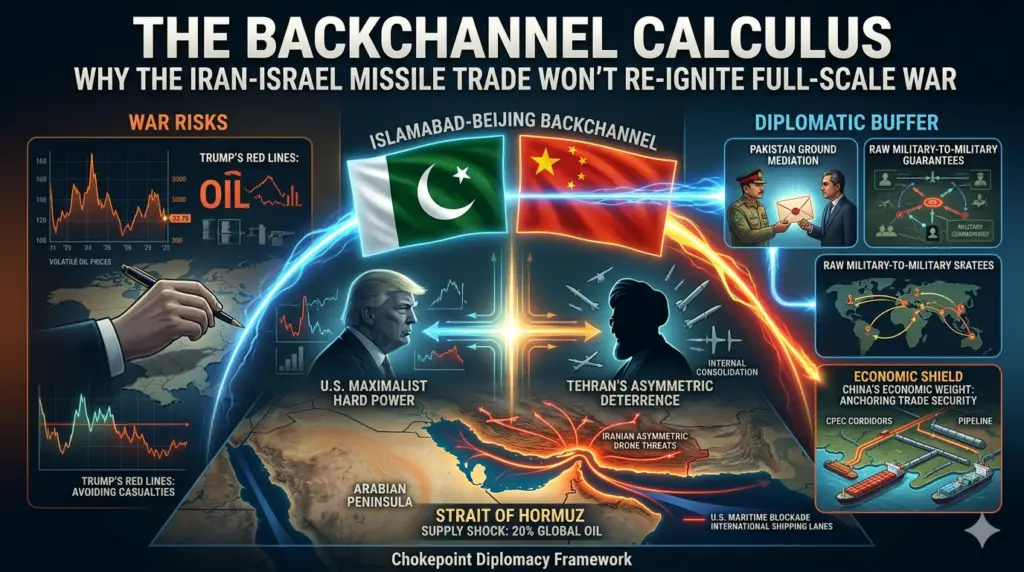
- Iran-Israel Missile Trade: The recent missile exchanges disrupted the ceasefire but will not trigger a full-scale Iran war.
- U.S. red lines remain focused on preventing troop casualties to avoid catastrophic maritime trade disruptions.
- Interior Minister Mohsin Naqvi delivered essential security assurances from Field Marshal Asim Munir to Tehran.
- China continues to back Pakistan’s mediation role to preserve vital energy supplies and market stability.
The sudden, violent collapse of the Middle East truce over the weekend offered a chilling reminder of how easily structured diplomacy can dissolve into tactical chaos. When Iranian ballistic missiles cut through the skies over Tel Aviv, and Israeli retaliatory strikes targeted the Karoun Petrochemical complex, global energy markets buckled. Yet, beneath the dramatic optics of anti-aircraft fire and shattered industrial assets, the underlying structural reality remains tightly managed. A full-fledged Iran war will not resume.
What we are witnessing is not the opening act of an uncontained regional conflagration, but rather a violent, highly calibrated form of transactional deterrence. Both Washington and Tehran have recognized that total military escalation yields no clear path to victory—only mutual economic and political ruin.
+-------------------------------------------------------------------------+
|                  THE CHOKEPOINT DIPLOMACY FRAMEWORK                     |
|                                                                         |
|        [U.S. Maritime Blockade] <=======> [Iran Asymmetric Drones]       |
|                   \                                /                    |
|                    v                              v                     |
|             [Strait of Hormuz Supply Shock: 20% Global Oil]             |
|                                   |                                     |
|                                   v                                     |
|                     [ Islamabad-Beijing Backchannel ]                   |
|                                   |                                     |
|           +-----------------------+-----------------------+             |
|           v                                               v             |
|  [Pakistan Ground Mediation]                    [China Economic Weight]        |
|  Naqvi delivers raw military-                 Beijing anchors trade security|
|  to-military guarantees from                    via regional corridors to      |
|  Field Marshal Asim Munir.                       prevent energy spikes.         |
+-------------------------------------------------------------------------+
The Limits of Trump’s Maximalist Hard Power
The current friction is the direct result of the Trump administration’s signature approach to foreign affairs: deploying maximum economic pressure backed by high-stakes military gambits, then expecting immediate capitulation. The conflict, which began on February 28 with bold temptations of a swift six-week campaign to permanently neutralize Tehran’s nuclear infrastructure, has instead transformed into a grueling war of attrition along critical maritime chokepoints.
Middle East war updates: Israel strikes Iran after major Sunday missile barrage terminates April ceasefire
By placing a strict naval blockade on Iranian ports, the U.S. inadvertently forced Tehran to weaponize its primary asymmetric advantage: its ability to disrupt the Strait of Hormuz, through which roughly 20% of global oil flows. The subsequent drop in commercial maritime traffic, combined with drones threatening international shipping as far out as Kuwait’s international airport, has constrained Washington’s geopolitical options.
President Trump has privately signaled to advisers that the threshold for ending diplomacy entirely is the loss of American troop lives. Short of that absolute red line, the White House is willing to tolerate lower-intensity skirmishes, localized proxy strikes in Lebanon, and isolated drone activity.
Israel and Iran Exchange Fire, Renewing Fear of Escalation
This is an explicit acknowledgment that a full-scale invasion of the Iranian heartland is economically and logistically unfeasible, especially when domestic political pressure demands an “end-of-war” agreement before oil price shocks destabilize Western markets ahead of the winter season. Trump’s own pragmatic observation carries immense analytical weight: “In that part of the world, ceasefire is when you’re shooting in a more moderate manner.”
The Islamabad-Tehran Strategic Bridge
While Washington and Tel Aviv manage their respective domestic political arenas, the actual structural safety net preventing an all-out war is being meticulously maintained by the Islamabad-Beijing diplomatic axis. Pakistan has stepped into the specialized role of chief negotiator, establishing a reliable ground-level pipeline that bridges the communication gap between the Western coalition and Iran’s leadership.
The strategic arrival of Pakistan’s Interior Minister, Mohsin Naqvi, in Tehran is the most visible manifestation of this backchannel framework. Naqvi carried an explicit, highly sensitive communication from Field Marshal Asim Munir, the chief of Pakistan’s defense forces, directed straight to Iran’s Supreme Leader, Ayatollah Mojtaba Khamenei.
This military-to-military channel holds unique value. Following the transition of power to Mojtaba Khamenei, Iran’s security apparatus and the Islamic Revolutionary Guard Corps (IRGC) are focused heavily on internal stabilization, regime continuity, and domestic consolidation. Tehran understands that an unchecked conventional war would severely weaken its regional influence and risk structural state collapse under sustained Western bombardment. By utilizing Pakistan as a neutral intermediary with deep institutional ties across the region, Iran can signal its defensive boundaries, negotiate asset unfreezing, and discuss terms for the Strait of Hormuz without appearing to capitulate under direct U.S. fire.
Beijing’s Shield and the Future Balance
Behind Pakistan’s active diplomacy stands the immense economic weight and strategic patience of China. Beijing cannot permit an uncontrolled escalation that permanently closes West Asian trade corridors, spikes global energy costs, or disrupts its long-term connectivity projects across the global South. By firmly backing Pakistan as the chief negotiator, China helps insulate the Iranian economy from absolute collapse while providing Washington with a realistic, face-saving diplomatic off-ramp.
The financial demands under review underscore the high stakes of this process. Iranian negotiator Mohsen Rezaei has indicated that a lasting peace deal hinges on the release of approximately $24 billion in frozen Iranian assets. Concurrently, U.S. Treasury Secretary Scott Bessent is evaluating frameworks to redirect portions of these assets toward repairing the extensive physical damage inflicted upon Gulf allies like Kuwait and Bahrain.
This creates a highly stable, if violently loud, status quo. Israel will continue to strike proxy infrastructure in Beirut to enforce its security boundaries against Hezbollah, and Iran will continue to use localized missile barrages and drone deployments to maintain its leverage before signing any final memorandum of understanding. However, because the structural costs of an unrestricted war remain far too high for all primary actors, this tit-for-tat cycle will serve as a mechanism for violent negotiation rather than a prelude to total war. The fundamental architecture of deterrence will hold.