


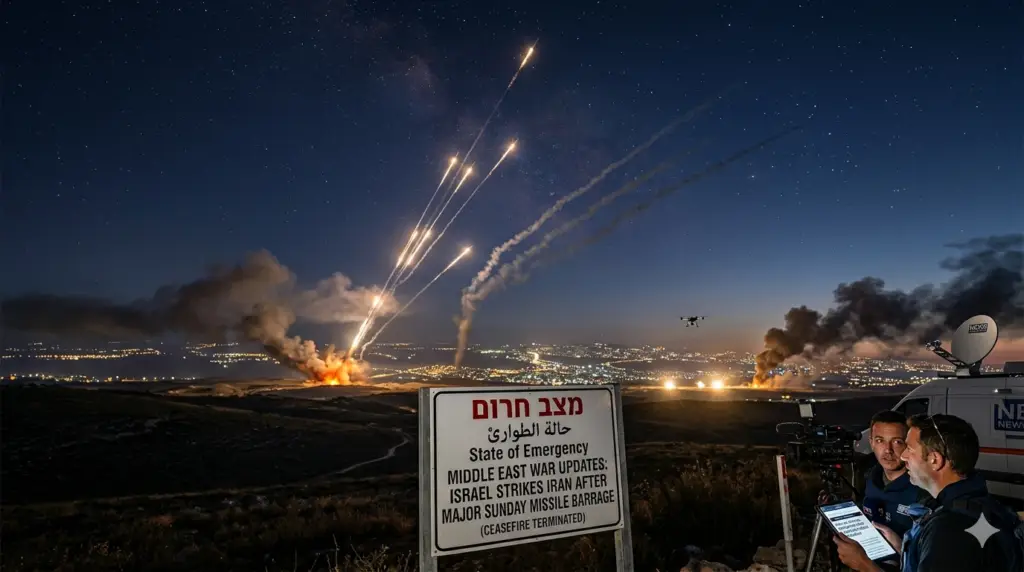
- Middle East war updates confirm that Israel has launched retailatory airstrikes on western and central Iran following a massive missile attack on Tel Aviv and northern airbases.
- The latest escalation shattered a fragile, U.S.-brokered ceasefire that had successfully held since early April.
- Direct mediation efforts led by Pakistan in Tehran have apparently stalled to prevent regional escalation after an Israeli strike hit Beirut.
- The closure of the Strait of Hormuz and critical Gaza border crossings points to a severe deterioration of security on the ground.
The fragile peace that has precariously held the Middle East together since April has shattered. The situation on the ground across the region is highly unstable and rapidly deteriorating, as Iran and Israel have initiated a dangerous cycle of fresh, direct military attacks against one another.
The Strait of Hormuz and the broader geopolitical landscape are once again on the brink of total war. This sudden escalation directly followed a high-stakes backchannel diplomatic mission by Pakistani Interior Minister Mohsin Naqvi, who arrived in Tehran carrying a critical, direct message from Pakistan’s powerful Chief of Defence Forces, Field Marshal Asim Munir. Despite Islamabad’s aggressive efforts to break a month-long diplomatic deadlock between Tehran and Washington, the region has instead erupted into open hostility.
The Pakistani Mediation and the Spark in Tehran
The latest spiral began under the shadow of intense, secretive diplomacy. Pakistan has been acting as the primary mediator between the United States and Iran since a wider war broke out on February 28. On Saturday, Pakistani Interior Minister Mohsin Naqvi arrived in Tehran for his third urgent visit in recent weeks.
Trump Sets Steel-Clad Red Line on Iran Conflict: No Escalation to Full-Scale War Unless American Troops Are Killed
Naqvi came bearing a sensitive, direct communication from Field Marshal Asim Munir intended for Iran’s Supreme Leader, Mojtaba Khamenei. The objective was clear: present new, structured proposals to unfreeze $12 billion in Iranian assets, lift the crippling U.S. naval blockade on Iranian ports, and chart a path toward a permanent peace deal.
However, the diplomatic leverage evaporated mid-negotiation. On Sunday morning, while backchannel talks were active in Tehran, the Israel Defense Forces (IDF) launched a lethal airstrike on the Dahiyeh suburb of southern Beirut—a prominent Hezbollah stronghold. The strike, which Israel asserted was a targeted operation against hostile positions, killed two civilians and injured 20 others.
Israel launches strikes on Iran after Tehran fires barrage of missiles
Iran’s chief negotiator, Mohammad Bagher Ghalibaf, immediately lambasted the strike, characterizing it as an action enabled by a “green light” from Washington alongside the ongoing naval blockade. For Tehran, the Beirut strike crossed an explicit red line, rendering diplomatic compromises temporarily untenable.
Fire in the Sky: The Sunday Barrage and Israel’s Response
By 10:00 p.m. local time on Sunday, the diplomatic track was entirely replaced by military engagement. The Islamic Revolutionary Guard Corps (IRGC) unleashed a massive barrage of ballistic missiles directed at Israeli territory. It marked the first direct Iranian bombardment of Israel since the April 8 temporary ceasefire.
Sirens wailed across Israel, forcing millions of civilians into bomb shelters. The IRGC confirmed it specifically targeted the Ramat David Air Base in northern Israel, calling it the primary launch point for aggression against Lebanon.
While the IDF stated that its air defense networks successfully intercepted the inbound missiles, preventing major domestic casualties, the political response was immediate. Rejecting public entreaties from U.S. President Donald Trump—who claimed to be calling Prime Minister Benjamin Netanyahu directly to urge restraint—the Israeli leadership chose to strike back hard.
Early Monday morning, the Israeli Air Force (IAF) executed retaliatory airstrikes deep inside Iranian territory, targeting military infrastructure across western and central Iran. Explosions rocked Iranian provinces, signaling the formal collapse of the spring truce.
On-Ground Realities and Regional Fallout
The immediate on-ground situation across the Middle East is highly volatile and characterized by hyper-vigilance.
- In Israel: The military has canceled all schools nationwide and placed strict limits on public gatherings, bracing for secondary waves of drone or missile strikes.
- In Iran: Authorities have closed western airspace entirely to civilian traffic, moving military assets into defensive postures as the Khatam al-Anbiya Central Headquarters warns of “crushing and destructive blows” if Israel expands its campaign.
- In Gaza: The Israeli government agency COGAT completely shut down the remaining operational land crossings, including the Kerem Shalom and Rafah crossings, sealing the territory off entirely due to the heightened regional security threat.
The maritime domain is equally paralyzed. The Strait of Hormuz, a choke-point responsible for a massive portion of the world’s daily petroleum transit, remains effectively closed under a combined U.S. naval blockade and aggressive Iranian defensive posturing. Commercial shipping lines are actively diverting vessels away from the Persian Gulf, raising immediate fears of global energy supply disruptions.
Critical Analysis: The Deadlock of Preconditions
The tragedy of this latest escalation lies in how close international mediators were to a breakthrough. U.S. and Iranian officials had both quietly signaled that they were nearing a comprehensive memorandum of understanding. The core failure, however, remains a rigid deadlock over the sequencing of economic relief versus nuclear disarmament.
The Diplomatic Impasse: Iran demands the upfront release of $12 billion in frozen assets and the immediate termination of the naval blockade to salvage its suffocating economy. Conversely, Washington insists that no assets will be unfrozen until Tehran surrenders its stockpile of highly enriched uranium.
By launching strikes into Lebanon, Israel effectively tested the boundaries of the fragile April truce. Iran, feeling trapped between an economic blockade and localized military degradation of its proxies, chose to re-establish deterrence via direct missile strikes. With Israel’s subsequent Monday morning bombardment of western Iran, both nations have abandoned the negotiation table for the battlefield.
Field Marshal Asim Munir’s mediated proposals are still under consideration. Washington can forcefully restrain Tel Aviv and Tehran agrees to look past the economic sequencing deadlock, the Middle East faces the very real prospect of an uncontained, multi-front war that will ripple across global markets.