


- Iran protests have entered their second week, resulting in a nationwide internet blackout and over 65 confirmed deaths.
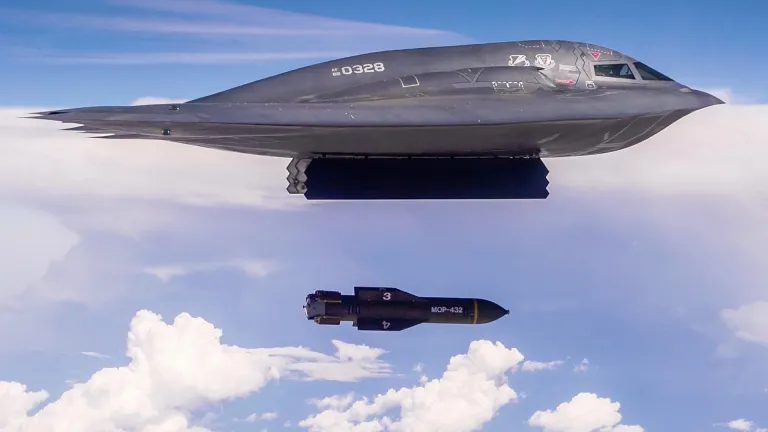
- The Trump administration has forward-deployed B-52 and B-21 bombers to the Middle East.
- White House officials are considering “lethal and non-lethal” options to prevent a regime-led massacre.
- Comparisons are being drawn to the 2025 joint U.S.-Israeli strikes on Iranian nuclear facilities.
WASHINGTON — The Trump administration has moved the United States to a maximum-readiness war footing against the Islamic Republic of Iran, with senior officials confirming that strategic bombers have landed at forward operating bases in the Middle East as protests inside Iran reach a historic, destabilizing crescendo.
President Donald Trump, according to three officials speaking on the condition of anonymity, has been presented with a range of “kinetic and non-kinetic” options. While a final order has not been signed, the Pentagon has moved with high velocity to ensure that the capability for a massive, multi-domain strike is “active and imminent.”
China Russia South Africa Naval Exercise: A Strategic Signal Amid Trump’s Hawkish Foreign Policy
This escalation follows a Saturday night of unprecedented unrest in Tehran, Mashhad, and Yazd, where demonstrators—spurred by a currency collapse and systemic corruption—have openly called for the dissolution of the clerical regime.
A Tipping Point in the Streets
The current wave of domestic unrest, which began two weeks ago, has evolved from localized economic grievances into a nationwide movement. Despite a 48-hour total internet blackout and a directive from Supreme Leader Ayatollah Ali Khamenei for a “merciless crackdown,” the demonstrations have not subsided.
Where is Israel’s operation heading?
Human rights groups, including Amnesty International and the Human Rights Activists News Agency (HRANA), report that the death toll has surged past 65, with hundreds more injured. The IRGC and the Artesh (conventional army) have issued joint statements vowing to protect “strategic infrastructure,” a term often used as a precursor to the use of lethal force against civilian crowds.
The Echo of 2025: “Midnight Hammer” vs. Today
The current military posture draws immediate comparisons to the June 2025 escalation, known as Operation Midnight Hammer. In that engagement, the U.S. and Israel executed a series of surgical strikes that fundamentally altered the regional security architecture.
| Feature | June 2025 (Operation Midnight Hammer) | January 2026 (Current Posture) |
| Primary Trigger | Accelerated Uranium Enrichment / Nuclear Threshold | Domestic Uprising / Massive Human Rights Violations |
| U.S. Assets Used | B-2 Stealth Bombers / GBU-57 Bunker Busters | B-52H Stratofortress / B-21 Raider (Forward Deployed) |
| Strategic Goal | Degradation of Nuclear Infrastructure (Fordow/Natanz) | Regime Deterrence / Protection of Protester Autonomy |
| Israeli Role | Lead Kinetic Partner (Operation Rising Lion) | Intelligence Sharing / Border Readiness |
| Iran’s Response | Ballistic Missile Salvos at Al Udeid (Qatar) | Total Communications Blackout / “Enemy of God” Charges |
During the 2025 strikes, the Trump administration focused almost exclusively on “eliminating Iran’s nuclear program.” However, the 2026 calculus is markedly different. White House officials are now weighing the use of cyberattacks to bypass the regime’s internet “kill switch,” alongside lethal options intended to deter the IRGC from engaging in “mass slaughter.”
Strategic Deployment and “Red Lines”
Military analysts note that the arrival of strategic bombers in the theater—specifically B-52H units and elements of the newer B-21 Raider program—signals a shift from “surgical” to “comprehensive” target packages. Unlike the 2025 strikes, which were largely contained to three nuclear sites, the current “menu of options” includes IRGC command-and-control centers and internal security headquarters.
Iran Regime Protests Explode as Trump Threatens Strikes and Tehran Stands Cornered
Secretary of State Marco Rubio underscored the shift early Sunday, stating, “The United States supports the brave people of Iran,” while President Trump took to social media to warn the clerical leadership: “If they start killing people like they have in the past, we’ll be hitting them very hard where it hurts.”
Geopolitical Fallout
The international community remains fractured. While the European Union, Canada, and Australia issued a joint statement condemning the violence against protesters, they have expressed deep reservation regarding a unilateral U.S. strike.
In Tehran, President Masoud Pezeshkian has attempted to frame the unrest as a “full-scale economic war with a foreign enemy,” but the rhetoric appears to be losing its grip on a populace facing a 13th day of mass strikes. With the rial in freefall and the exiled Crown Prince Reza Pahlavi calling for a final seizure of city centers, the window for a diplomatic de-escalation is nearly closed.
As of Sunday morning, the Pentagon remains in a state of “flexible response.” If the regime initiates the “mass slaughter” feared by the Center for Human Rights in Iran, officials indicate the U.S. strike may come “anytime soon.”