


-
Iran Strikes Kuwait: Gulf War Escalation exposes host nations to direct Iranian missile and drone barrages targeting US military facilities.
-
Rising conflict dynamics threaten global energy supplies, sending crude prices soaring past $95 per barrel.
-
Overlapping regional defense pacts risk drawing South Asian and Gulf nations into a widening confrontation.
Iran’s war with the United States entered a potentially transformative phase on Thursday after Tehran launched missiles and drones against US military facilities in Kuwait and the United Arab Emirates, forcing Gulf governments to confront a question they have long tried to avoid: can American bases on their territory remain a shield without making them targets?
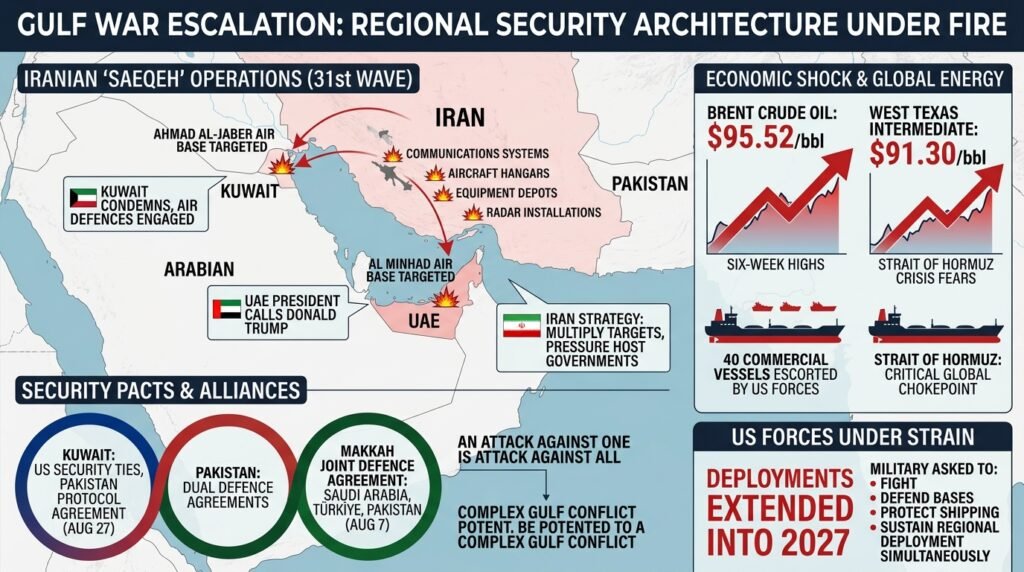
The Iranian Army said its 31st wave of “Saeqeh” operations struck Ahmad al-Jaber Air Base in Kuwait and Al Minhad Air Base in the UAE, targeting communications systems, equipment depots, aircraft hangars, troop positions and radar installations. Kuwait confirmed that its air defences engaged Iranian missiles and drones, condemned the attacks and signalled that it reserves the right to take necessary measures.
The escalation is significant because Iran is no longer confining its retaliation to American assets inside Iran or at sea. It is attempting to raise the cost of Washington’s regional military architecture by placing host governments under pressure. CNN reported that Kuwait faced another night of Iranian attacks and that its air-defence systems were activated. The UAE’s president, Sheikh Mohamed bin Zayed, also spoke with President Donald Trump as the regional crisis intensified.
READ NEXT: Strait of Hormuz Crisis: Is America Losing Its Grip on the Middle East?
Tehran’s warning is broader still. Iranian officials have repeatedly urged Middle Eastern governments to remove US forces from their soil, effectively telling Washington’s Arab partners that hosting American troops could make their territory part of the battlefield. That threat puts Kuwait in a difficult position. It has close security ties with Washington, but is also strengthening its defence relationship with Pakistan.
Pakistan and Kuwait signed the Protocol Agreement-2026 on August 27, expanding military cooperation in areas including training, capacity building and border management. The agreement, reached weeks before Thursday’s attack, gives the new crisis a direct South Asian dimension.
Pakistan’s strategic position becomes even more consequential because Islamabad is already part of the Makkah Joint Defence Agreement with Saudi Arabia and Türkiye. Signed on August 7, the pact treats an armed attack against one signatory as an attack against all, although its precise military obligations remain deliberately undefined. On August 31, the three countries moved further by establishing a strategic political and defence committee.
READ MORE: Longer Middle East Deployments Strain U.S. Forces as Iran Conflict Drags On
Kuwait is not a member of the Makkah pact. Yet its newly expanded defence relationship with Pakistan creates an unusual strategic overlap: Pakistan is institutionally tied to Saudi Arabia and Türkiye while simultaneously deepening defence cooperation with Kuwait, one of the Gulf states now exposed to Iranian retaliation.
That matters if Kuwait moves from interception to retaliation.
A Kuwaiti military response could broaden the war from an American-Iranian confrontation into a more complex Gulf conflict. Saudi Arabia and other Arab states would then face pressure to strengthen collective deterrence, while Pakistan would confront a difficult balancing act between its longstanding relationship with Iran and its increasingly substantial defence commitments across the Gulf.
The United States, meanwhile, is facing its own constraint: endurance.
The Wall Street Journal has reported that the Pentagon is quietly extending Middle East deployments into 2027, increasing pressure on troops, equipment and maintenance. CNN has reported that US forces recently escorted 40 commercial vessels carrying 18 million barrels of oil through the Strait of Hormuz while simultaneously striking Iranian targets. The picture is of a military being asked to fight, defend bases, protect shipping and sustain a prolonged regional deployment simultaneously.
That strain matters because Iran’s strategy does not require it to defeat the United States conventionally. It only needs to keep multiplying the number of targets Washington must defend.
The economic battlefield is spreading far beyond the Gulf.
Brent crude settled Thursday at $95.52 a barrel, while West Texas Intermediate reached $91.30. Both benchmarks had climbed to six-week highs as renewed fighting revived fears of prolonged disruption around the Strait of Hormuz. The Guardian reported that the latest attacks were adding to concerns over global energy security, while The Washington Post reported that Iran’s strikes had wounded dozens in Kuwait and underscored the vulnerability of Gulf states.
For countries such as Pakistan, higher energy prices are an immediate concern. Prolonged disruption around Hormuz can increase import bills, inflation and transport costs even for states far from the battlefield. The longer the war continues, the greater the possibility that a regional military confrontation becomes a global economic shock.
The most dangerous development may not be the missiles themselves, but the emerging chain reaction.
Iran is warning Gulf states to expel American forces. Kuwait is signalling that it may retaliate. Washington is extending deployments. Pakistan is deepening defence ties with Kuwait while remaining bound to Saudi Arabia through the Makkah pact. And oil markets are pricing in the possibility that Hormuz will remain a geopolitical choke point.
The question now is whether the Gulf can contain the war—or whether Thursday’s strikes become the moment when the region’s security architecture pulls more countries directly into it.