


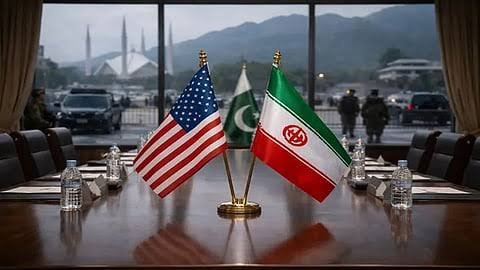
- Iran-US Negotiations have failed to produce a breakthrough despite the high-level diplomatic intervention of Pakistan’s leadership.
- The strategic stalemate over the Strait of Hormuz continues to disrupt global energy markets and maritime security protocols.
- Field Marshal Asim Munir and PM Shahbaz Sharif remain central to the “Islamabad Track,” attempting to reconcile irreconcilable demands.
- The U.S. “locked and loaded” posture persists as the Treasury Department intensifies sanctions on Iran’s shadow-fleet tankers.
Despite the relentless shuttle diplomacy led by Pakistan’s Field Marshal Asim Munir and Prime Minister Shahbaz Sharif, the latest round of US-Iran negotiations has reached a perilous stalemate. While Islamabad has successfully facilitated direct engagement—a feat that eluded global powers for decades—the core demands of Washington and Tehran remain fundamentally irreconcilable.
The Pakistani Push: Statesmanship Under Pressure
The “Islamabad Track” has emerged as the primary conduit for de-escalation in the 2026 conflict. Prime Minister Shahbaz Sharif and Field Marshal Asim Munir have leveraged Pakistan’s unique strategic position to broker a fragile, rolling ceasefire that has twice prevented imminent US-Israeli air strikes.
- Military-Diplomatic Synergy: Field Marshal Munir’s direct lines to both the IRGC leadership and the Pentagon have been credited with “pulling the region back from the precipice,” according to regional analysts.
- Hosting the Heavyweights: Islamabad has hosted 21-hour intensive sessions, with PM Sharif acting as the “honest mediator” trusted by both the Trump administration and the Iranian Foreign Ministry.
- Global Recognition: US Congressman Jack Bergman and various European leaders have lauded Pakistan’s “true statesmanship” in creating a framework for a potential 45-day peace plan.
Fundamental Disconnects
Despite these “sincere efforts,” the negotiations are buckling under the weight of three non-negotiable pillars:
| Issue | US/Israeli Position | Iranian Position |
| Maritime Access | Immediate, unconditional reopening of the Strait of Hormuz. | Reopening tied to “reparations” and a formal oversight role. |
| Nuclear Program | Permanent dismantling or long-term verifiable suspension. | Right to civil enrichment; demand for total sanctions lifting. |
| Security Guarantees | Ending “shadow fleet” operations and regional proxy support. | Withdrawal of US blockades and an end to Israeli strikes. |
“I will not say with confidence that we’re going to reach a deal until we’re actually signing a negotiated settlement,” Vice President JD Vance remarked Tuesday, echoing the “locked and loaded” posture of the Trump administration.
Escalation at Sea: The Shadow Fleet Crackdown
The diplomatic friction is mirrored by rising tensions in the Indian Ocean. Overnight, US officials confirmed the seizure of the Skywave, an Iran-linked tanker carrying over 1 million barrels of crude. This follows the seizures of the Majestic X and Tifani earlier this spring.
General Dan Caine, Chairman of the Joint Chiefs of Staff, has signaled a shift toward “active pursuit” of any vessel supporting the Iranian war effort. In response, Iran has warned that its blockade of the Strait of Hormuz—the artery for 20% of global oil—will remain absolute until its financial and security demands are met.
Mediators See Little Progress in U.S.-Iran Talks
The Final Offramp?
While PM Shahbaz Sharif describes this as a “shining moment” for Pakistani diplomacy, the window for a peaceful resolution is narrowing.
Trump Seals Historic Billion-Dollar China Deals in Landmark Beijing Breakthrough
President Trump noted he was “an hour away” from ordering strikes last week, holding off only at the request of Gulf allies and the Pakistani leadership. Without a breakthrough on the “reparations vs. denuclearization” deadlock, the region remains one drone strike away from a total return to hostilities.
Geopolitical Forecasting: The Islamabad Track
The mediation led by Field Marshal Asim Munir and Prime Minister Shahbaz Sharif faces a critical inflection point. While Islamabad has successfully delayed kinetic strikes, the fundamental divergence between U.S. denuclearization demands and Iranian reparation claims suggests a “frozen conflict” rather than a resolution. Expect continued shadow-fleet seizures and tactical maritime friction as both powers test Pakistan’s diplomatic endurance, potentially forcing a transition toward a multilateral “Islamabad Accord” by late 2026.