


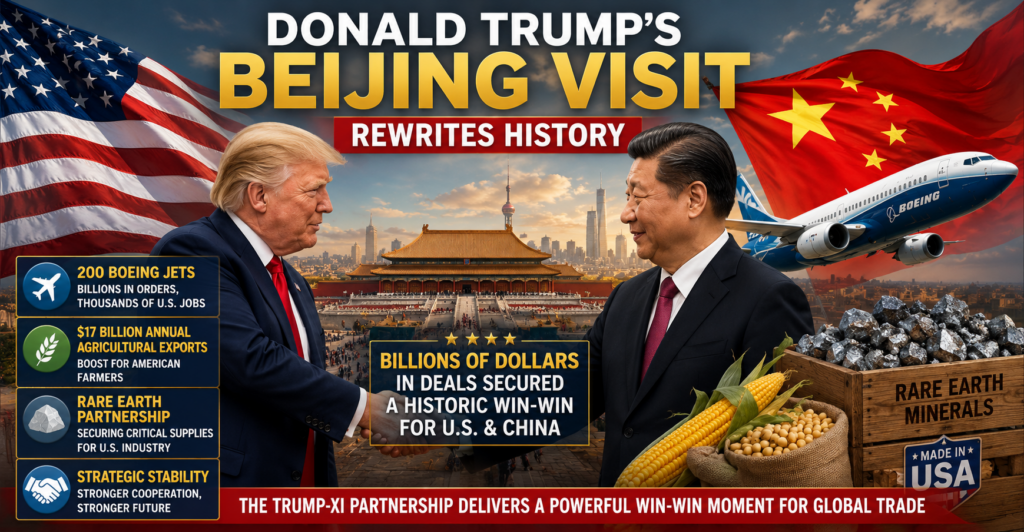
- Trump China Deals 2026 mark the first time a U.S. president secured billions in a single foreign visit
- China commits to purchasing 200 Boeing aircraft, boosting U.S. manufacturing jobs
- $17 billion annual agricultural imports promise relief for American farmers
- Rare earth supply chain breakthroughs strengthen U.S. industrial and defense sectors
President Donald Trump’s famed art of the deal worked wonders in Beijing this week, as Chinese President Xi Jinping proved to be a gracious and calculating host—almost like an ancient but wise Chinese emperor—who did not disappoint his guest. The result was a landmark diplomatic and economic breakthrough that reset the tone of U.S.-China relations and, most notably, delivered billions of dollars’ worth of deals in a single presidential visit—an unprecedented achievement in modern American diplomacy.
In what the White House described as a mission to restore “peace and prosperity,” Trump’s visit—the first by a U.S. president to China since 2017—produced a sweeping set of agreements spanning trade, aviation, agriculture, and strategic cooperation. The scale and speed of the agreements underscored not just Trump’s transactional diplomacy but also a renewed willingness on both sides to stabilize the world’s most consequential bilateral relationship.
At the heart of the visit was a bold economic framework that saw the creation of two new institutions: the U.S.-China Board of Trade and the U.S.-China Board of Investment. These bodies are designed to institutionalize cooperation, streamline trade flows, and address long-standing disputes over market access and investment barriers. Analysts say this mechanism could become the backbone of a more predictable and structured economic relationship between Washington and Beijing.
Trump-Xi summit Singapore markets fail to rally investors despite positive diplomatic signals
But it was the sheer magnitude of the deals that stole the spotlight.
In a historic first, Trump secured billions of dollars in commitments during a single overseas visit, setting a new benchmark for economic diplomacy. Among the most headline-grabbing agreements was China’s commitment to purchase 200 Boeing aircraft—its first such major order since 2017. This deal alone is expected to inject billions into the U.S. economy, support thousands of high-skilled manufacturing jobs, and reassert American dominance in the global aviation market.
Trump Final Approval of Nvidia H200 Chips to China Confirms Islamabad Telegraph Exclusive, Signals Strategic Tech Reset
Equally significant was China’s pledge to import at least $17 billion worth of U.S. agricultural products annually through 2028. This commitment offers a lifeline to American farmers, many of whom have struggled with fluctuating export markets and trade uncertainties in recent years. The agreement also includes expanded access for U.S. beef and poultry, with China reopening its markets to hundreds of American facilities and lifting previous restrictions tied to health concerns.
Another critical breakthrough came in the area of rare earth minerals—resources vital for advanced technologies, defense systems, and clean energy. China agreed to address U.S. concerns over supply chain disruptions and ease restrictions on the export of key materials such as neodymium, scandium, and yttrium. This move is expected to reduce strategic vulnerabilities for American industries and stabilize global supply chains.
White House touts deals on soybeans and rare earths after Trump-Xi summit, while China talks up tariff cuts
Beyond economics, Trump and Xi found common ground on major geopolitical issues. Both leaders reaffirmed their opposition to Iran acquiring nuclear weapons and called for the reopening of the Strait of Hormuz, emphasizing that no state or non-state actor should be allowed to disrupt global energy flows. They also reiterated their shared commitment to the denuclearization of North Korea, signaling a rare moment of alignment on security priorities.
The chemistry between Trump and Xi was unmistakable throughout the visit. Observers noted a level of personal rapport that translated into tangible outcomes, with both leaders framing the agreements as a “win-win” for their nations. Trump praised Xi’s leadership and hospitality, while Xi reciprocated by emphasizing mutual respect and long-term cooperation.
This diplomatic synergy appears to have paid off. Markets responded positively to the news, with global investors viewing the agreements as a sign of reduced tensions and increased economic stability. Businesses on both sides are also expected to benefit from clearer rules and expanded opportunities.
Critics may argue that challenges remain—particularly in areas like technology competition and human rights—but even skeptics acknowledge that the visit marks a turning point. By securing concrete economic gains while opening channels for dialogue, Trump has reshaped the narrative of U.S.-China engagement.
In the end, the Beijing visit was more than just a diplomatic tour—it was a masterclass in deal-making on the global stage. For the first time, a U.S. president has walked away from a single foreign visit with billions of dollars in secured deals, reinforcing the idea that strategic pragmatism, when paired with strong leadership chemistry, can yield extraordinary results.
As both nations prepare for future summits, including Xi’s upcoming visit to Washington, the message from Beijing is clear: when the world’s two largest economies choose cooperation over confrontation, the dividends can be historic.