


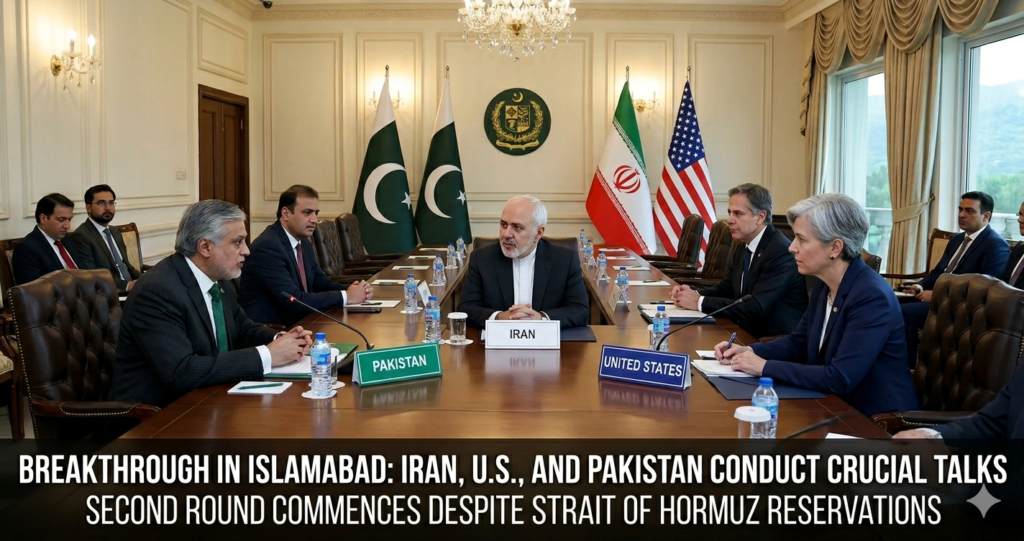
- Iran-US talks Islamabad enter a critical phase as Tehran sends a high-powered delegation despite rising Strait of Hormuz tensions
- Pakistan emerges as a key global mediator, hosting decisive negotiations between Washington and Tehran
- Oil markets react sharply, with supply fears pushing prices amid Hormuz disruptions
- Potential MoU could extend ceasefire and stabilize global energy and security dynamics
ISLAMABAD — In a dramatic geopolitical shift, Iran has confirmed it is dispatching a high-powered delegation to Islamabad for a decisive second round of negotiations with the United States, signaling a potential breakthrough in one of the world’s most volatile standoffs. The move comes despite escalating tensions in the Strait of Hormuz and Tehran’s earlier refusal to re-engage in dialogue.
According to sources within Iran’s Ministry of Foreign Affairs, the delegation—comprising senior security officials and seasoned diplomats—will arrive in Pakistan’s capital with a renewed mandate to push negotiations forward. The second round of talks, following an initial session on April 11 that resulted in a fragile ceasefire, is now being described by insiders as a “continuous march toward complete consensus.”
Strait of Hormuz Tensions Fail to Derail Diplomacy
The decision to return to talks comes at a time when prospects for diplomacy appeared to be collapsing. Just days ago, the U.S. Navy seized the Iranian-flagged container ship Touska, while maintaining a strategic blockade in the Strait of Hormuz—one of the world’s most critical النفط transit chokepoints.
Iranian Foreign Ministry spokesperson Esmaeil Baghaei had sharply criticized Washington, stating that the United States had “violated the ceasefire from the beginning.” The incident intensified fears of a broader military confrontation and sent shockwaves through global energy markets.
Yet, in a notable pivot, Tehran appears to be recalibrating its approach—from confrontation to negotiation. Diplomatic sources suggest Iran now views the Islamabad talks as the only viable pathway to de-escalation and long-term stability.
Iran-US talks Islamabad: Islamabad Emerges as the Global Diplomatic Hub
As Washington and Tehran prepare to converge in Islamabad, Pakistan has emerged as a critical mediator in the crisis. The international community is increasingly viewing the Pakistani capital not merely as a venue, but as a strategic diplomatic bridge capable of narrowing the gap between U.S. “maximum pressure” policies and Iran’s “strategic resistance.”
Diplomatic Earthquake: U.S.-Iran Mine-Clearing Operation Signals Breakthrough Before Islamabad Talks
Senior Iranian officials have described Pakistan as a “trustworthy facilitator,” underscoring a rare level of confidence in Islamabad’s role. This perception is echoed across major global capitals.
European leaders, including Kaja Kallas, have emphasized that Pakistan’s mediation could provide a stabilizing “compass” amid escalating tensions. Meanwhile, the Kremlin has voiced support for continued dialogue, with spokesman Dmitry Peskov warning that failure to sustain talks could trigger wider economic disruption.
Strait of Hormuz Crisis 2026: IRGC Fires on Indian Tanker as Oil Prices Surge Amid Global Supply Fears
In the Asia-Pacific, Australian Foreign Minister Penny Wong has also commended Pakistan’s “constructive diplomatic role,” highlighting Islamabad’s growing stature on the global stage.
Global Economy Hinges on Islamabad Talks
Beyond geopolitics, the stakes of the Islamabad talks are deeply economic. The Strait of Hormuz, through which nearly 20 percent of global oil supply passes, remains under severe strain due to ongoing tensions.
With crude oil prices surging past $120 per barrel, markets worldwide are bracing for prolonged volatility. Analysts warn that continued disruption could trigger inflationary shocks across major economies, from the United States to Europe and Asia.
Why the UAE Cannot Be Ignored in Iran Talks
A senior diplomat involved in the process noted that “failure is no longer an option,” adding that a potential Memorandum of Understanding (MoU) under discussion in Islamabad could extend the current ceasefire by up to 60 days—offering critical breathing space to global markets.
Pakistan’s High-Stakes Diplomatic Moment
As delegations prepare to arrive, Pakistan’s leadership, including Deputy Prime Minister Ishaq Dar, is positioning Islamabad as the focal point of global diplomacy. Behind the scenes, both civilian and military leadership are working to ensure that the second round of talks moves beyond symbolic engagement toward tangible outcomes.
The atmosphere in Islamabad is one of cautious optimism. Building on a 21-hour marathon session in the first round, the upcoming negotiations are expected to span multiple days, reflecting the urgency and complexity of the crisis.
For a world grappling with rising energy prices, geopolitical uncertainty, and the looming threat of wider conflict, the Islamabad talks represent more than just another diplomatic effort—they are a critical test of whether dialogue can prevail over escalation.