


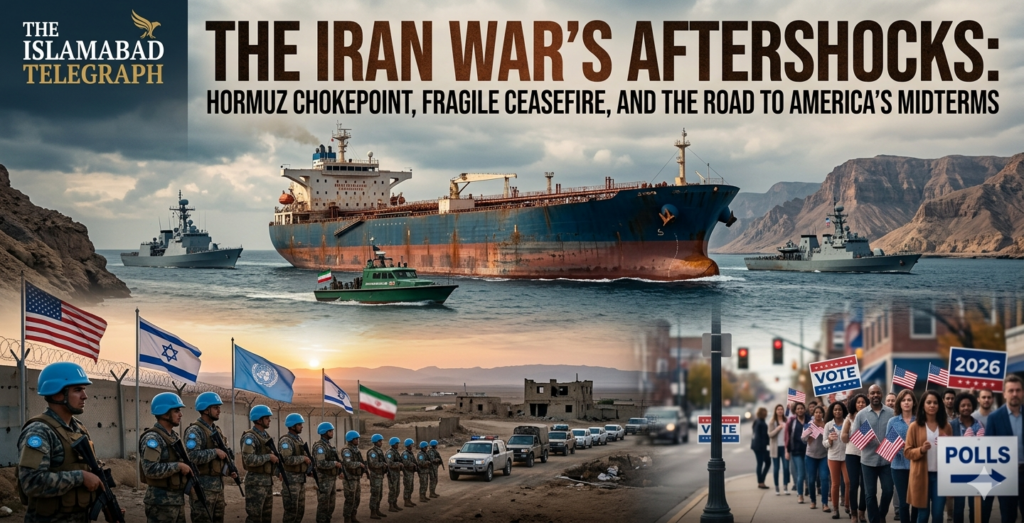
- Iran War Aftershocks 2026 & Energy Crisis: Analysis of the Strait of Hormuz closure and its impact on $110/barrel oil prices.
- Geopolitical Shifts: Saudi Arabia’s Vision 2030 pivot and Europe’s Zeitenwende rearmament urgency.
- Military Ledger: CSIS insights on munitions depletion and the transition to hybrid warfare tactics.
- Election Impact: How gas price volatility is shaping the 2026 U.S. midterm narrative for the Trump administration.
As a fragile two-week ceasefire between the United States, Israel, and Iran holds into early May 2026, the conflict that erupted in late February has already redrawn the strategic map of the Middle East and beyond. What began as targeted strikes on Iranian nuclear and military sites quickly escalated into a broader confrontation, with Tehran’s decision to mine and effectively close the Strait of Hormuz sending shockwaves through global energy markets.
Oil prices spiked above $110 per barrel at the height of the crisis before settling around $90–95, while liquefied natural gas (LNG) shipments from Qatar and the UAE ground to a halt. The war’s human and economic toll—hundreds of strikes, damaged infrastructure, and disrupted shipping—has forced even distant capitals to recalibrate.
At the heart of the crisis lies the Strait of Hormuz, the narrow waterway through which roughly one-fifth of global oil and a significant share of LNG once flowed daily. Iran’s mining operations and threats to commercial traffic turned a theoretical vulnerability into a lived nightmare for Gulf exporters. Saudi Arabia, in particular, has been forced into an uncomfortable reckoning. The temporary closure exposed the limits of overland pipelines and alternative routes, which can handle only about a quarter of normal volumes—and remain vulnerable to further disruption by Iranian proxies or Houthi attacks from Yemen.
Chatham House’s recent expert commentary captures the shift bluntly: the war has compelled Riyadh to reconsider its Vision 2030 economic transformation, accelerating diversification away from oil dependence while quietly exploring new security arrangements.
The UAE’s reported exit from OPEC coordination further signals fractures in Gulf unity, as Abu Dhabi hedges against prolonged volatility. “The closure of the Strait of Hormuz has revealed a key threat to Saudi Arabia’s Vision 2030 strategy and plans for economic transformation,” the analysis notes, underscoring how Tehran’s asymmetric tactics have compelled even wealthy Gulf states to rethink reliance on maritime chokepoints.
Araghchi’s Beijing Dash: Timing, Tensions, and China’s Emerging Role as Middle East Broker
This reshaping extends to naval strategy. London and Paris have floated a defensive coalition to safeguard future shipping once the ceasefire solidifies, drawing lessons from anti-piracy operations off Somalia and in the Malacca Strait. Chatham House analysts highlight that any such mission must be “independent and strictly defensive,” aimed at restoring insurer confidence rather than forcing open the waterway by gunboat diplomacy.
The episode has also spotlighted broader European engagement: Germany, already in the midst of its Zeitenwende rearmament, has quietly increased contributions to maritime security planning, part of a wider NATO-adjacent push for autonomy amid U.S. distractions.
Breaking News: Iran Fires Missiles at U.S. Navy Vessel Near Strait of Hormuz, Raising Fears of Wider War
The International Institute for Strategic Studies (IISS) underscores the defence-economic angle in its freshly released The Military Balance 2026. Global defence spending hit $2.63 trillion in 2025, with Europe’s outlays rising sharply as governments confront the reality of protracted great-power competition. Germany’s Bundeswehr modernization—long promised but unevenly delivered—has gained fresh urgency.
Berlin is accelerating procurement of frigates, air-defence systems, and munitions stockpiles, wary that another Hormuz-style shock could expose Europe’s lingering dependence on imported energy and U.S. security guarantees. IISS data also flag U.S. budget pressures: the Iran campaign consumed expensive munitions at a pace that has forced trade-offs with Ukraine aid and Indo-Pacific readiness.
Islamabad Summit: World on Edge as U.S.-Iran Talks Enter Make-or-Break Phase
CSIS reports detail the operational ledger: U.S. and Israeli forces achieved rapid air superiority and degraded Iranian missile stocks, but at significant cost. Daily strike operations transitioned from expensive Tomahawks to cheaper JDAMs, yet the campaign still burned through interceptors and exposed cyber vulnerabilities on both sides.
Energy markets remain jittery; even partial reopening of Hormuz has not erased the premium on risk. CSIS’s forthcoming Strategic Trends 2026 (set for release May 7) is expected to frame the conflict within a “fragmenting global order,” highlighting shifting partnerships, Europe-China economic ties, and battlefield technologies that blurred lines between conventional and hybrid warfare.
After the strike: The danger of war in Iran
In Washington, the war’s domestic fallout looms large. Brookings Institution analysts note that oil-price volatility and supply-chain disruptions have already fed into inflation concerns, complicating the Trump administration’s economic narrative. Higher gasoline prices at American pumps—reaching levels not seen since 2022—risk alienating working-class voters in swing districts.
The Supreme Court’s recent rulings on regulatory and energy policy could amplify partisan divides, with Democrats framing the conflict as a cautionary tale of unilateralism and Republicans touting it as necessary deterrence. “The strategic aftershocks of Trump’s Iran war” extend to the ballot box, where foreign-policy competence and pocketbook issues often collide in midterm cycles.
Carnegie Endowment scholars, meanwhile, probe longer-term questions: Iran’s nuclear ambitions persist despite the strikes, and European governments appear to be “quiet quitting” full alignment with U.S. policy, pursuing selective engagement on sanctions and energy diversification. The war has also spotlighted Pakistan’s unlikely diplomatic role.
Islamabad hosted back-channel talks and leveraged ties with both Tehran and Washington, positioning itself as a potential honest broker. Sanam Vakil, director of the Middle East and North Africa Programme at Chatham House, offers a complementary Gulf perspective. “Iran’s ‘forward defence’ strategy has boomeranged,” she notes, arguing that Tehran’s cultivation of proxies and Hormuz leverage ultimately weakened the regime’s conventional deterrence while alienating potential partners.
Pakistani journalist and geopolitical analyst Kaswar Klasra, who has closely tracked the mediation efforts, sees opportunity amid the chaos. “Pakistan emerged as a key player in US-Iran talks because geography and history give Islamabad unique leverage,” he observes.
“The fragile ceasefire opens a window not just for energy stability but for regional powers like Pakistan to shape a post-war order that reduces great-power dominance in the Gulf.” Klasra warns, however, that border tensions with Iran and Islamabad’s defence pact with Saudi Arabia complicate neutrality. Yet the war has also exposed limits to U.S. power projection, Vakil adds, as Washington balances multiple theatres.
Taken together, the think-tank consensus is sobering. The Iran war was neither a clean victory nor an unmitigated disaster, but a stress test for the post-1945 order. Hormuz remains a live wire—subject to future Iranian coercion or proxy mischief. U.S.-Iran relations are in a tense “retention” phase: Washington retains sanctions leverage and military posture in the Gulf, yet Tehran has demonstrated its ability to impose global costs disproportionate to its conventional strength.
For Germany and Europe, the episode reinforces the case for higher defence budgets and reduced strategic dependence. And in Washington, the political clock ticks toward November 2026, where voters will weigh the price of gasoline against the perceived success of deterrence.