


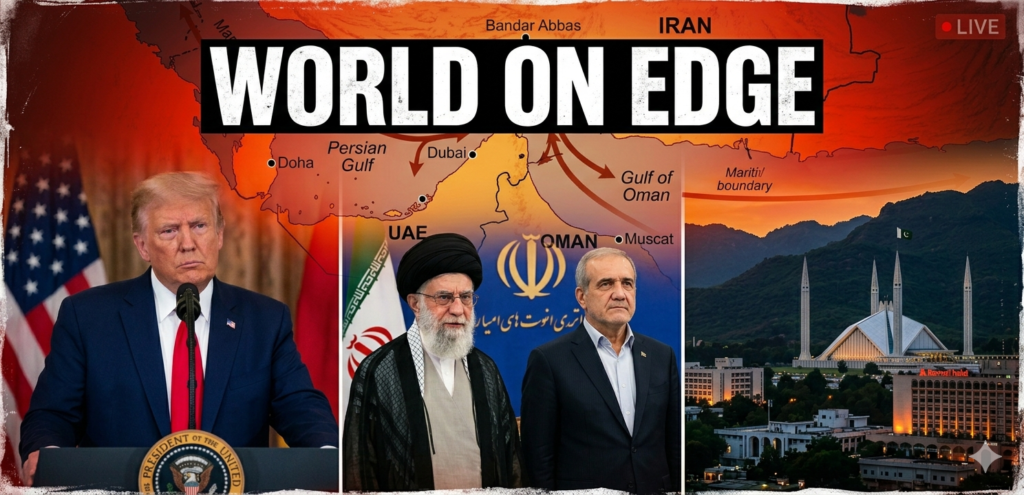
- High-stakes U.S.-Iran talks in Islamabad signal potential diplomatic breakthrough amid regional tensions
- Pakistan enforces unprecedented security lockdown as global focus shifts to Islamabad Summit 2026
- “Guardian Protocol” proposal raises possibility of Iran nuclear rollback with third-country oversight
- Strait of Hormuz crisis and Middle East instability heighten urgency for immediate diplomatic resolution
ISLAMABAD — US-Iran Talks, are talk of the town. Pakistan’s capital has transformed into a fortified diplomatic theater as high-powered delegations from the United States and Iran prepare to arrive for a critical second round of negotiations that could reshape the geopolitical landscape of the Middle East and beyond.
Barbed wire coils across avenues, shipping containers block key arteries, and more than 10,000 security personnel have been deployed across Islamabad and neighboring Rawalpindi. The Red Zone—home to Pakistan’s most sensitive government installations—has been effectively sealed, underscoring the stakes of what insiders describe as a “final push” toward de-escalation.
According to senior officials familiar with the process, advance teams have already begun logistical coordination, with main delegations expected to land at Nur Khan Airbase within days.
Strait of Hormuz Impact on Singapore: Energy Shock Threatens Asia’s Trade Lifeline
This follows an unprecedented first round of talks earlier this month, brokered quietly by Shehbaz Sharif, positioning Pakistan as a central diplomatic bridge in one of the world’s most volatile conflicts.
A Fragile Opening: Breakthrough or Breakdown
Despite the tense backdrop, diplomatic signals suggest cautious optimism.
A senior source told The Islamabad Telegraph that a “structured breakthrough” is now within reach, though far from guaranteed.
Over the weekend, Donald Trump’s administration presented a revised framework to Tehran. The proposal reportedly includes:
- A robust verification mechanism for Iranian maritime operations
- A phased lifting of U.S. naval restrictions
- Conditional pathways toward broader sanctions relief
Iranian officials have publicly acknowledged receiving the proposal, stating it is under “serious evaluation.” However, divisions remain within Tehran’s power structure, particularly involving the Islamic Revolutionary Guard Corps, which remains wary of any agreement perceived as limiting strategic leverage.
US-Iran Talks: Inconclusive Historic Negotiations Reduce Mistrust, Key Issues Still Unresolved as Both Sides Continue Dialogue
Sources indicate that if technical teams can narrow differences, a high-level political summit could follow swiftly—raising the possibility of direct engagement between Donald Trump and Masoud Pezeshkian on Pakistani soil.
The “Guardian Protocol”: A Radical Nuclear Proposal
Perhaps the most consequential development is the emergence of what insiders are calling the “Guardian Protocol.”
Under this scenario, Iran would:
- Suspend uranium enrichment for up to 10 years
- Transfer its stockpile of enriched uranium to a neutral third country
- Accept enhanced international monitoring
Diplomatic sources suggest Pakistan is being considered as a potential custodian of this material—an extraordinary role that would elevate Islamabad’s global strategic significance.
Global Shock: Iran Re-Closes Strait of Hormuz, Threatening to Scuttle Pakistan-Led Peace Talks
For Washington, such an arrangement would provide unprecedented guarantees against nuclear escalation. For Tehran, it offers a face-saving mechanism that avoids direct capitulation to Western powers.
While still highly sensitive and far from finalized, the proposal reflects the scale of compromise being explored behind closed doors.
U.S.-Iran Talks: A Region on the Brink: Hormuz, Lebanon, and Israel
Even as diplomacy advances, the wider region remains dangerously unstable.
Strait of Hormuz: Global Energy Lifeline at Risk
The Strait of Hormuz—through which a significant portion of global oil flows—remains effectively restricted.
Iran has signaled that access will remain limited unless U.S. maritime pressure eases, while American naval forces continue to monitor and intercept suspected shipments.
US negotiators to return to Pakistan for talks as Trump repeats threat to Iran’s infrastructure
Any prolonged disruption risks sending oil markets into further turmoil.
Lebanon Flashpoint
A fragile ceasefire between Israel and Lebanon is already showing signs of strain.
Reports of intermittent strikes and counter-threats have raised fears that even a minor escalation could derail diplomatic momentum in Islamabad.
Gulf Anxiety: Missile Build-Up and Strategic Uncertainty
Across the Gulf, unease is intensifying.
Member states of the Gulf Cooperation Council are closely monitoring reports that Iran has significantly expanded its missile deployment capacity—reportedly reaching levels far beyond pre-conflict estimates.
Pakistan’s Quiet Diplomacy Delivers a Strategic Breakthrough
Regional analysts warn that failure of the Islamabad talks could trigger a wider confrontation, placing Gulf states at the frontline of any escalation.
Strategic Analysis: Trump’s Pressure-and-Deal Doctrine
President Donald Trump appears to be pursuing a dual-track strategy—combining aggressive rhetoric with diplomatic outreach.
While publicly warning of renewed military action, he has simultaneously signaled willingness to secure a historic agreement.
This approach has left Tehran navigating a delicate balance between resistance and engagement, particularly as economic pressures mount.
Forecast: Four Scenarios That Could Shape the Week Ahead
As delegations prepare to converge on Islamabad, four possible outcomes are emerging:
1. The Islamabad Accord (Most Likely)
A limited agreement involving maritime de-escalation and partial sanctions relief, leading to the reopening of the Strait of Hormuz.
2. The Guardian Protocol (High Impact)
Iran suspends its nuclear program for a decade and transfers enriched uranium abroad—potentially to Pakistan—triggering full sanctions rollback.
3. Technical Stalemate
Negotiations continue but stall over verification mechanisms, extending the ceasefire without resolving core disputes.
4. Total Collapse
A regional flashpoint—particularly in Lebanon—triggers escalation, collapsing talks and pushing the region toward broader conflict.
Islamabad Under Lockdown
Security preparations reflect the magnitude of the moment:
- Over 10,000 police personnel deployed
- Snipers positioned across key rooftops
- 600+ checkpoints monitoring entry and exit routes
- Transport services suspended across twin cities
- Red Zone completely sealed
Hotels are fully booked, guest houses shuttered, and surveillance systems operating around the clock.
A Defining Moment for Pakistan—and the World
As dusk settles over the Margalla Hills, Islamabad finds itself at the center of a global crossroads.
What unfolds in the coming days could determine not only the trajectory of U.S.-Iran relations, but the stability of global energy markets, regional security, and the broader international order.
For Pakistan, the summit represents more than mediation—it is a moment of strategic elevation on the world stage.
If diplomacy prevails, Islamabad may be remembered as the city that pulled the world back from the brink.
If it fails, the consequences could reverberate far beyond the region.
Exclusive Update: The Islamabad Telegraph has learned that a “C-17 Globemaster” carrying advance logistics for the U.S. delegation landed at 4:12 PM local time. Simultaneously, an Iranian government Airbus is expected to enter Pakistani airspace by midnight. The stage is set.