


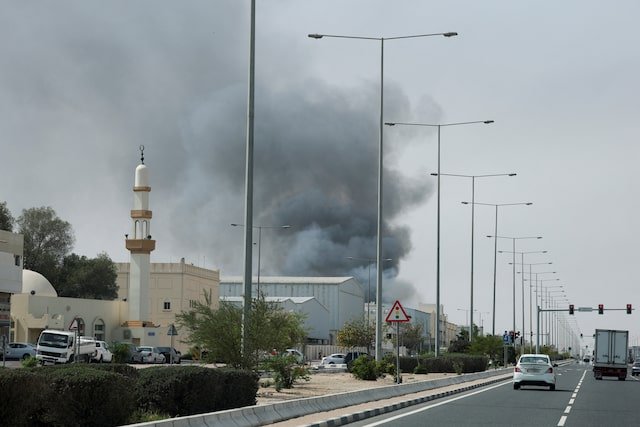
- Iran war escalation reaches critical level with strike on Qatar’s Ras Laffan gas hub
- Trump orders military readiness for “mother of all attacks” on Iran
- Global oil prices surge as Gulf energy infrastructure comes under threat
- Strait of Hormuz disruption raises fears of prolonged global energy crisis
In a dramatic escalation that has jolted global energy markets and intensified fears of a wider regional war, power corridors in Washington, D.C., were abuzz late Wednesday with reports that Iran has struck Qatar’s largest gas-producing hub, sending shockwaves through diplomatic and military circles.
Senior officials confirmed to The Islamabad Telegraph that Donald Trump was immediately briefed on the latest #IranianMissile barrage targeting the #RasLaffan Industrial City—one of the world’s most critical liquefied natural gas (LNG) facilities. The strike comes amid an already spiraling U.S.-Israeli conflict with Tehran that has begun to threaten the stability of global energy supply chains.
According to sources within the White House, the U.S. president reacted swiftly and forcefully. “It’s time to go full throttle on Iran. Get ready,” a source within Trump’s inner circle told this reporter, adding that military commanders have been instructed to prepare for what insiders are calling the “mother of all attacks.”
Beyond The Crisis: How the UAE Protected Lives, Preserved Stability, and Led with Compassion
The #Iranian strike on Qatar’s gas infrastructure follows reports that Iran’s own South Pars gas field—its share of the world’s largest natural gas reservoir—was hit earlier this week in what regional media widely attributed to Israeli operations, allegedly carried out with tacit U.S. approval. Neither Washington nor Tel Aviv has officially confirmed involvement.
#QatarEnergy acknowledged “extensive damage” at Ras Laffan, raising alarm across global capitals already grappling with rising fuel prices and supply disruptions. Brent crude surged more than 5 percent, breaching $108 per barrel, while U.S. diesel prices climbed above $5 a gallon for the first time since the inflation crisis of 2022. The economic ripple effects are now being felt from Washington to Brussels to Beijing, as policymakers scramble to assess the fallout.
‘Extensive damage’ at Qatar industrial site as Iran retaliates for strike on gas field
Iran, in a statement carried by state media, warned that multiple energy facilities across the Gulf are now “legitimate targets.” These include key installations in Saudi Arabia, the United Arab Emirates, and Qatar—effectively placing the entire Gulf energy architecture in the crosshairs of a rapidly expanding conflict.
Saudi officials reported intercepting four ballistic missiles aimed at Riyadh, along with a drone targeting a gas facility in the kingdom’s eastern region. Meanwhile, Iranian missiles and drones have reportedly been launched toward U.S. bases across the Middle East, including installations in Bahrain, Iraq, and Kuwait, signaling Tehran’s willingness to widen the battlefield.
The escalation has raised urgent concerns about the Strait of Hormuz, a strategic chokepoint through which nearly 20 percent of the world’s oil and LNG supplies pass. Iran’s earlier move to disrupt shipping lanes had already strained global logistics; direct attacks on production infrastructure now risk a prolonged energy crisis.
Inside #Washington, intelligence assessments presented to Congress painted a complex picture. While Iran’s military capabilities have been degraded since the conflict began on February 28, officials warned that Tehran retains sufficient capacity to strike U.S. interests and regional allies. “The regime is wounded, not broken,” one official noted.
Vice President JD Vance indicated that the administration would unveil new measures within 24 to 48 hours aimed at stabilizing domestic fuel prices, though details remain unclear. Analysts caution that any sustained rise in energy costs could carry significant political consequences, particularly as inflationary pressures resurface.
Meanwhile, the human toll continues to mount. Rights groups estimate that more than 3,000 people have been killed in Iran since the conflict began, with hundreds more casualties reported across Lebanon, Israel, and Gulf states. Israeli airstrikes in Beirut have flattened residential buildings, while Iranian missile attacks have struck cities including Tel Aviv and #Haifa.
European leaders are scrambling to contain the crisis. Kaja Kallas held urgent talks with Iran’s foreign minister, emphasizing the need to ensure safe passage through the Strait of Hormuz and calling for a diplomatic resolution. However, prospects for de-escalation appear increasingly remote.
For Trump, the unfolding crisis presents a defining moment of his presidency. While he has publicly projected confidence—at times discussing unrelated domestic issues even as the war intensifies—privately, officials acknowledge the gravity of the situation. Military deployments are increasing, and contingency plans for broader engagement are reportedly under review.
The central dilemma facing Washington is stark: escalate further and risk a protracted regional war, or pull back and allow Iran to retain the capacity to disrupt global energy markets and regional stability. Either path carries profound risks.
As global capitals watch anxiously, one reality is becoming clear: the #Iran war is no longer a contained conflict. It is rapidly evolving into a geopolitical crisis with far-reaching implications for energy security, global الاقتصاد, and international order.