


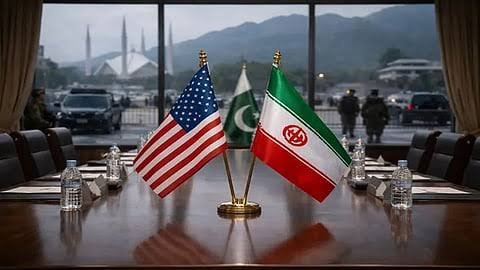
- Islamabad Memorandum of Understanding ends US-Iran conflict and reopens the Strait of Hormuz, restoring global oil flows
- Oil prices plunge up to 8% as markets react instantly to blockade removal and renewed shipping routes
- Global stocks surge while inflation outlook improves across Europe, Asia, and emerging economies
- Pakistan emerges as a pivotal diplomatic power, with Field Marshal Asim Munir and PM Shehbaz Sharif leading mediation
The announcement came not with hesitation, but with the quiet authority of history bending in real time.
“I am honoured to announce that the historic ‘Islamabad Memorandum of Understanding’ has been electronically signed today between the United States of America and the Islamic Republic of Iran,” Prime Minister Shehbaz Sharif declared, formalizing what only days ago seemed diplomatically improbable and strategically elusive.
Within seconds, the tremors of that announcement were felt far beyond Islamabad.
In London, Brent crude futures dropped nearly 8 percent in early trading, sliding from war-driven highs of $104 per barrel to below $96 within hours. In New York, West Texas Intermediate mirrored the decline, falling by over $7 intraday—its steepest single-session drop in months. Asian markets, which had opened cautiously amid lingering uncertainty, surged in response. Japan’s Nikkei 225 climbed 2.3 percent, while Hong Kong’s Hang Seng rose 1.8 percent, led by airline, shipping, and manufacturing stocks—sectors most sensitive to energy costs.
At the center of this rapid recalibration lies a single, decisive provision: Iran’s immediate reopening of the Strait of Hormuz, coupled with the United States’ lifting of its naval blockade.
US Iran Deal Global Stock Markets Surge as Hormuz Reopening Fuels Record-Breaking Rally
For months, the narrow maritime corridor—through which approximately 20 to 21 million barrels of oil pass daily, nearly one-fifth of global consumption—had been transformed into a geopolitical fault line. Insurance premiums for tankers traversing the Strait had surged by as much as 300 percent. Freight costs spiked. Supply chains tightened. And central banks, already grappling with post-pandemic inflation, faced renewed pressure from energy-driven price shocks.
Now, that pressure is easing—at least for the moment.
Goldman Sachs estimates that a full normalization of Hormuz traffic could shave between 0.4 and 0.7 percentage points off global inflation over the next two quarters. For energy-importing economies such as India, Türkiye, and much of the European Union, the relief could be even more pronounced, narrowing trade deficits and stabilizing currencies that had come under sustained pressure.
Trump defends his Iran deal, criticizes longtime ally Israel as G-7 ends
Currency markets reflected that shift almost instantly. The euro strengthened against the dollar, while emerging market currencies—from the Pakistani rupee to the Indonesian rupiah—posted modest but meaningful gains. Sovereign bond yields, which had climbed on fears of prolonged conflict, edged lower as investors recalibrated risk.
Yet beyond the immediate market response lies a deeper strategic realignment—one that may prove more consequential than the price of oil itself.
“The signing of this agreement at the highest level of the respective governments demonstrates the commitment of both sides to a diplomatic resolution of the conflict,” Sharif said, framing the Memorandum not merely as a ceasefire, but as a structural pivot away from escalation.
For Washington, the agreement represents a recalibration of force and diplomacy. After months of military pressure that failed to compel decisive Iranian concessions, the shift toward negotiation underscores a recognition that strategic endurance—not rapid coercion—now defines the balance of power in the region. President Donald J. Trump’s endorsement of the agreement reflects a broader foreign policy instinct: to translate military leverage into diplomatic outcomes, even when the path is politically fraught.
For Tehran, the reopening of Hormuz under negotiated terms signals both resilience and pragmatism. Despite sustained pressure, Iran retained its most critical lever—the ability to disrupt global energy flows—and ultimately used it not as an instrument of prolonged confrontation, but as a bargaining chip in a negotiated settlement.
The convergence of these positions was neither inevitable nor straightforward.
Behind the scenes, a complex web of diplomacy unfolded across multiple capitals. Qatar sustained backchannel communications at moments when formal talks faltered. Saudi Arabia and Türkiye provided regional legitimacy to the process, while Egypt played a stabilizing role in broader Arab consensus-building. Each contributed to a diplomatic ecosystem that, while fragile, proved resilient enough to withstand the shocks of ongoing hostilities.
At the center of this architecture stood Pakistan.
Sharif’s statement offered explicit recognition of Field Marshal Syed Asim Munir, whose “tireless efforts, selfless dedication and instrumental role were critical in facilitating this breakthrough.” For analysts, the acknowledgment is more than ceremonial—it reflects a rare synchronization of Pakistan’s civilian and military leadership at a moment of global consequence.
In recent years, Pakistan’s geopolitical identity has often been framed through the lens of internal challenges. The Islamabad Memorandum, however, projects a different image: that of a state capable of bridging divides between adversaries, leveraging both diplomatic credibility and strategic positioning to shape outcomes beyond its immediate sphere.
This evolution carries implications for the broader international system.
For decades, crisis diplomacy in the Middle East has been dominated by a narrow set of global powers. The success of the Islamabad process suggests a gradual diffusion of that authority, with regional and middle powers playing increasingly decisive roles. It is a shift toward what some analysts describe as “distributed diplomacy”—a model in which influence is less centralized, and outcomes are shaped by a broader coalition of actors.
Whether this model proves durable remains an open question.
Markets, for now, are pricing in optimism. Energy equities, which had surged during the conflict, are adjusting downward, while sectors tied to global trade and consumption are gaining momentum. Airlines, among the hardest hit by elevated fuel costs, saw their shares rise between 3 and 5 percent across major exchanges. Shipping companies, facing the prospect of normalized routes and lower insurance costs, are similarly positioned for recovery.
But beneath the optimism lies a persistent undercurrent of caution.
The durability of the agreement will depend on compliance, verification, and political will—variables that have historically undermined similar accords. Any disruption in Hormuz, any delay in the lifting of blockades, or any escalation along peripheral fronts such as Lebanon could quickly reverse the current trajectory.
For now, however, the balance has shifted—from confrontation to cautious stabilization.
“May this Memorandum of Understanding serve as an enduring foundation for greater understanding, mutual respect and shared prosperity for the complete region,” Sharif concluded.
In the language of diplomacy, such words often carry aspirational weight. Today, they carry something more tangible: the immediate recalibration of global markets, the easing of systemic risk, and the emergence of a new axis of mediation in an increasingly fragmented world.
For investors, policymakers, and strategists alike, the message is unmistakable.
The crisis that once threatened to fracture the global economy has, at least for this moment, been contained—not through force alone, but through a convergence of diplomacy, strategy, and timing that has placed Islamabad at the center of a rapidly evolving geopolitical order.